🎧 Listen to this story
Narrated by Kore · 6,834 characters
Every evening, just as the light turns the color of weak tea and the first porch lamps flicker on, a family of four sisters and one stubborn old father do something that confuses their neighbors. They stop what they are doing. They step outside, or lean toward a window, or pause mid-phone-call, and they look up.
They are watching for starlings. And they are saying goodnight to their mother.
The Winter Their Mother Died
Marguerite Dellacroix passed away in late November, after a long illness that had narrowed her world to a hospital bed set up near the big bay window of the family farmhouse. She was seventy-three. She had spent forty years as a school librarian, and she had a way of speaking softly that made even a whisper feel like a secret worth keeping.
In the final weeks, she asked for the bed to be moved so she could face west. When her daughter Odile asked why, she smiled and said, “That is where the evening happens.”
What the family did not know yet was that the evening, at that particular window, was about to give them something extraordinary.
The Cloud That Moved Like One Creature
About ten days after the funeral, the five of them were gathered in the kitchen, the way grieving families do when no one wants to be the first to leave. The house was heavy with casserole dishes and unspoken things. Odile’s youngest sister, Wren, happened to glance out the window around dusk and went very still.
“Come look,” she said quietly.
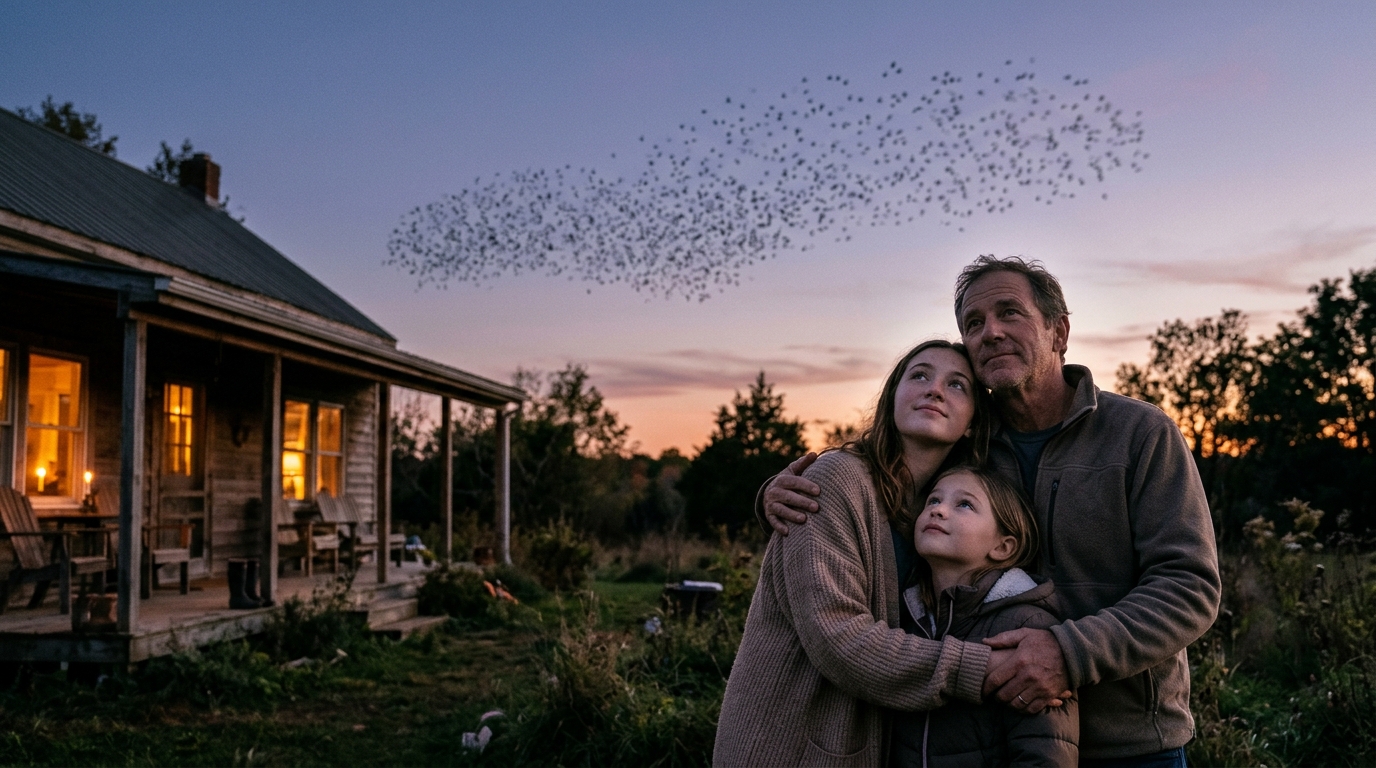
Above the bare fields behind the house, a murmuration of starlings was folding and unfolding across the pink-gray sky. Thousands of birds moved as a single shape, a living smoke that poured into spirals, thinned into ribbons, then gathered itself back into a dark and breathing sphere. There was no sound at first, then the soft whirr of countless wings reached the glass.
No one spoke. The father, Anselm, set down his coffee cup without taking his eyes off the sky.
“Your mother would have loved this,” he finally said. His voice cracked on the last word. Then, for the first time in two weeks, all five of them laughed through their tears, because Marguerite had been trying to get them to watch the starlings for decades.
A Quiet Joke That Became a Ritual
It turned out that Marguerite had kept a small notebook of bird sightings for most of her adult life. Tucked inside the back cover, Odile later found a line written in her mother’s careful librarian handwriting: Starlings at dusk again. The girls rolled their eyes. I will make them watch someday.
The sisters had indeed rolled their eyes, over the years. Starlings are not glamorous birds. They are noisy, common, and often dismissed as pests. But as Marguerite understood, there is a particular magic in the ordinary things we stop noticing.
So the family began a small tradition. Each evening, as the light began to fail, someone would announce it: “Starlings time.” And whoever was nearby would stop and look.
Some nights the flock appeared, swirling and spectacular. Other nights the sky stayed empty, and they looked anyway. They discovered that the looking mattered more than the seeing.
What the Murmuration Taught Them About Grief
Grief, the sisters say, is a lot like a murmuration. It has no leader and no obvious plan. It rises in a great dark swell, then thins out into something almost beautiful, then gathers itself back into a heavy shape without warning.
Wren put it best when she described it to a friend: “The birds never crash into each other. Each one just pays attention to the few nearest to it. That is how we got through that winter. We just stayed close to the ones next to us.”
Researchers who study starling flocks have found something remarkably similar. Each bird tracks only about seven neighbors at a time, adjusting its movement to theirs. No single starling directs the show. The beauty emerges from small, steady attention to the people, or birds, right beside you.
The Evening Hour as a Place to Heal
There is something gentle about doing your remembering at dusk. The day’s demands have loosened their grip. The phone goes quiet. The light softens everything it touches, including the sharp edges of loss.
The family discovered that mornings were for being brave and afternoons were for being busy, but evenings were for being honest. At the end of the day, standing in the cooling air, they could say her name out loud without it breaking them.
Odile described one particular night in February, when snow was falling and the starlings did not come. The five of them stood in the yard anyway, hands in their pockets, breath rising in small clouds.
“Goodnight, Mom,” Anselm said into the empty sky, as simply as if she were in the next room.
And from somewhere across the frozen field, a single starling began to sing, a strange clicking, whistling little song, as though it had been waiting for permission.
How to Start Your Own Evening Remembrance
You do not need a flock of starlings to borrow what this family found. If you are carrying a loss of your own, or simply want to turn your evenings into something gentler, here are a few ideas drawn from their experience:
- Choose a small, repeatable signal. The family’s “Starlings time” announcement gave them a shared cue. A phrase, a candle, a song, anything simple that says: now we remember.
- Look up together. Standing under an open sky has a way of making grief feel less cramped. Even five minutes outdoors at dusk can shift the weight in your chest.
- Keep going when nothing happens. Some evenings the sky stays empty. Show up anyway. The ritual is the gift, not the spectacle.
- Write down what they loved. Marguerite’s notebook became a treasure. Consider recording the small passions of someone you love, so they can be rediscovered later.
- Let the ordinary become sacred. The most meaningful memorials are often built from everyday things: a bird, a window, a particular shade of evening light.
A Mother’s Last Lesson
Spring has come to the farmhouse now. The starlings are building nests under the eaves of the old barn, as they do each year, squabbling and chattering and entirely unaware that they have become part of a family’s heart.
Odile keeps her mother’s bird notebook on the kitchen windowsill. Under that final line, the one about making the girls watch someday, she has added a few words of her own in pencil:
We watched, Mom. We are still watching.
As the day winds down and the sky turns gold and then violet, they gather at the window. Sometimes the birds come in their thousands, and sometimes not at all. But every evening, five people pause, look up, and remember a woman who taught them that the best things in life are often the ones we are too busy to see.
So tonight, when the light begins to fade where you are, take a moment. Step outside. Look up. You never know what the evening has been saving for you.