
🎧 Listen to this story
Narrated by Aoede · 8,214 characters
When Sound Becomes Something You Feel in Your Bones
Most of us take for granted the way music enters us: through our ears, traveling as invisible waves until our brains translate them into emotion. We close our eyes at concerts and let the sound wash over us. We hum along without thinking. We feel the bass in our chest and assume that is the closest anyone can get to truly feeling music.
Then there is Marcus Velez. And Marcus would like to politely challenge everything you think you know about what it means to experience music.
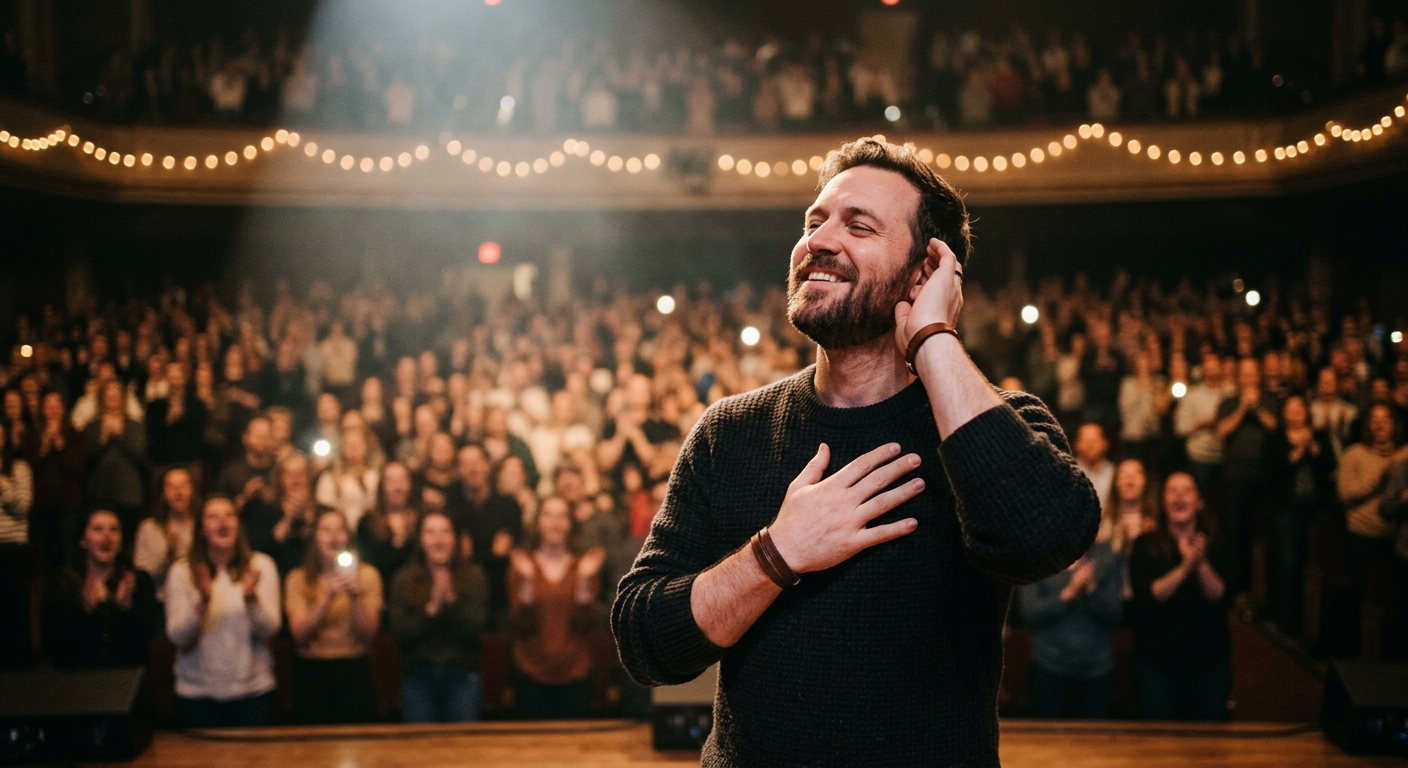
Born profoundly deaf in both ears, Marcus, 34, has been performing original compositions to sold-out audiences across North America and Europe for the past seven years. He does not use cochlear implants during performances. He does not rely on an interpreter or a hearing assistant on stage. What he relies on, instead, is the one thing that has guided his entire musical life: vibration.
Growing Up in Silence, Surrounded by Sound
Marcus grew up in San Antonio, Texas, the youngest of four children in a family that was, by all accounts, obsessed with music. His father played guitar. His mother sang in the church choir. His older siblings filled the house with everything from cumbia to classic rock. Marcus sat in the middle of all of it, pressing his palms flat against the hardwood floors, feeling the thrum of the speakers move through the walls and up into his hands.
“People assume my childhood was quiet,” he said in a recent interview with a music publication. “It wasn’t. It was loud in ways most people never get to experience. I just experienced it differently.”
At age nine, Marcus began piano lessons with a deaf educator who had developed a curriculum based entirely on tactile feedback. He learned to read music not just visually but physically, pressing his forearm against the edge of the piano’s body to feel how different keys created different vibrations in the wood. By twelve, he was composing short pieces. By sixteen, he had performed at a regional showcase and brought the audience to its feet.
The Science Behind What He Does
It is worth pausing here to understand that what Marcus does is not magic, though it can feel that way to watch. It is neuroscience, physics, and years of disciplined training converging into something extraordinary.
The human body is remarkably good at detecting vibration. Specialized nerve endings called Meissner’s corpuscles and Pacinian corpuscles in the skin respond to different frequencies of mechanical pressure. Deaf musicians have long understood this. Evelyn Glennie, the legendary Scottish percussionist who is also profoundly deaf, has spoken extensively about how she hears music through her feet, her legs, her cheekbones.
Marcus takes this a step further in his live performances by working directly with sound engineers and stage designers to maximize what he calls “the tactile landscape” of a show. His custom-built stage platform sits on a network of transducers, devices that convert audio signals directly into vibrations in the floor. Different sections of the stage are tuned to amplify different frequency ranges. When he moves across the stage, he is, in a very literal sense, moving through the music.
What His Setlist Feels Like
In an interview feature, Marcus described what individual songs feel like beneath his feet and hands:
- Low bass frequencies: “Like standing at the edge of the ocean. A steady, rolling pressure that never quite lets you forget it is there.”
- Mid-range piano chords: “Warmth. Buzzing warmth in my palms. Almost like holding a cup of coffee.”
- High-frequency strings: “This is the one people are surprised by. It is almost like a tickle. Very specific, very bright.”
- Percussion hits: “No metaphor needed. Those I feel exactly as they are. A knock, a push, a release.”
The Moment That Changed Everything
For all of his technical mastery, Marcus credits one specific moment with transforming him from a skilled musician into a performing artist who genuinely moves people. It happened at a small venue in Austin, during what was supposed to be a low-stakes showcase early in his career.
Midway through his set, a power failure cut the monitors and the transducer system offline. The audience assumed the show was over. Marcus stood on a suddenly silent stage, and then he did something no one expected: he knelt down, pressed both palms flat against the bare wooden boards, and kept playing. He played from memory, from feel, from the residual vibration of the crowd’s own energy moving through the building.
“I could feel them breathing,” he later said. “Three hundred people, and I could feel the room.”
The video of that moment, shot on a shaky phone by an audience member, has been viewed more than forty million times.
What Audiences Take Away
Ask people who have attended a Marcus Velez concert what they remember most, and the answers are surprisingly consistent. It is not a specific song. It is not the technical spectacle of the stage setup. It is the feeling, they say, of being reminded that human perception is far more expansive than they had assumed.
One attendee described it this way in a social media post that was widely shared: “I went in thinking I was going to watch something inspiring. I came out realizing I had been experiencing music wrong my entire life. He is not overcoming a limitation. He found a door the rest of us didn’t know existed.”
That reframing matters. Marcus is deliberate about the way his story is told. He resists the word “despite” whenever it appears in coverage about him. He is not performing despite being deaf. He is performing exactly as himself, using every sensory tool available to him, and arriving at something that hearing musicians, with all their auditory advantages, rarely achieve: a performance that audiences describe as something they felt rather than simply watched.
Lessons From a Stage Built on Vibration
You do not have to be a musician, or deaf, or particularly inclined toward philosophy, to find something worth carrying home from Marcus’s story. A few things stand out:
- Constraint can be a compass. The limitations Marcus was born with did not close a door. They pointed him toward a completely different architecture of experience, one that turned out to be rich beyond measure.
- Connection does not require a common language. His audiences hear the music. He feels it. They meet somewhere in the middle, in the emotional response that neither can fully explain. That meeting place is what art is for.
- Expertise is always redefinable. The conventional definition of musical talent centers on the ear. Marcus quietly, persistently, and now very publicly, proved that definition incomplete.
- Presence is its own form of communication. When the power went out in Austin and Marcus pressed his hands to the stage and kept playing, he was not communicating through sound. He was communicating through sheer, undeniable presence. The audience felt that.
What He Is Working on Next
Marcus is currently developing a new project that he describes as his most personal work to date: a collaborative performance piece that invites audience members to remove their shoes and stand directly on vibration panels embedded in the concert floor, so that they can feel exactly what he feels during the show. The project, titled Common Ground, is scheduled to premiere later this year.
“I don’t want people to understand my experience,” he said. “I want them to find their own version of it. Everybody has a sense they are not fully using. I just got lucky enough to figure out which one was mine early.”
A Final Note
There is a moment near the end of every Marcus Velez concert when the stage goes dark except for a single light, and he places one hand on the piano and one hand flat on the stage floor, and he plays the last song of the set without looking at the keys once. The audience, by this point, is almost always silent in a way that feels different from ordinary concert silence. It is the silence of people who are, perhaps for the first time, trying to feel the music rather than just hear it.
That is what Marcus has given his audiences. Not just a performance. A new way of paying attention to the world.