🎧 Listen to this story
Narrated by Sadachbia · 7,945 characters
An Unlikely Pair That Redefined What Friendship Looks Like
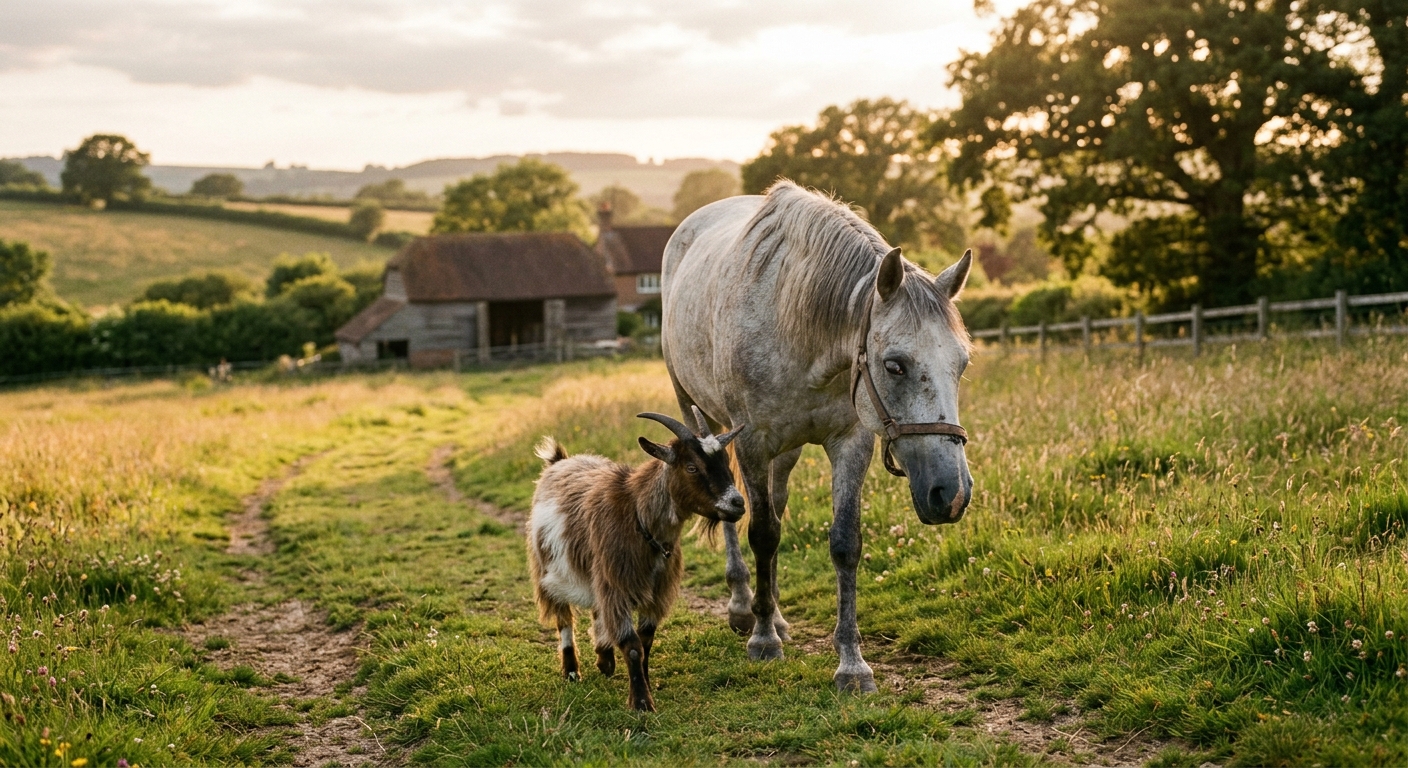
There are friendships that make sense on paper, and then there are the ones that defy every expectation, every category, every neat explanation we try to give them. The story of Callie the blind horse and her goat companion, Jack, is firmly in the second category. Over the course of 15 years, these two animals built a bond so remarkable that the farmers, veterinarians, and animal behaviorists who witnessed it struggled to find the right words to describe what they were seeing.
This is not a fable. This is not a metaphor dressed up as a news story. This happened on a small family farm in rural Tennessee, and the people who lived it say it changed the way they think about loyalty, love, and the intelligence of the animals we share this world with.
How It All Began
Callie came to the McCready family farm as a four-year-old mare. She had already lost most of her vision by then, the result of a degenerative eye condition that her previous owners had not caught in time. When she arrived, she was skittish, disoriented, and prone to injuring herself by walking into fences and water troughs. The McCready family, headed by Jim and Patricia McCready, knew they had taken on a challenge, but they were committed to giving Callie a safe and comfortable life.
Jack, a two-year-old pygmy goat with a personality roughly three times the size of his body, had been on the farm for about a year when Callie arrived. Patricia remembers the first time they were introduced: “We weren’t sure how Jack would react. Goats can be unpredictable. But he just walked right up to her, calm as anything, and pressed his side against her leg. Like he was saying, ‘I’ve got you.'”
Within a week, the two were inseparable.
The Daily Work of Being a Guide
What Jack did for Callie over the years was not instinctive in the way we typically think of animal instinct. It was learned, refined, and astonishingly consistent. Here is what the McCreadys observed on an almost daily basis:
- Morning navigation: Each morning, Jack would position himself just to Callie’s left and walk her from the stable to the water trough and then to the grazing area, following the same route so she could build a mental map of the space.
- Obstacle alerts: If something was in Callie’s path, a bucket, a tool left on the ground, a new fence post, Jack would stop, bleat twice, and wait for her to slow before guiding her around it.
- Thunderstorm comfort: During storms, when Callie’s anxiety spiked, Jack would press himself firmly against her flank and stay there until the thunder passed. Veterinarians noted that her heart rate during storms was significantly lower when Jack was present.
- Social translation: When other horses in the pasture were agitated or approaching in a way that might startle Callie, Jack would position himself between her and the approaching animals, giving her time to sense them before contact.
Jim McCready, a man who describes himself as “not much for sentimental talk,” spent years quietly documenting these behaviors in a worn notebook he kept in the barn. He shared some of those entries with a local agricultural reporter in 2018, and the story spread quickly from there.
What the Experts Said
Dr. Mara Sinclaire, an animal behaviorist based in Nashville who visited the farm in 2019, was initially skeptical when she heard the story secondhand. “I expected to see a goat that happened to be near a horse a lot,” she admitted. “What I actually saw was something that looked, functionally, like a working guide animal relationship. The level of attunement between them was extraordinary.”
Dr. Sinclaire noted that while interspecies companionship in farm animals is well documented, the specific guiding behavior Jack exhibited was unusual. “Most companion animals provide comfort and reduce stress. What Jack was doing went further. He had developed specific, repeatable behaviors that directly compensated for Callie’s disability. That kind of adaptive, other-directed behavior is remarkable in any animal.”
She was careful not to over-anthropomorphize the relationship, but she was equally careful not to dismiss what she had witnessed. “Whether or not Jack ‘understood’ that Callie was blind in the way a human would understand it, his behavior was functionally equivalent to understanding. And that matters.”
The Harder Years
As with any long friendship, the road between Callie and Jack was not always smooth. In Callie’s ninth year on the farm, she developed a severe respiratory infection that kept her isolated in a quarantine stall for nearly three weeks. Jack, barred from entering, spent most of those three weeks lying against the outside wall of the stall, as close as the barrier would allow.
Patricia McCready recalls checking on them one evening and finding Jack asleep with his head pressed into the gap at the base of the stall door, as if he could will himself through the wood to be beside her. “I stood there for a long time,” she said quietly in a 2020 interview. “I didn’t want to disturb it. It felt like something private.”
When Callie recovered and they were reunited, the two stood together for a long time without moving. No dramatic display. Just presence. Patricia said it was the most quietly emotional thing she had ever witnessed on the farm.
Lessons From a Barn in Tennessee
People who hear this story often want to extract a lesson from it, something clean and quotable to carry forward. And there are lessons here, certainly. But the McCreadys are cautious about packaging the experience too neatly.
“I think what Jack taught us,” Jim said in one interview, “is that showing up is the thing. Every single day, he showed up. He didn’t make a big deal of it. He just did it.” That consistency, that quiet daily commitment, is perhaps the most human thing about Jack’s story, and it has nothing to do with Jack being human at all.
Here are some of the quieter truths this story surfaces:
- Loyalty is not a feeling. It is a practice, renewed every day in small actions.
- Vulnerability does not have to mean isolation. The right companion can make it the beginning of connection.
- We often underestimate the inner lives of those around us, human and animal alike.
- Helping someone does not require similarity. It requires attention.
The End of an Era
Callie passed away at the age of nineteen, peacefully, in the spring of 2021. Jack, then seventeen years old and well past the typical lifespan of a pygmy goat, had slowed considerably in his final years. He had never fully transferred his guiding behaviors to anyone else. When Callie was gone, he spent most of his remaining months near the spot where she had liked to graze.
Jack passed away the following autumn.
The McCreadys buried them near each other at the edge of the property, under a cluster of oak trees that both animals had favored on warm afternoons. There is no marker, no plaque. Just the grass and the shade and the particular quiet that settles over a place where something meaningful happened.
Patricia, when asked how she wanted people to remember Callie and Jack, thought for a moment before answering: “I just want people to know that they took care of each other. That’s enough. That’s everything.”
Why This Story Stays With Us
In a world that often rewards loudness and spectacle, the story of Callie and Jack offers something different. It is a story about faithfulness that never asked for an audience, about a friendship that functioned not because it was easy or convenient, but because one small goat decided, in his own way, that another creature needed him.
We keep returning to stories like this because they remind us that connection is possible across every divide we imagine to be permanent. Across species. Across ability. Across all the categories we use to sort the world into who belongs with whom.
Sometimes the most profound guide we find is the one we never expected.