🎧 Listen to this story
Narrated by Kore · 7,522 characters
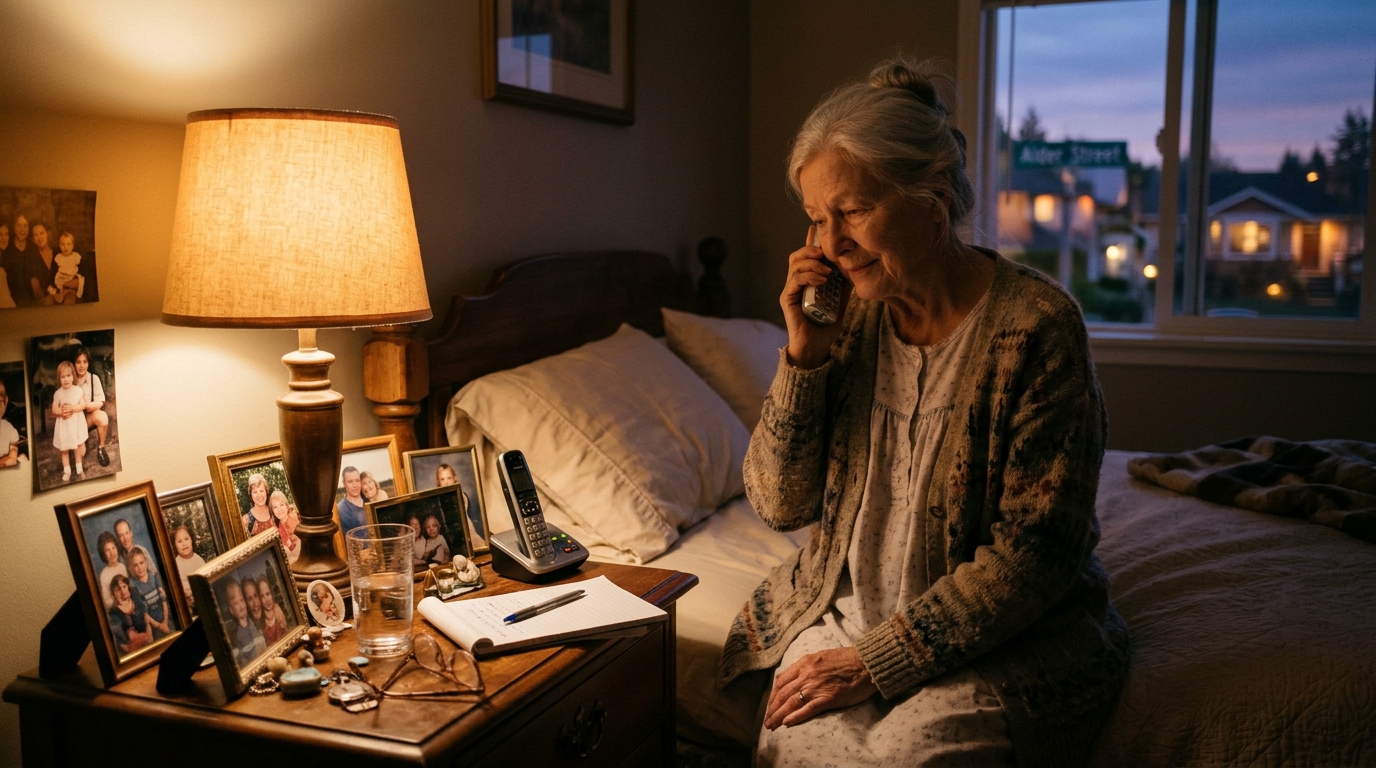
There is a particular kind of quiet that settles over a neighborhood around midnight. The porch lights click off one by one. The dishwashers finish their cycles. Somewhere a dog sighs and turns around three times before lying down. And on Alder Street, in a small yellow house with a crooked mailbox, a retired nurse named Marguerite Dolan sets her glasses on the nightstand, tucks her phone beside the lamp, and goes to sleep with one ear still half awake.
She has done this for eleven years, ever since she hung up her scrubs for good. The phone has rung at 3AM more times than she can count. She has never once let it go to voicemail.
How It Started
Marguerite worked thirty-four years as a nurse, most of them on the overnight shift of a county hospital. She will tell you she was never the smartest person on the ward, never the most decorated. But she was the one who stayed. When a frightened patient couldn’t sleep, she pulled up a chair. When a family sat in the waiting room at four in the morning, not knowing what to ask, she asked the questions for them.
When she retired, she assumed the nights would feel strange. They did. The first week, she woke at 2AM out of pure habit, reaching for a chart that wasn’t there. It was during that restless week that her neighbor, a young father named Teo, knocked on her door in his bathrobe. His baby daughter had a fever that wouldn’t break, and he was too scared to wait for the pediatrician’s office to open.
Marguerite put on her coat over her nightgown, crossed the street, and spent twenty minutes with a thermometer, a damp cloth, and a calm voice. The fever was manageable. The baby was fine. Teo, still shaking, asked if he could have her number, just in case.
She wrote it on the back of a grocery receipt. That receipt, she later learned, was photocopied and passed around the block.
The Calls Nobody Else Would Take
Over the years, the calls have been all kinds. Some are medical. Many are not. Here is a small sample of what a 3AM phone can hold:
- The scared first-time mother who couldn’t tell whether her newborn’s breathing was normal. (It was. Marguerite stayed on the line until the baby settled.)
- The widower down the lane who called not because he was sick, but because the house had become too quiet and he needed to hear a human voice.
- The college student with a bad reaction to a new medication who didn’t want to go to the ER alone.
- The teenager who called at 3:15 one winter night, not saying anything at first, just breathing. Marguerite didn’t hang up. She talked about the weather, the cat, the soup she’d made that afternoon, until the teenager finally said, quietly, ‘I think I need help.’
She is careful to say she is not a replacement for emergency services. If something is serious, she tells people to dial 911, and she stays on the line while they do. But she has learned that many of the worst hours of a person’s life are not emergencies at all. They are loneliness, fear, and uncertainty, wearing the costume of a medical question.
What the Night Teaches You
When asked why she does it, Marguerite doesn’t give a grand answer. She laughs a little and says, ‘Because I’m already awake.’
But when pressed, when the kettle has been poured and the conversation slows down the way conversations do in the evening, she offers something quieter.
‘The night makes everything feel bigger,’ she says. ‘A cough sounds like pneumonia. A worry sounds like a catastrophe. Nobody is at their bravest at three in the morning. I just remind people that the dark isn’t telling the whole truth. Most of the time, it looks smaller by daylight.’
She learned this on the hospital ward, watching patients and families wrestle with fears that seemed unbearable at 3AM and manageable by breakfast. The lesson stuck with her long after the badge came off. Sometimes what a person needs is not a cure. It is a steady voice that says: You are not alone out here, and this will look different when the sun comes up.
An Evening Ritual of Her Own
Marguerite has a routine she keeps every night, rain or shine, and it is the part of her story that tends to stay with people. Around nine o’clock, after dinner and the dishes, she steps out onto her front porch with a cup of chamomile tea and simply looks at the street.
She sees which windows are lit. She notices whose car is missing from the driveway. She waves to anyone walking a dog. It is, she admits, a kind of rounds. Thirty-four years of checking on people does not switch off just because the shift is over.
‘I like to know the neighborhood is tucked in,’ she says. ‘Then I can sleep.’
It is a small habit, but it has a quiet power. Because Marguerite pays attention in the evening, she often knows who might need her before the phone ever rings. When an elderly neighbor’s porch light stayed off for two nights in a row, she was the one who knocked and found him fallen but conscious, waiting for help he was too embarrassed to call for.
The Ripple Effect
What began as one receipt with a phone number has grown into something no one planned. Teo, the young father from her first night, now keeps a basic first-aid and fever-care guide taped inside his cabinet, written out by Marguerite in careful block letters. Other neighbors have started leaving soup on each other’s porches. A group text has formed, originally to ask Marguerite questions, that now mostly consists of people checking in on one another.
‘She didn’t just answer the phone,’ Teo says. ‘She taught us how to look out for each other. Now when something happens on this street, five people show up, not one.’
This is perhaps the most lasting gift of her work. She is not the only one answering anymore. She has quietly seeded a neighborhood of people who know that being awake at 3AM for someone else is not a burden. It is a way of saying: you matter to me.
What We Can Take From Her
You do not need a nursing license to do what Marguerite does. You need only a willingness to be reachable. Here are a few gentle lessons from her years of night watches:
- Make yourself easy to ask. Many people suffer in silence because they do not want to be a bother. Tell someone, plainly, that they can call.
- Stay on the line. Often the answer matters less than the presence. A calm voice is a kind of medicine.
- Notice in the evening. A dark porch light, a missing newspaper, a quiet house. Small observations at dusk can prevent big troubles by dawn.
- Know your limits. Helping well means knowing when to say, ‘This needs more than I can give. Let’s call someone who can help.’
- Let it spread. The best kindness teaches others to be kind in turn.
Before the Lamp Goes Out
Last winter, Marguerite’s phone rang at 3:07 on a freezing Tuesday. It was a woman from the end of the block whose husband had been sick for weeks and who had, for the first time, simply run out of strength. She didn’t have a medical question. She just said, ‘I don’t know why I’m calling.’
‘That’s alright,’ Marguerite told her. ‘I’m here. Tell me about your day.’
They talked for an hour. By the end, the woman had made a plan to ask her sister for help, had eaten something for the first time in a day, and had fallen asleep with the phone still against her ear.
Marguerite hung up gently, set the phone back beside the lamp, and lay in the dark listening to the house settle around her. Outside, the street was quiet, every window dim, every person on it a little less alone than they had been an hour before.
She closed her eyes. If it rings again tonight, she’ll be ready.