🎧 Listen to this story
Narrated by Kore · 6,488 characters
I have never been a person who handles endings well. I am the one who lingers in the doorway at the end of a party, who rereads the last page of a book three times before closing it, who stays on the phone long after the conversation has run out of things to say. For most of my adult life, I treated every ending as a small loss, something to be postponed, softened, or avoided altogether.
Then, on an ordinary Tuesday night in late autumn, a stranger on a train said something that quietly rearranged the way I think about all of it. I have been turning her words over ever since, usually in the hour before sleep, when the house is quiet and the day has finally stopped asking things of me.
The Last Train Home
It was the 9:40 evening train, the slow one that stops at every small town between the city and the coast. I had just come from a farewell dinner for a colleague of eleven years, a man who had trained me when I was new and frightened and sure I would be found out as a fraud. The dinner had been lovely and awful at the same time. There were speeches, a gift, a few tears we all pretended were the wine.
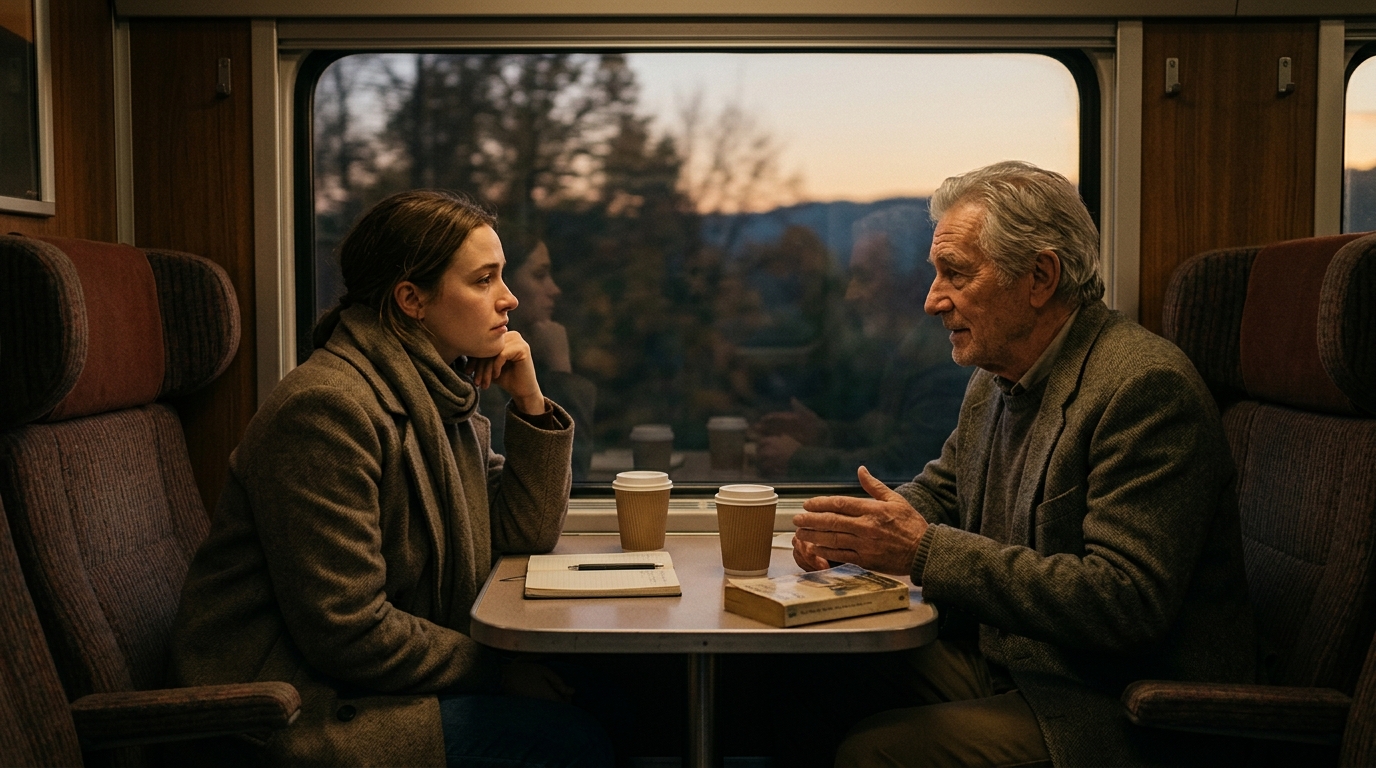
I climbed aboard with a heavy chest and a paper bag holding a slice of leftover cake, and I took a window seat. Outside, the platform lights smeared into gold streaks as the train pulled away. The carriage was nearly empty. Across the aisle sat an older woman with silver hair pinned neatly back, a knitted shawl the color of dried lavender, and a small canvas bag on her lap. She was working through a crossword with a pencil, unhurried, the way people do when they have nowhere urgent to be.
I must have sighed rather loudly, because she looked up and smiled.
“Long day?” she asked.
“A long goodbye,” I said, and was surprised at how quickly the words came out.
What She Said
She set down her pencil. I half expected polite sympathy, the kind we offer strangers to be kind and then forget. Instead she tilted her head and said, “Tell me about it, if you like. I have forty minutes and no one waiting.”
So I told her. About my colleague, about the eleven years, about how I did not know who I would be at that office without him. About how I had stayed too long at the dinner, hugged him twice, and still felt I had not said the thing I meant to say.
She listened without interrupting, nodding slowly. When I finished, she was quiet for a moment, watching the dark fields slide past the window.
“I was a nurse for thirty-eight years,” she said. “Night shifts, mostly. Do you know what I learned about endings?”
I shook my head.
“People think an ending is the thing that takes something away. But I sat with a great many people at the end of their days, and I can tell you the opposite is true. The ending is what shows you what the whole thing was. You cannot see the shape of a story until it stops. That dinner tonight, the tears, the gift, the clumsy hug, none of that was the loss. That was the proof that something mattered enough to be missed.”
The Lesson That Settled In Slowly
I wish I could say I understood her right away. In truth, the words sat in me like a stone dropped into a still pond, and the ripples took hours to reach the shore. It was only later, at home, after I had brushed my teeth and turned off the lamp, that they began to settle into something I could hold.
There is a particular kind of honesty that arrives at the end of a day. The noise falls away, the small urgencies lose their grip, and you are left with a clearer view of what actually happened. I lay in the dark thinking about my colleague and realized she was right. The heaviness I felt was not the sadness of losing eleven years. It was the weight of how much those years had given me. You can only feel that weight when something ends.
Three things she told me before my stop
- Do not rush to fill the silence after a goodbye. The quiet that follows is where the meaning finally has room to arrive.
- Say the small thing now. She told me the sentences we save for the perfect moment are the ones that go unsaid. A clumsy “thank you” today beats an eloquent one that never comes.
- Let an ending be an ending. Not every door needs to be propped open. Closing one gently is a kindness to everyone, including yourself.
The Stop Where She Got Off
Her stop came before mine, a tiny station with a single lamp and a bench. She gathered her canvas bag, tucked her pencil behind her ear, and rose with a small groan that made us both laugh.
“Write him a note,” she said, nodding as if she had read my mind. “Not a speech. Just the true thing. He will keep it longer than you think.”
Then she stepped onto the platform, and the doors closed, and I watched her walk toward the lamp until the train carried me past it. I never learned her name. I have never seen her again. And somehow that feels exactly right, a small, complete story with a beginning, a middle, and an end I did not try to hold onto.
What I Did the Next Morning
I wrote the note. It took me four minutes and was three sentences long. I thanked him for the time he sat with me late in my first year when I almost quit. I told him I still use the way he taught me to read a room. I told him I was a better colleague, and a better person, because he had been patient with me when I had not earned it.
He called me that evening. His voice cracked a little. He said he had read it standing in his empty kitchen, and that it was the best thing anyone had given him in years. We talked for an hour, and not once did either of us try to avoid the ending. It was the best conversation we had ever had.
A Way of Ending the Day
I have started a small habit since that night. In the quiet before sleep, I ask myself a single question: what ended today, and what did it show me? Sometimes the answer is large, a project finished, a season changing. More often it is small: a conversation that wound down, a meal that was eaten, a day that simply closed. Each one, if I let it, reveals a little of the shape of my life.
If you find endings hard, as I always have, you might try it too. Sit with the day as it folds itself away. Notice what it gave you. Say the small true thing to someone before it slips past.
And if you ever find yourself on a slow evening train, with a heavy heart and a stranger across the aisle, consider speaking. You never know whose few quiet sentences might change the way you see everything that comes to a close.
Goodnight, friends. May your endings be gentle, and may you recognize what they have to teach you.