🎧 Listen to this story
Narrated by Kore · 6,209 characters
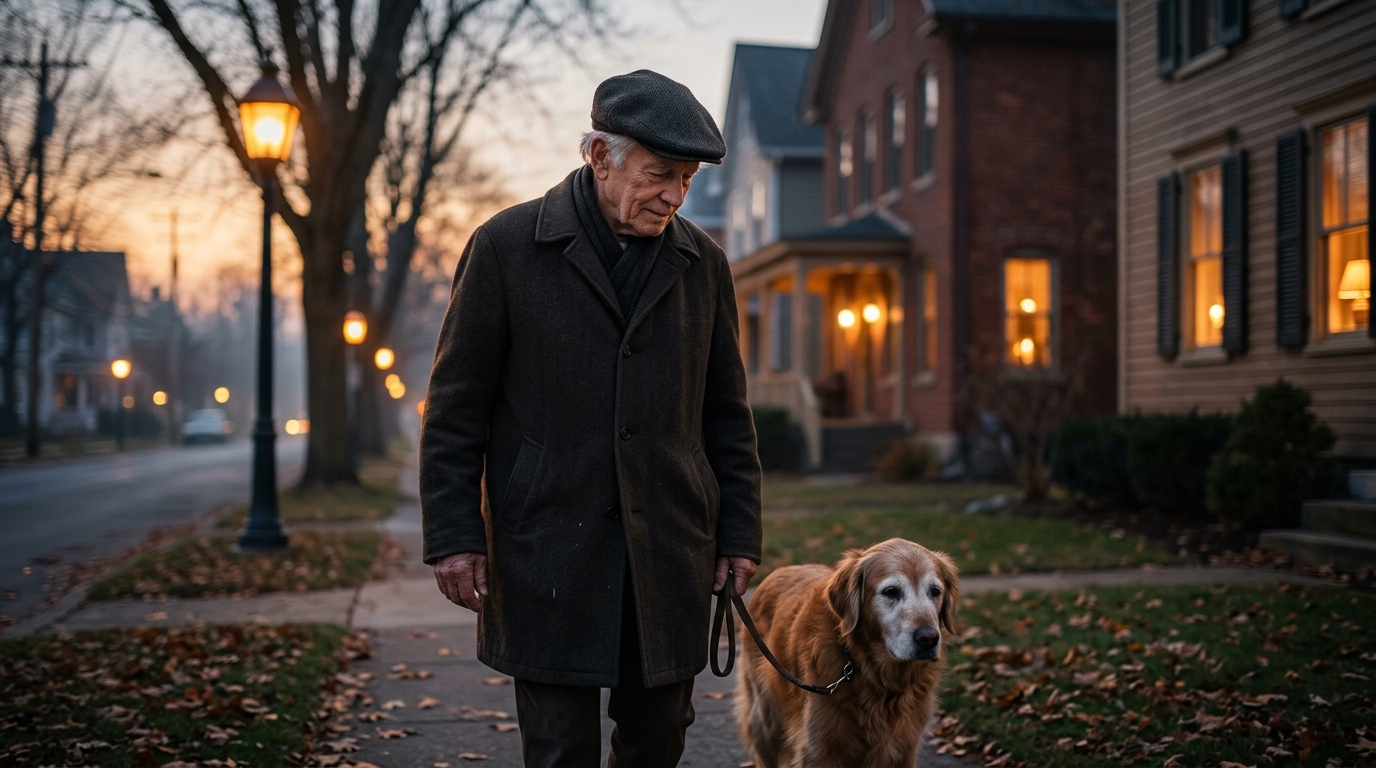
There is a moment around six-thirty each evening, once the school buses have emptied and the dinner smells begin drifting from open kitchen windows, when a tall figure in a faded green jacket steps out of his front door on Alder Lane. He carries a small flashlight he rarely needs and a thermos he almost always shares. His name is Walter Dunmore, he is seventy-one years old, and for nearly eleven years he has walked the same loop of neighborhood streets so that everyone on them gets home safe.
Nobody asked him to. There is no badge, no official program, no sign-up sheet. Just a retired Army sergeant, a pair of sturdy boots, and a quiet conviction that the hour between daylight and dark is when a neighborhood most needs someone watching over it.
The Hour Between
Walter calls it the in-between hour. It is the stretch when the working day ends but the night has not quite begun, when people are tired, distracted, and heading home with their minds on dinner or tomorrow’s to-do list. It is also, he says, when things tend to go wrong: a dropped set of keys in a dim driveway, a teenager walking home too late, an elderly neighbor unsure of an uneven curb.
‘I spent twenty-two years learning that the evening is when you pay attention,’ Walter told me, settling onto his porch step as the sky turned the color of peach tea. ‘When the light goes soft, people let their guard down. Somebody ought to keep a little of theirs up.’
His loop covers about a mile and a half, winding past the elementary school, the corner market, the bus stop on Pennington, and the small park with the crooked oak tree. He walks it slowly, not as a sentry but as a neighbor, nodding to porch-sitters, lifting a hand to passing cars.
How It Started
Walter does not make a big story of the beginning, but the people who live nearby know it. Eleven years ago, a young woman who lived two doors down was walking home from a late shift when she twisted her ankle badly on a broken stretch of sidewalk. It was dark, her phone was dead, and for forty minutes no one passed by. Walter found her on his way back from a late errand and drove her to urgent care.
‘That stuck with me,’ he said. ‘Forty minutes. Right here, on our own street. And not one person knew.’
The next evening, he put on his jacket and walked the block. He has not missed many evenings since.
What an Evening Walk Actually Looks Like
It would be easy to imagine something dramatic, but the truth is gentler. Walter’s patrol is made of small, ordinary acts, repeated until they become a kind of quiet safety net. Here is what a typical night might include:
- Walking the last few yards with a teenager who is coming home from practice, chatting about nothing in particular
- Checking that the streetlight outside the Hendersons’ house is working, and calling the city when it is not
- Pausing to help a neighbor carry groceries from the car to the porch
- Noticing when a regular face has not been seen in a few days, and knocking gently to check in
- Offering a cup of warm tea from his thermos to anyone who looks like they need a minute
- Simply being a familiar, steady presence in the fading light
That fourth item is the one neighbors speak about most. Last winter, Walter noticed the porch light at an elderly widow’s home had stayed off for two evenings in a row. He knocked, got no answer, and called for help. She had fallen in her kitchen and been unable to reach the phone. Paramedics later said another few hours could have made a serious difference.
The Lesson He Carries Home
I asked Walter what the walks have given him, because it seemed clear that something flowed in both directions. He was quiet for a long moment, watching a pair of porch lights flicker on down the street.
‘When I came home from service, the evenings were hard,’ he admitted. ‘Quiet used to feel loud. This gave the quiet a purpose.’ He tapped his thermos. ‘Now it is my favorite part of the day.’
That is the thing about an evening kindness: it does not just protect the person on the receiving end. It settles the one giving it, too. There is a peace that comes from knowing you spent the last of the daylight looking out for someone else.
A Neighborhood That Looks Back
Something lovely has happened on Alder Lane over the years. People started noticing Walter, and then they started noticing each other. Porch lights come on earlier now. Kids wave from their driveways. Someone left a hand-knit scarf on his doorstep one November with a note that read only, ‘For the walker.’ A new neighbor, a young father, recently asked if he could join the loop on Thursdays with his toddler in a stroller.
‘That is how it grows,’ Walter said, almost shyly. ‘You do not need a movement. You just need somebody to show up at the same time every day.’
What We Can Take From This
You do not need a uniform, a title, or a mile and a half of sidewalk to practice what Walter practices. The heart of it is simple, and it fits into the quiet hours of any ordinary evening:
- Notice. Pay attention to the people and places around you as the day winds down.
- Show up consistently. Safety and trust are built through small, repeated presence, not grand gestures.
- Check in. A knock on a door or a simple ‘how are you’ can matter more than you know.
- Let it settle you. Acts of care at the end of the day have a way of calming the heart before sleep.
When the Last Light Fades
As our conversation ended, the sky had deepened to a dusty violet and the streetlights hummed to life one by one. Walter stood, tucked his flashlight into his pocket, and checked his watch out of habit rather than need.
‘Time to go,’ he said with a small smile. ‘Somebody might be walking home.’
I watched him head down Alder Lane, a steady silhouette moving through the glow of porch lights, nodding at a woman unloading her car, lifting a hand to a boy on a bicycle. Behind him, the street felt a little warmer and a little safer, the way a place does when someone is quietly keeping watch.
Tonight, as the day softens and the noise fades, you might think of the Walters in your own life, the people who look out for us without being asked. And you might wonder, just for a moment, whether tomorrow evening you could be one of them.