🎧 Listen to this story
Narrated by Kore · 6,691 characters
The tornado took eleven minutes. It took the grain elevator, the school gymnasium, the hardware store, the Methodist church, and more than two hundred homes. What it left behind was a landscape so unfamiliar that residents later said they got lost walking streets they had known all their lives.
But this is not mainly a story about destruction. It is a story about what a town did with its evenings.
The First Night
On the night of the storm, with the power out and the sky strangely clear, a retired bus driver named Walt Henderson did something he could not fully explain. He carried two lawn chairs to the cracked concrete slab where the Main Street diner once stood, set them side by side, and sat down. He did not have a plan. He just did not want to be alone in the dark with what had happened.
By the time the last light bled out of the western sky, forty people had joined him. Someone had a camp stove. Someone else had a few bottles of water and a sleeve of crackers that had survived in a pantry. Nobody gave a speech. They simply sat among the broken boards and insulation and talked quietly as the stars came out.
The next evening, Walt came back. So did most of the others.
A Ritual Takes Shape
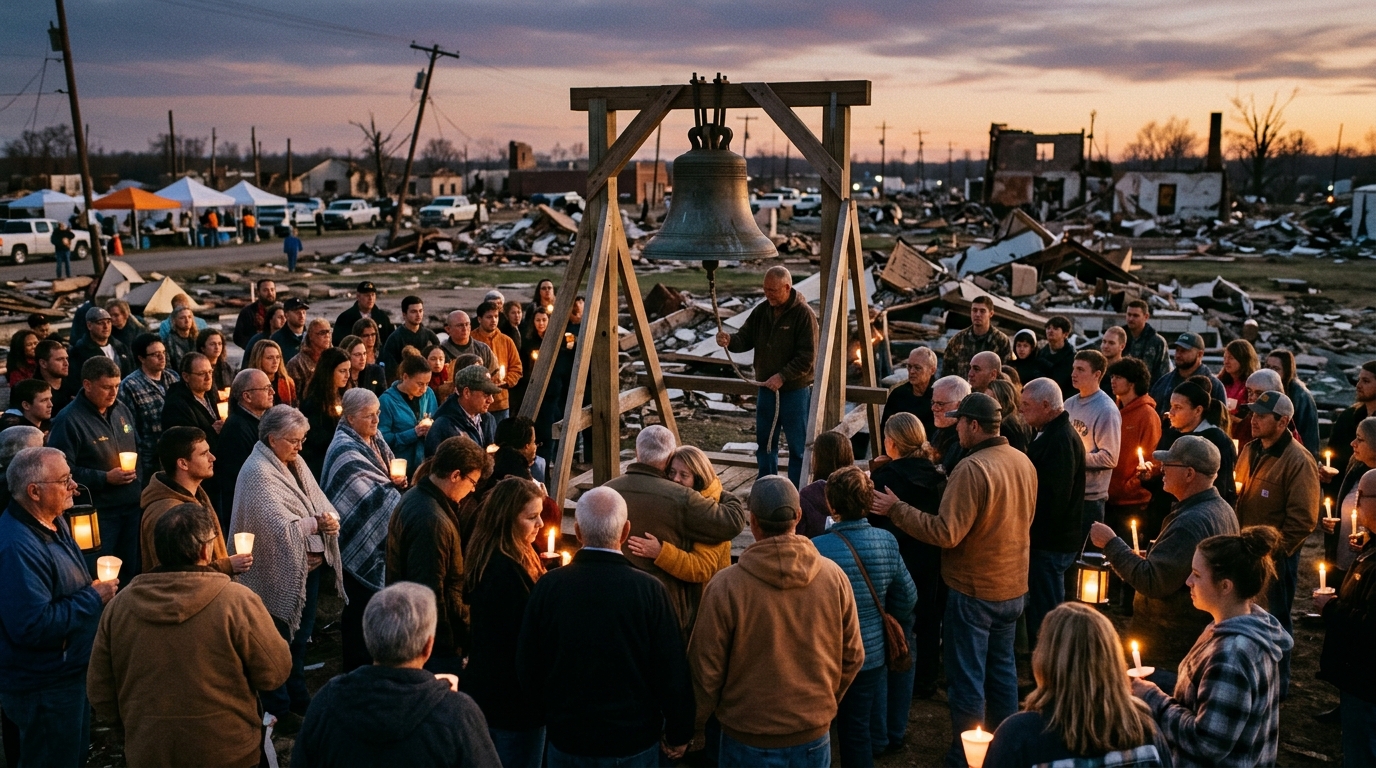
Within a week, the gathering had a name, though nobody remembers who first used it: the Seven O’Clock Sit. A woman named Marisol Ortega, whose house had lost its roof, started ringing a brass handbell she had salvaged from the elementary school. It rang once at seven each evening, and people drifted in from tents, borrowed trailers, and relatives’ spare rooms.
The rules, if you could call them that, were simple:
- Bring a chair, or sit on an overturned bucket.
- Bring food if you have it, take food if you need it.
- No one has to talk about what they lost.
- No one is allowed to be alone when the light goes.
Contractors, insurance adjusters, and relief workers came and went during the day. The town had endless practical tasks ahead of it. Yet the Sit never became a meeting about those tasks. It was the one hour in which the town simply was a town again.
Why the Evening Mattered
Ask anyone who lived through that first summer, and they will tell you the same thing: the days were survivable, but the evenings were hard. During the day there was work to do, forms to fill out, debris to haul. Busyness is its own kind of shelter. But when the sun sank low and the noise of machinery faded, the quiet arrived, and with it, the full weight of everything gone.
That is when people needed each other most.
Dr. Priya Raman, a counselor who volunteered with the relief effort, noticed it early. “Grief tends to find you at dusk,” she said. “The distractions fall away. What I saw in that town was people refusing to face that hour in isolation. They built a place for it. That was the healthiest thing they could have done.”
What Happened Around the Fire
As weeks turned into months, the Sit grew. Someone built a ring of salvaged bricks and started a small evening fire. Kids who had been withdrawn since the storm began chasing fireflies at the edges of the circle. An elderly man who had not spoken more than a few words since losing his home started telling stories about the town in the 1950s, and soon a crowd of younger residents was leaning in to listen.
Here are a few of the things that happened in that circle, as residents remember them:
- A neighbors’ feud ended. Two families who had argued over a property line for nearly a decade found themselves sharing a thermos of coffee. The fence they had fought over no longer existed. Neither family brought it up again.
- A town plan was born. The rebuilding committee did not start in a conference room. It started when a teenager named Dev Patel, sitting cross-legged in the dirt, asked what everyone wanted the town to feel like when it was finished. The answers filled three notebooks.
- A recipe was saved. A woman who had lost every family photograph realized she still carried her grandmother’s pie recipe in her head. She dictated it aloud one evening, and six people wrote it down on the backs of receipts.
Rebuilding the Heart First
The physical rebuilding eventually began, and it was slow. Lumber shortages, permit delays, and the sheer scale of the work stretched the process across years. But when residents describe those years, they rarely talk about the construction. They talk about the evenings.
“We knew we could pour a foundation any time,” Walt Henderson said, now in his late seventies, still the unofficial keeper of the lawn chairs. “But if we lost each other, if everybody scattered to different towns and different lives, there would be nothing to build the foundation for. So we held onto each other first. The buildings could wait.”
That decision, to treat community as the first thing worth restoring, shaped everything that followed. When the new community center finally opened, its largest room was designed around a central fire pit, and a brass bell hangs by the door.
The Lesson That Settles In at Dusk
There is something worth sitting with here, especially at the end of a long day of our own. We tend to believe recovery begins with logistics: the repairs, the paperwork, the plan. Those things matter. But this town understood something quieter and more fundamental. People do not heal in isolation, and a place is only as strong as the people willing to show up for each other when the light fades.
You do not need a disaster to practice this. Most of us have an hour at the end of the day when the busyness drops away and we are left with our own thoughts. What if, instead of retreating into screens or silence, we made a small habit of reaching toward someone? A phone call to a lonely relative. A porch visit with a neighbor. A shared dinner with no agenda.
The Bell Still Rings
These days, the Seven O’Clock Sit is smaller, but it has not stopped. Most evenings, a dozen or so residents still gather by the fire at the community center. New families who moved to town after the rebuilding are invited by the second week. Children who were toddlers during the storm now ring the bell themselves.
Marisol Ortega, who still carries the original handbell in her tote bag, says people sometimes ask why they keep it up when the town has long since recovered.
“We never recovered because we rebuilt the buildings,” she says. “We recovered because every night, for as long as it took, we made sure nobody sat in the dark by themselves. Why would we stop doing the thing that saved us?”
As the sky turns amber tonight and the day’s noise begins to fade, perhaps there is someone in your life who could use a chair pulled up beside theirs. The bell does not have to be brass. It just has to ring.