🎧 Listen to this story
Narrated by Kore · 7,547 characters
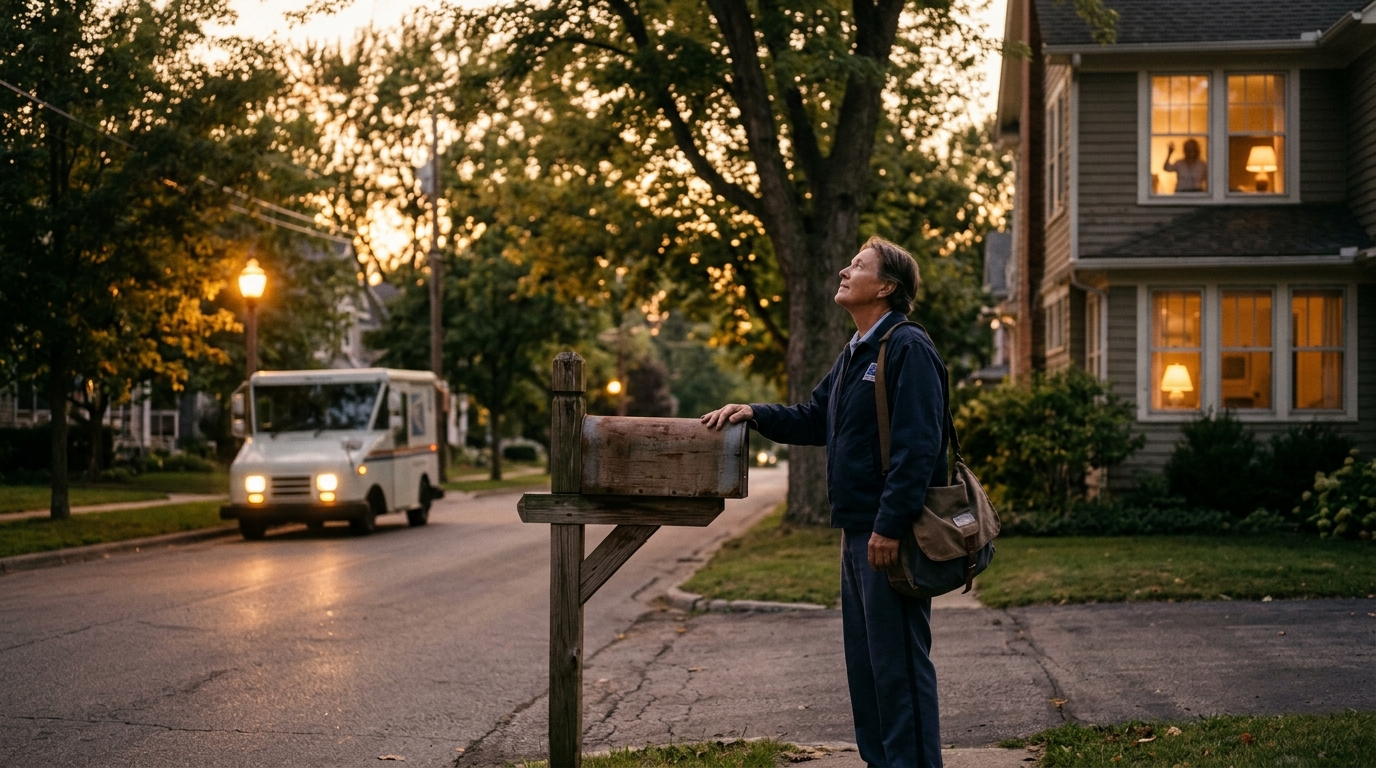
There is a particular kind of quiet that settles over a neighborhood around five in the afternoon. Garage doors rumble down. Porch lights flicker on one by one. The long shadows of maple trees stretch across lawns that have been mowed and re-mowed over decades. It is the hour when most people are heading in, and it is also the hour when Dale Whitfield is still out, walking the final stretch of his route with a canvas bag that has grown lighter and a habit that has not changed in twenty-six years.
Dale is a letter carrier in a modest mill town, and he has a rule that appears in no postal handbook. Before the sun goes down, he checks on every elderly customer on his route. Not with a clipboard or a formal visit. He does it with a glance at a curtain, a word over a fence, a knock that sounds almost like a joke. And in a world that moves faster every year, it may be the most important delivery he makes.
How a Simple Habit Began
The habit started, as many good things do, by accident. Early in his career, Dale noticed that the mail at one house on Alder Lane had been piling up inside the screen door for three days. The woman who lived there, a retired schoolteacher named Mrs. Okafor, was the sort of person who greeted him by name and asked about his kids. She had never once let the mail sit.
He knocked. Nothing. He knocked again, louder, and then he heard a faint voice from somewhere deep in the house. She had fallen in her kitchen the night before and had been lying on the floor, unable to reach the phone. Dale called for help. She recovered fully, and she told anyone who would listen that she had been saved by a man who simply noticed an overflowing mailbox.
“I didn’t think I did anything special,” Dale says. “I just paid attention. That’s the whole job, really. You pay attention to the same houses every day, and you learn what normal looks like. So when something is off, you know.”
What Normal Looks Like
This is the quiet genius of the work. A letter carrier walks the same path day after day, year after year. He sees the same doors, the same windows, the same flower pots. Over time, he becomes a living record of what ordinary life looks like on each street, and that makes him one of the first people to notice when it changes.
Dale keeps a mental catalog of small signals that tell him whether all is well:
- The newspaper that is usually pulled inside by mid-morning but is still lying in the driveway at dusk
- The blinds that are always raised by noon and are still drawn
- The porch light that burns all day, a sign someone forgot to turn it off, or couldn’t
- The mail that has stacked up beyond the usual one or two days
- The familiar wave from a window that does not come
None of these things mean trouble on their own. But Dale has learned that a pattern broken is a question worth asking, and the evening, he says, is when he asks it.
Why Before the Sun Goes Down
Ask Dale why he saves these check-ins for the end of his route, and he gets a little thoughtful. “Evening is when things feel loneliest,” he says. “During the day there’s noise. Deliveries, phone calls, neighbors out in the yard. But when the light starts to go, a lot of the people I deliver to are sitting alone with a television murmuring in the background. If I can give them thirty seconds of company before the dark comes, that’s worth more than the stamp on any letter.”
He times his route so the older customers come last. By the time he reaches them, the day’s urgency has drained away, the sky has turned the color of peaches and dusty rose, and there is room for a real hello. He might admire a tomato plant. He might ask how a knee is holding up. He might simply stand on the walkway for a minute and talk about the weather, which, as anyone who has ever lived alone will tell you, is never really about the weather.
A Few of the Doors He Knows By Heart
There is Mr. Delacroix, ninety-one, who keeps a chair by the front window specifically so he can see Dale coming. He raises two fingers in a salute every afternoon. If the chair is empty, Dale knocks.
There is the Pruitt sisters’ house, where two women in their eighties share a home and a standing argument about whose turn it is to get the mail. Dale hands it to whichever one answers and pretends not to hear the debate.
And there is Mrs. Okafor, now in her nineties, who still stands at the door with a glass of lemonade in summer and a thermos of tea in winter. She calls him her guardian in a blue uniform. He tells her she is overpaying him in tea.
The Evening That Mattered Most
Dale does not like to tell the story of the worst evening, but others on the route tell it for him. Two winters ago, on a gray December afternoon, he reached the end of Alder Lane and noticed that Mr. Delacroix’s chair was empty. The light was fading fast. There was frost already forming on the grass.
He knocked and heard nothing. He walked around to the side of the house and found the back door ajar. Inside, Mr. Delacroix had slipped on the cold kitchen tile and could not get up. He had been there for hours. The house was freezing because the furnace had gone out.
Dale stayed with him until the paramedics arrived, wrapped in a quilt from the couch, holding the old man’s hand and talking about nothing at all to keep him calm. The doctors later said that another few hours in that cold could have been the difference between a recovery and a tragedy.
“People call me a hero when they tell it,” Dale says, shaking his head. “I just didn’t want to walk away from an empty chair.”
What This Small Act Teaches Us
When the day finally quiets and the streetlights hum on, it is worth thinking about what Dale’s habit really says. There is something almost radical about it in an age that prizes speed and efficiency. He could finish his route faster. He could skip the conversations. No one would complain, and no one would know.
But he chooses attention over efficiency, and that choice ripples outward. Here are a few things his evenings have taught the people around him:
- Noticing is a form of love. You do not need grand gestures. Paying attention to someone’s ordinary rhythms is a quiet way of telling them they matter.
- Routine can be a lifeline. For people who live alone, a predictable, friendly face at a predictable hour can anchor an entire day.
- Small interruptions to our schedule can change everything. Thirty seconds at a doorway cost Dale almost nothing and have given others years.
- You do not need permission to care. No policy required this of him. He simply decided it was part of being a good neighbor.
Ending the Day Differently
As the neighborhood settles in tonight, consider the people in your own life whose evenings may be quiet in a way that is not always peaceful. A grandparent who lives a few towns away. A neighbor whose lights are on but whose door rarely opens. An elderly friend who would never ask for company but would be glad of it.
You do not need a uniform or a route to do what Dale does. You only need to look up, to notice, and to knock. A short phone call before dinner. A wave across a fence. A plate of something warm left on a porch as the light fades.
When Dale finally turns toward home, his bag empty and the sky deepening to violet behind him, he often glances back at the last house on Alder Lane. A single lamp glows in Mrs. Okafor’s window, steady and warm. It tells him what he came to find out: all is well, and the day can end.
That small glow, he says, is the best thing he delivers all day, even though he is not the one who sends it.