🎧 Listen to this story
Narrated by Kore · 8,097 characters
There is a particular kind of quiet that settles over a stable yard around dusk. The wheelbarrows are parked, the hay nets are filled, and the last of the sunlight slides across the paddock like warm honey. It is the hour when most of the day’s noise has drained away, and what is left is something softer, something that lets you hear things you missed all afternoon.
At Willow Bend Rescue Farm, that is the hour when a gray mare named Juniper walks to the front gate and stands there. She does not graze. She does not pace. She simply waits, ears forward, eyes fixed on the gravel drive. And at about a quarter past six, a blue minivan turns in, and a nine-year-old boy named Eli climbs out and starts running.
A Horse Nobody Wanted
Juniper arrived at the farm four years ago in a condition the staff still describes carefully. She was underweight, wary of hands, and flinched at sudden movement. Her previous owner had stopped caring for her long before she was surrendered. She spent her first months at the farm standing at the far edge of the pasture, as if she had decided that distance was the safest thing she could afford.
The farm’s founder, a retired nurse named Margaret Oyelaran, says she nearly gave up on trying to coax her closer. “You can’t rush a horse like that,” she told me. “You sit on an overturned bucket and read a paperback, and you pretend you don’t care whether she comes over. Because the second you care too much, she can feel it.”
It took most of a year before Juniper would eat from Margaret’s hand. It took longer still before she would let anyone touch her face.
A Boy Who Had Gone Quiet
Eli’s story begins in a different kind of silence. Diagnosed with autism at age three, he had spoken a handful of words as a toddler and then, around his fourth birthday, stopped. His mother, Danielle, describes the years that followed as a long stretch of hoping and translating. She learned to read the way he tugged her sleeve, the way he tilted his head, the way his shoulders tightened when a room got too loud.
Speech therapy helped in small increments. He could point, he could use picture cards, he could hum along to songs he loved. But words, real spoken words meant for another person, stayed out of reach. School was exhausting for him. Crowds were worse. By the end of most days, Danielle says, he would collapse onto the couch and simply stare at the wall, emptied out.
A therapist suggested equine-assisted activities, mostly as one more thing to try. Danielle admits she was skeptical. “I’d tried so many things. I didn’t want to get my hopes up about a horse.”
The First Evening
They scheduled the visit for the end of the day, because that was when the farm was quietest and the other children had gone home. Margaret had a gentle rule for first meetings: no instructions, no expectations, no one standing too close.
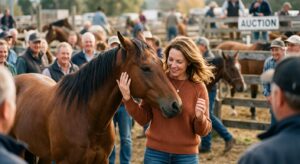
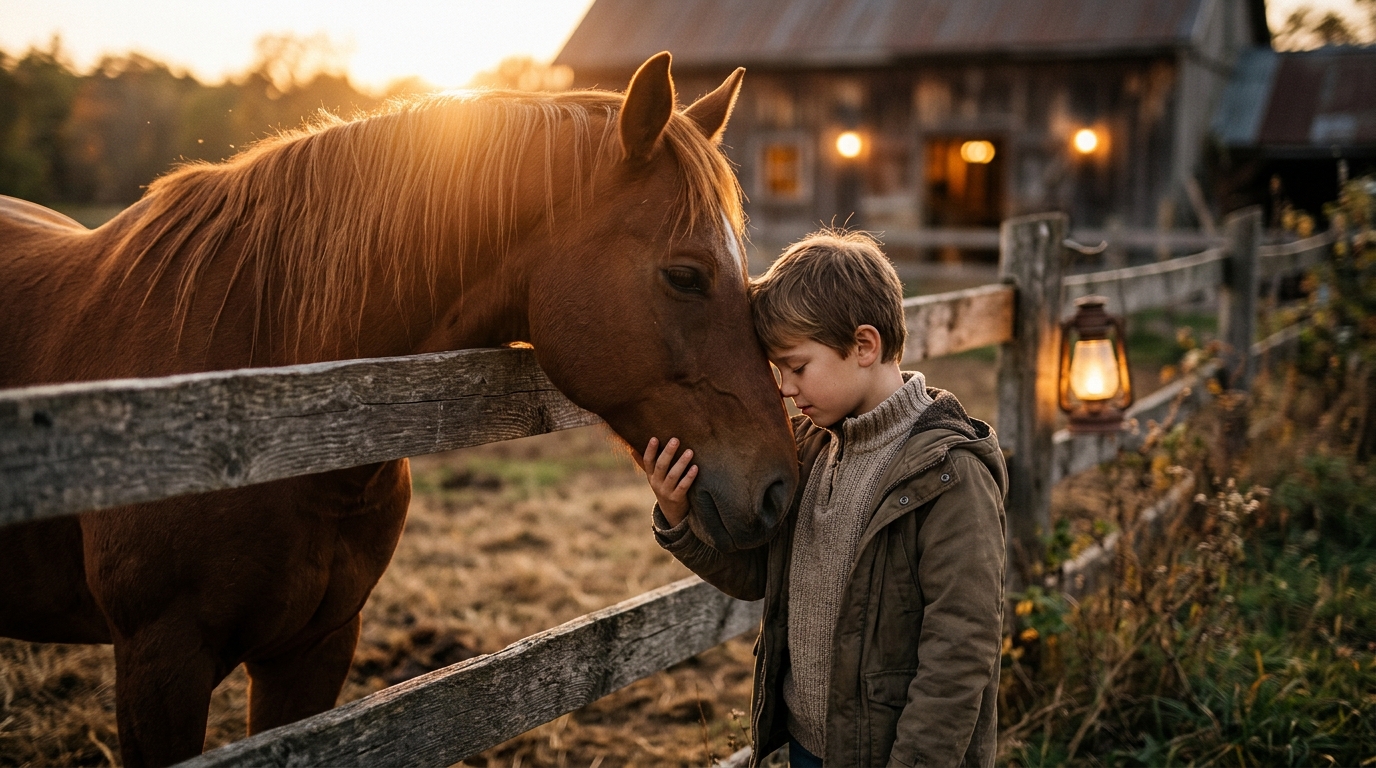
Eli walked to the fence and stopped. Juniper, who had been dozing at the far side of the paddock, lifted her head. For a long moment, neither of them moved. Then the mare walked over, slowly, and lowered her nose until it hovered a few inches from the boy’s hand.
Eli did not pull away. Danielle remembers holding her breath. He stood there, perfectly still, while the horse breathed warm air across his fingers. Then he did something she had not seen him do in months: he smiled, and he leaned his forehead against the fence rail, close to the mare’s face.
“That was it,” Margaret said. “That was the whole session. Twenty minutes of two creatures standing very still next to each other.”
What Stillness Teaches
Horses are extraordinarily sensitive to the emotional temperature of a person. They do not care about eye contact, small talk, or whether a child answers a question correctly. They respond to calm. They respond to honesty of movement. For a boy who spent his days being asked to perform, to look people in the eye, to respond on cue, a horse offered something rare: acceptance with no conditions attached.
Over the following weeks, Eli’s visits became a rhythm. He would arrive, brush Juniper’s coat in long, slow strokes, and lean against her shoulder while the light turned amber. He started humming to her. Margaret noticed that Juniper would shift her weight toward the sound, ears swiveling to catch it.
The staff began to see patterns they had read about but never quite believed:
- Eli’s breathing slowed when he was near the mare, matching her steady rhythm.
- He tolerated sounds near the stable that would have overwhelmed him elsewhere.
- He began initiating contact, reaching for the brush on his own.
- He started to look at things, and then at people, with more curiosity.
The Word
It happened in the fourth month, on an unremarkable Thursday. It was almost dark. The yard lights had just flickered on, and the air smelled of cut grass and cooling earth. Eli was brushing Juniper’s neck when she shifted suddenly and the brush slipped from his hand into the dust.
Danielle was standing a few yards away, talking quietly with Margaret. She says she did not hear it at first, because it was so soft. Then Margaret put a hand on her arm.
“Up,” Eli said.
He was looking at the brush. Then he looked at the horse. “Up, Juni.”
He wanted the mare to lift her head so he could reach the spot behind her ear. Two words, spoken plainly, to a friend. Danielle sat down in the gravel and cried. Margaret, who has witnessed many things in thirty years of caring for animals and people, says she had to turn away and pretend to check a water trough.
More Than a Word
After that evening, the words came slowly, then a little faster. “Juni.” “Gate.” “Apple.” “Good girl.” Each one seemed to arrive first in the stable yard and only later at home or at school. Danielle says there was something about the setting that made it safe to try: no one was waiting for him to get it right, no one was correcting him. The horse simply listened.
His speech therapist reports that Eli now uses short spoken sentences with people he trusts, and that he has begun to initiate conversation, mostly about horses, which Margaret finds entirely reasonable. He still finds loud places hard. He still has days when words retreat. But the door that had been closed for years now stands open, and he walks through it more often than not.
The Gate at Dusk
Which brings us back to the evening ritual. Somewhere along the way, Juniper began to anticipate the visits. The staff first noticed it as a coincidence: the gray mare standing at the gate near the end of the day. Then they realized she appeared at the same hour on the days Eli was coming, and drifted back to the pasture on the days he was not.
Nobody can say precisely how a horse knows. Perhaps it is the sound of the minivan, or the angle of the light, or simply the memory of a gentle presence that arrives when the day is winding down. Margaret prefers not to over-explain it. “She waits,” she says. “He comes. I don’t need a theory.”
When Eli reaches the gate, there is no leap or fanfare. He stops, takes a breath, and says her name. Juniper lowers her head until it rests against his chest, and the two of them stand there for a while, a boy who found his voice and a horse who found a reason to trust again.
An Evening Reflection
There is something worth carrying home from this story as the light fades from your own day. We spend so much of our lives trying to fix, to teach, to push things along. Yet some of the deepest healing happens when someone, or something, simply makes room for us exactly as we are.
As you wind down tonight, consider these gentle questions:
- Who in your life offers you stillness without asking for anything in return?
- Where might you offer that same patient presence to someone else?
- What small, quiet moment from today deserves to be noticed before you sleep?
Out at Willow Bend, the stable yard has gone dark and silent. The gray mare has wandered back to the pasture, her coat catching the last pale light. Tomorrow evening, at about a quarter past six, she will walk to the gate again. And somewhere across town, a boy will be getting ready to say her name.