🎧 Listen to this story
Narrated by Kore · 6,032 characters
There is a particular kind of quiet that settles over a wolf sanctuary once the sun slips behind the ridgeline. The visitors have gone home. The gravel paths have stopped crunching. The last light turns the tall grass the color of old honey, and the animals, who spent the day dozing in the heat, begin to stir. For the caretakers, this is the hour when the real work of listening begins.
It was in exactly that hour, on a cool autumn evening, that a wolf named Ash did something he had never done in his entire life. He lifted his head, closed his eyes, and howled.
The Wolf Who Never Made a Sound
Ash arrived at the sanctuary as a young adult, thin and watchful, with a gray coat that looked almost silver in certain light. He had spent his early years in a small enclosure on a private property, kept as a novelty by an owner who had no idea what a wolf truly needs. He was fed, technically. He was sheltered, technically. But he was alone, and for a social animal that lives and breathes through connection, alone is its own kind of starvation.
When the rescue team brought him in, the veterinarian noted something unusual. Ash was physically recovering well, but he was entirely mute. No whining. No yipping. No growling, even when startled. Wolves are among the most vocal animals in the wild, and a silent wolf is a worrying one.
“We joked that he’d taken a vow of silence,” one caretaker recalled. “But the truth was sadder than that. He had never had anyone to answer him. Why would you keep calling into a void?”
Why Wolves Howl at All
To understand why this moment mattered so much, it helps to know what a howl actually is. A howl is not a cry of sadness, as the old stories suggest. It is a conversation. Wolves howl to gather the pack, to locate one another across distance, to say I am here, where are you? It is the sound of belonging, announced into the dark.
A wolf raised in isolation has no one to learn that language from. Howling is partly instinct, but it is also deeply social, a chorus that pups absorb by listening to their elders. Ash had no chorus. He had only the sound of the wind and his own breathing.
What Caretakers Watch For
- Body language: A loosened tail and relaxed ears signal growing trust.
- Proximity: Choosing to rest near others instead of apart is a milestone.
- Play: A wolf that bows and bounds is a wolf that feels safe.
- Voice: The final and rarest sign, a wolf comfortable enough to call out.
The Slow Work of Introductions
Introducing a rescued wolf to an established pack is not a quick or simple process. It happens through fences first, with weeks of sniffing, watching, and cautious curiosity from both sides. Ash was placed in an enclosure adjacent to a small pack of three wolves who had lived at the sanctuary for years. Neither side rushed. The caretakers sat in folding chairs at a respectful distance, taking notes and drinking lukewarm tea, saying very little.
Day after day, Ash would lie close to the fence line, near enough to catch their scent. The pack’s matriarch, a broad, patient female named Juniper, would sometimes lie on her side of the wire, back to back with him, as if to say we can wait.
When the day finally came to open the gate between them, the entire staff held their breath. There was no fighting, no drama. Ash simply stepped through, and Juniper touched her nose to his shoulder, and the pack folded him in as though he had always belonged.
The Evening It Happened
What came next unfolded not at midday, when everyone was watching, but in the blue hush of early evening, when the staff had gathered quietly near the fence to see how the pack settled for the night.
The sanctuary’s youngest wolf began it, a lanky yearling who tilted his muzzle toward the first stars and let out a thin, wavering note. Juniper joined, then the others, until the air itself seemed to hum with layered voices rising and falling over the dusk.
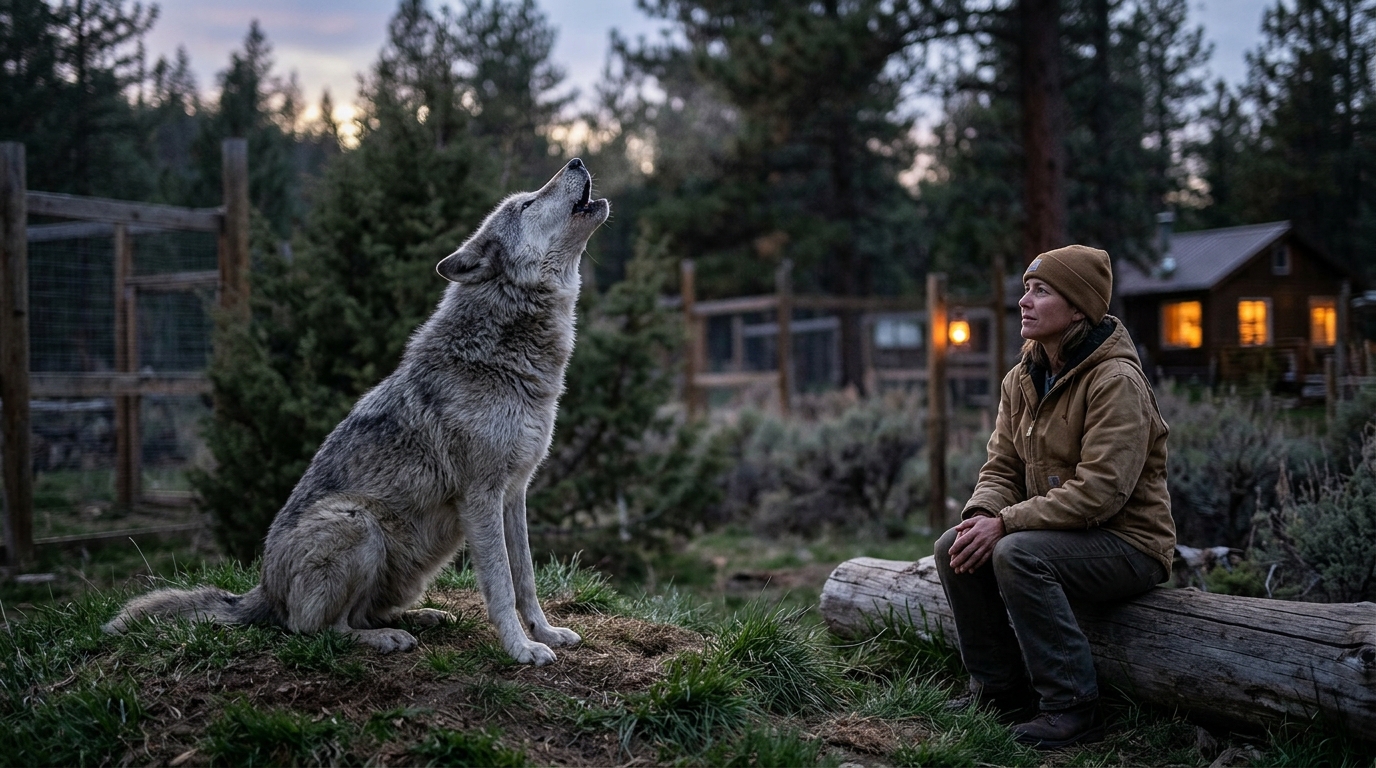
And then, beneath the chorus, came a sound nobody had ever heard from him. It was low and uncertain at first, almost cracked, like a door that hadn’t been opened in years. Ash had his head raised, his throat stretched long, his eyes half shut. He was howling.
“I didn’t realize I was crying until I tasted it,” said one of the caretakers. “Three years of nothing. And then this. He wasn’t copying them. He was answering them. That’s the difference. He finally had someone to answer.”
What the Stillness Teaches Us
There is something about the end of the day that strips things down to what matters. When the noise fades and the to-do lists dissolve, we are left with a simple question that wolves seem to understand better than we do: Who is listening for me?
Ash’s story lingers because it reflects something true about every living thing. We can survive a long time without being heard, but we cannot truly flourish. A voice needs an echo. A heart needs a place where its sound is welcome.
Small Reflections to Carry Into Tonight
- Be someone’s answer. Reach out to the quiet person in your life. They may be waiting for a reason to speak.
- Be patient with silence. Trust takes longer than we think, and it cannot be hurried.
- Make room at the fence. Sometimes love begins simply as proximity, two beings sharing a boundary and a sunset.
- Notice your own voice. What have you been holding back because no one seemed to be listening?
Home Is a Chorus
Ash still lives at the sanctuary today, and these days he howls most evenings, usually a half beat behind the others, as if savoring the sound of his own belonging. The staff say you can tell his voice apart now: deeper than the rest, a little rough around the edges, unmistakably his.
When you think about it, that is all any of us are looking for. Not a perfect life, and not a loud one, but a place where our voice has somewhere to land.
So tonight, when the sky darkens and the house grows still, take a moment to listen. Somewhere, someone may be waiting to hear from you. And somewhere, there may be a chorus ready to take you in, if you only dare to lift your head and call.