🎧 Listen to this story
Narrated by Kore · 6,156 characters
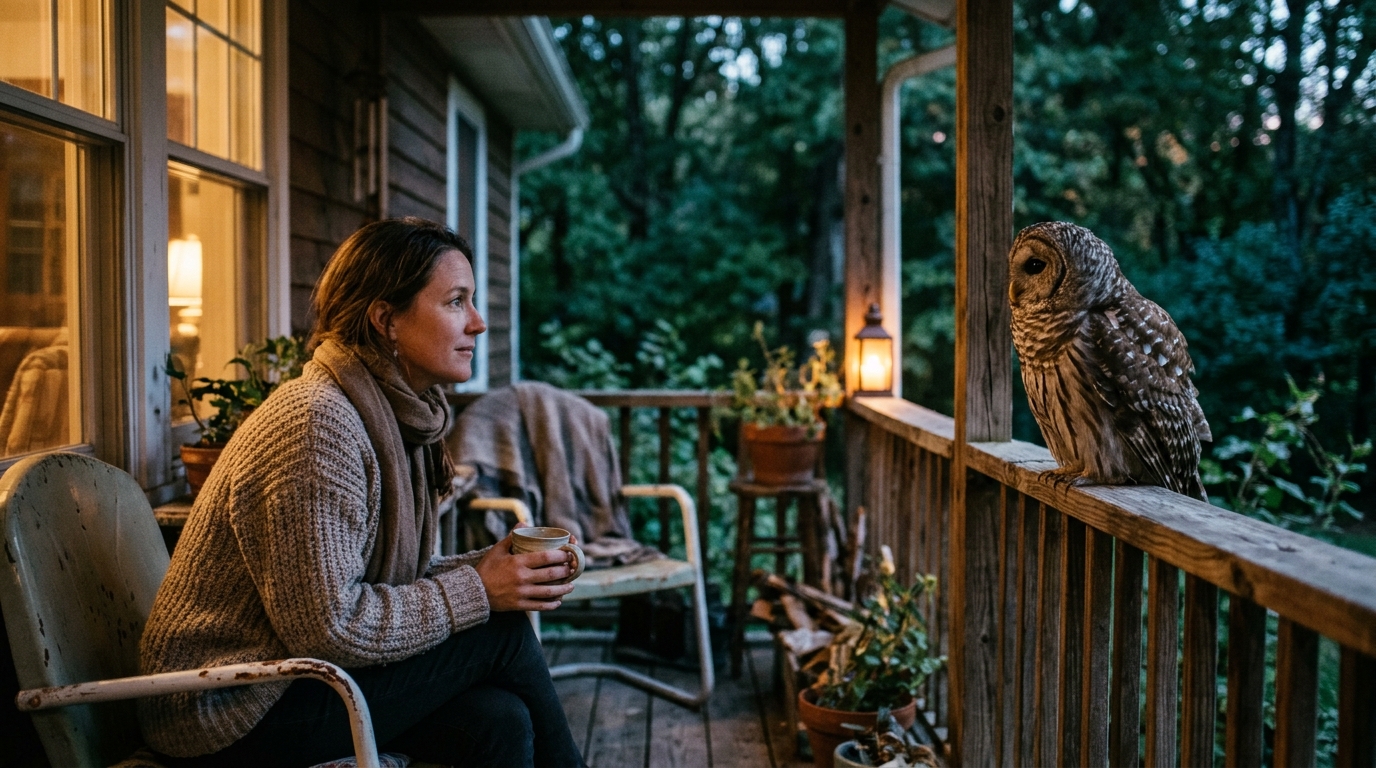
Walter Hendricks is eighty-one years old, and he keeps a strict schedule. Supper at five. Dishes by six. And at a quarter to seven, when the light turns the color of weak tea and the swallows have gone quiet, he carries a worn paperback and a mug of chamomile out to the screened porch behind his house in rural Vermont.
What he did not expect, three autumns ago, was an audience.
The First Evening
It began on a cool October night. Walter had been a widower for just over a year. His wife, Margaret, had been the reader in the family, the one who filled the house with library books and read aloud passages that struck her. After she died, the books on her shelves sat untouched, and the evenings grew very long.
One night, almost out of stubbornness, he took down a battered copy of one of her favorites and carried it out to the porch. He read for maybe ten minutes before the feeling crept over him that he was being watched.
He looked up. On the maple branch that hangs over the corner of the porch sat a barred owl, big as a house cat, dark eyes steady and unblinking, its head tilted slightly as though it were trying to read over his shoulder.
“I said good evening,” Walter told me, laughing at himself. “Out loud. To an owl. I figured that was the end of my dignity.”
A Visitor Becomes a Habit
The owl came back the next night. And the next. By the end of that first week, Walter noticed he had started checking the clock, not out of loneliness exactly, but with a small warm sense of expectation, the way you might listen for a neighbor’s footsteps.
Barred owls are known for their call, the rolling “who cooks for you, who cooks for you-all” that echoes through northern woods. But this one was nearly silent around Walter. It simply arrived, settled onto the same bough, fluffed its feathers against the cold, and watched him turn pages.
Walter named her Margaret’s Library Cat before settling on a shorter name: Pearl. He admits he has no idea if the owl is female. “She just looks like a Pearl,” he says. “Calm. Doesn’t say much. Pays attention.”
What the Experts Say
When I called a wildlife rehabilitator in the area, she was careful not to overstate things. Owls do not bond with humans the way dogs do, she explained. But barred owls are surprisingly adaptable and curious, and they are creatures of habit with strong territorial loyalty. A porch with a steady, still human, a warm lamp that draws moths, and a quiet yard full of mice can become part of an owl’s evening route.
“Whether she understands what he is doing is another question,” the rehabilitator said. “But a safe, predictable place is valuable to a wild animal. And a calm person who does not chase or crowd her makes that place even safer.”
In other words, Walter earned her trust the way trust is always earned: by being gentle, consistent, and unhurried.
The Rules of a Quiet Friendship
Over three years, Walter has developed a few unspoken rules, and they say a lot about how to be good company to anything, wild or otherwise.
- Never feed her. The rehabilitator had warned him that feeding wild owls can ruin their hunting instincts. Pearl catches her own supper in the field behind the house.
- Keep the porch light low. A soft lamp beside his chair is enough. Bright lights, he learned, make her leave.
- Do not stare back. Walter keeps his eyes on his book. “Staring is rude,” he says. “Even to an owl.”
- Let her go when she goes. Some nights she stays an hour. Some nights ten minutes. He never follows or calls after her.
The Evening Walter Almost Stopped
There was one stretch last winter when the visits stopped. For nearly two weeks, the maple branch stayed empty. A hard cold snap had settled in, and Walter, whose knees had been bothering him, spent several evenings indoors by the woodstove.
“I told myself it was fine,” he said. “She’s a wild animal. She doesn’t owe me anything.” But he found he could not concentrate on his reading. He kept glancing at the dark window.
On the fourteenth night, bundled in two sweaters and a wool blanket, he went out to the porch again. He sat for twenty minutes with the book open on his lap. And then, soundlessly, a shape drifted out of the dark and settled onto the branch.
“I’ll tell you something,” Walter said, and his voice caught. “I had not cried since the funeral. I cried right there in that chair. Not because I was sad. Because something had come back.”
What the Dark Teaches
There is a particular wisdom in the hours after sunset. The day’s demands loosen. The phone goes quiet. The mind, finally, has room to feel what it has been too busy to feel.
For Walter, those hours used to be the hardest part of the day, the stretch when Margaret’s absence was loudest. Now they are the part he protects most fiercely. He did not replace his grief with an owl. Nothing could. But the ritual gave the grief somewhere to sit, alongside something alive and watchful and patient.
“She’s not company the way a person is,” he told me. “She’s company the way the evening is. She’s just there, and it’s enough.”
Three Small Lessons from a Porch
- Presence is a gift. Pearl does nothing for Walter except show up. And showing up, night after night, turns out to be most of what anyone needs.
- Trust grows slowly and quietly. It cannot be forced, only offered, again and again, without demand.
- Healing rarely announces itself. It arrives like an owl at dusk, soft-winged, unannounced, and suddenly there on the branch.
The Last Page of the Day
When I visited Walter, I arrived just before dusk, and he insisted I stay for the ritual. We sat on the porch while the sky faded from gold to plum to a deep, soft blue. He opened his book. I tried very hard to be as still as the chair I sat in.
Just as the first star appeared, there was a faint rustle in the maple. Walter did not look up. He only smiled a small smile, turned a page, and said quietly, to no one and to everyone, “Good evening, Pearl.”
If there is a lesson in any of this, perhaps it is simply that. Somewhere near you, at the end of your own long day, something may be waiting to keep you company in the quiet. All you have to do is sit still long enough to notice it.