🎧 Listen to this story
Narrated by Kore · 7,530 characters
There is a particular kind of quiet that settles over a beach town around the time the last umbrellas are folded and the light turns the color of warm honey. The shops pull their shutters. The gulls go back to wherever gulls go. And the tide, which has been busy all day, finally slows its pace.
It was in exactly that hour, on a still evening in late September, that a retired schoolteacher named Marguerite Dalloway noticed something at the water’s edge that did not belong to the usual evening pattern of shells and driftwood.
A Shape in the Surf
Marguerite had walked the same stretch of sand every evening for eleven years. She called it her way of closing the day, a slow wander that helped the worries of the afternoon drift out with the tide. That night she nearly missed it. A dark, rounded shape lay half in the foam, rising and falling so slightly that at first she took it for a boulder the sea had rearranged.
Then it moved. One flipper lifted, weakly, and sank again.
It was a green sea turtle, roughly the size of a patio table, and she was in terrible shape. Her shell was crusted with barnacles. Her eyes were swollen and clouded. A tangle of old fishing line was wound around one front flipper, cutting deep. She was breathing in shallow, labored pulls, and the sun was sinking fast.
Marguerite did what most of us would do. She froze, then she reached for her phone.
The Call That Rippled Outward
She dialed the number posted on the faded sign near the boardwalk, the one for the regional marine wildlife hotline. A volunteer named Teodoro answered on the second ring. He told her to keep people back, keep the turtle shaded and damp, and not to try to drag her. Help was coming, but the nearest rescue van was forty minutes away.
Forty minutes is a long time when something is dying in front of you. So Marguerite did the second thing most of us would do. She called a neighbor.
Within a quarter of an hour, there were nine people on the beach. By the time the van arrived, there were more than sixty.
What the Evening Brought Out in Everyone
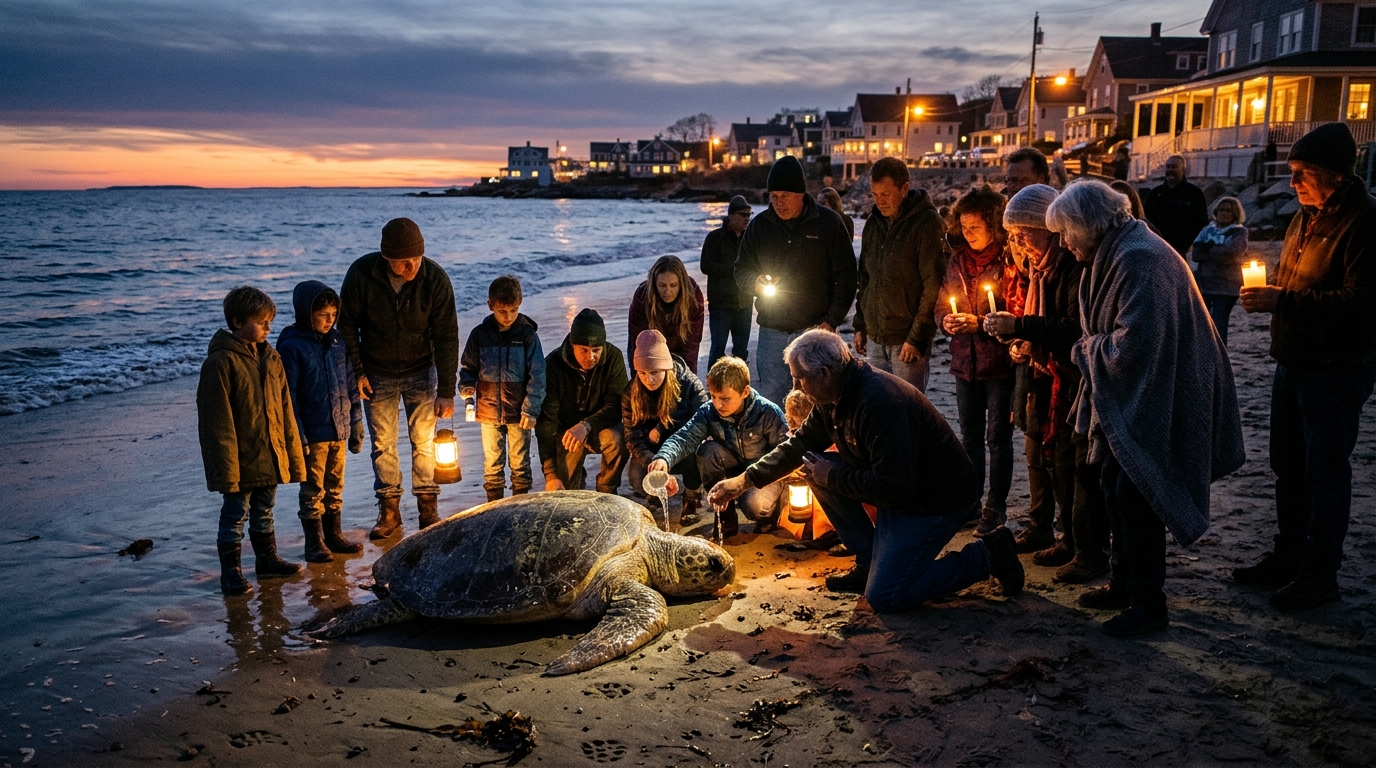
Nobody organized it. That is the part people still talk about. A man who runs the fish-and-chips stand came down still wearing his apron and began scooping cool seawater into a bucket, pouring it gently over the turtle’s shell. Two teenagers who had been skateboarding near the pier fetched towels from their houses, soaking them and draping them across her back. A woman who owned the bakery arrived with a thermos of tea, not for the turtle, but for the volunteers who were beginning to shiver as the sea breeze picked up.
Someone set a ring of beach chairs around the animal to hold back the curious. Someone else, a child no older than eight, quietly asked if she could hold the flashlight, and she held it steady for the better part of an hour without once complaining that her arm hurt.
As the sky deepened from amber to rose to a soft violet, the crowd grew hushed. Phones that had been out for photos went back into pockets. People lowered their voices the way you do in a room where someone is sleeping. A town that rarely agreed on anything, from parking rules to the new pier lights, stood shoulder to shoulder in the dusk, united by a single fragile creature.
The Moment Teodoro Arrived
When the rescue van finally pulled onto the sand, its headlights sweeping across the waiting faces, a small cheer went up and was immediately shushed by the crowd itself. Teodoro and his partner, a veterinary technician named Priya, worked calmly. They assessed her, wrapped her in wet padding, and slid a specialized stretcher beneath her. It took eight people to lift her.
Teodoro later said it was the first rescue where he had more helpers than he knew what to do with. “Usually it’s two of us and a stranger,” he told a local reporter. “That night I had a whole town.”
The Long Road Back
The turtle, whom the children of the town soon named Dusk, spent four months at the rehabilitation center. The fishing line had damaged tissue in her flipper, and she was severely dehydrated and underweight. She needed fluids, antibiotics, careful feeding, and a great deal of patience.
And the town kept showing up. Not all at once, but steadily, the way a good habit forms.
- The bakery began donating a portion of every Saturday’s sales to the center.
- The skateboarders organized a monthly beach cleanup, pulling hundreds of feet of discarded line from the sand.
- Marguerite started a small journal at the boardwalk sign, where residents could write notes of encouragement for the rehab staff.
- The fish-and-chips owner replaced his plastic cutlery with wooden ones and put a recycling bin for fishing line outside his stand.
None of it was dramatic. All of it mattered.
A Release at the Same Hour
On a clear evening in late January, Dusk went home. The center had chosen the same stretch of beach, and they had chosen the same hour, as the sun lowered toward the horizon and the water turned to hammered gold.
Hundreds of people came. They stood in a long, quiet line along the shore as the crate was carried to the sand and opened. For a moment, the turtle simply sat there, blinking, as if she were taking in the faces she could not possibly remember. Then she turned toward the sea and began to move, slow at first, then steadier, her flippers finding the rhythm they had been born knowing.
The first wave reached her, then the second. And then she was swimming, a dark shape growing smaller against the shimmering light, until the water closed around her and she was gone.
Nobody spoke. The little girl who had held the flashlight months earlier reached up and took her mother’s hand.
What Settles In After the Day Is Done
Marguerite still walks the beach each evening. She says the experience changed how she thinks about the hour itself. The end of the day, she explains, used to feel like a closing door, a time for tallying what had gone wrong. Now it feels more like an invitation. “You never know what the tide is going to leave at your feet,” she says. “And you never know who might be standing beside you when you decide to do something about it.”
There is a gentle lesson tucked inside this story, the kind that surfaces when the noise of the day falls away. We tend to imagine that caring for something fragile requires special training or a grand plan. Mostly, it requires noticing. It requires stopping when the shape in the surf does not look right. It requires a phone call, a bucket of water, a borrowed towel, a steady hand on a flashlight.
Small Ways to Carry This Into Your Own Evenings
- Take a slow walk near water, a park, or a quiet street at dusk, and let yourself actually notice what is around you.
- Save a local wildlife rescue number in your phone before you ever need it.
- Pick up stray fishing line, six-pack rings, or loose plastic when you see them. Tiny acts protect more lives than we will ever know.
- Say yes the next time a neighbor asks for a hand. Communities are built from small yeses.
Goodnight, Dusk
Somewhere out past the breakers tonight, a green sea turtle with a faint scar on her flipper is gliding through dark, cool water, unaware that sixty strangers once knelt in the sand to keep her breathing. She will not remember the buckets or the towels or the whispered encouragement of a town holding its breath.
But the town remembers. And as the lights go out one by one along the shore and the tide turns its slow page, there is a comfort in knowing that when something needed us, we answered. That is a good thing to carry to bed.