🎧 Listen to this story
Narrated by Kore · 7,010 characters
There is a particular hour, just as the sky turns the color of weak tea and the streetlights flicker on one by one, when most of us are finally exhaling. Dinner dishes are drying in the rack. Someone is calling a child in from the yard. The day is folding itself shut.
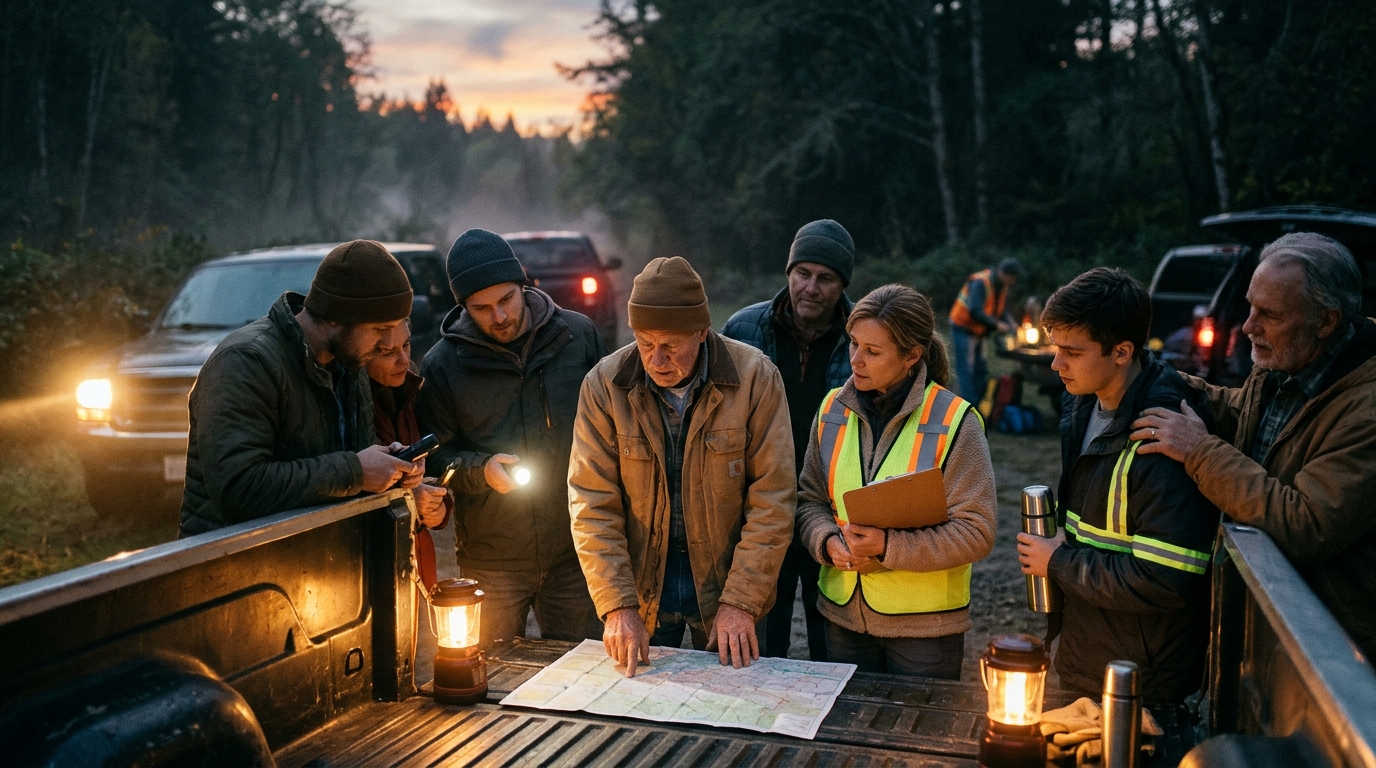
For a small group of volunteers in a mountain county, that hour is when the real work begins.
They are a ground search and rescue team, forty-one unpaid members who carry pagers on their belts at grocery stores, at birthday parties, and at their own kitchen tables. When someone goes missing in the hills, a hiker, a child who wandered from a campsite, an elderly man with memory loss who slipped out a back door, these are the people who put down their forks and go.
I spent an evening with the team to understand what drives people to walk into the dark for strangers. What I found was less about dramatic rescues and more about something quieter: a stubborn, tender refusal to leave anyone out there alone.
A Pager at Dinnertime
Marlene, the team’s longest-serving coordinator, has been doing this for twenty-six years. She told me the first thing a new volunteer learns is that the phone does not care what time it is.
“Most of our calls come in the evening,” she said, stirring a pot of coffee strong enough to stand a spoon in. “People set out in the afternoon thinking they have plenty of daylight. Then the light starts to go, the trail splits, and suddenly they are not sure which way is back. By the time someone realizes they are overdue, it is dusk.”
So the team learns to move fast when the world is slowing down. Packs stay by the door, already loaded. Headlamps are charged. A thermos sits ready on the counter. Every member knows that the first hours after dark are precious, and that the person waiting out there is probably cold, frightened, and listening for any sound that might mean help.
The Search That Taught Them Never to Quit
Every team has a story that shaped it. Theirs is about a retired schoolteacher named Walter, who walked out of his daughter’s home one October afternoon and did not return.
The first night, the team searched until dawn. The second day, they searched again. By the fifth day, official resources were stretched thin and the odds were not in anyone’s favor. Some people quietly began to use the word “recovery” instead of “rescue.”
Marlene refused to say it.
“His daughter kept leaving the porch light on,” she told me. “Every evening, she would stand there at dusk and just look at the tree line. I could not bring myself to tell her we were done when she had not stopped hoping.”
On the seventh evening, a volunteer named Dev was working a section of creek bed near the edge of the search area. The light was nearly gone. He was about to call it for the night when he noticed a flash of yellow, the cuff of a rain jacket, tucked beneath a rocky overhang.
Walter was alive. Dehydrated, bruised, and shivering, but alive. He had sheltered under that overhang for days, drinking from the creek, waiting.
“He told us later that every night he could see the headlamps moving along the ridge,” Marlene said, her voice softening. “He said it looked like a line of lanterns. He just kept telling himself that as long as the lanterns were out there, someone was still looking.”
The team has never forgotten that. They say it is the reason they keep going when the odds look thin.
What the Evening Teaches Them
When I asked the volunteers what the work has taught them, the answers came slowly, the way honest answers do at the end of a long day.
- Hope is a discipline, not a feeling. It is something you practice, especially when you are tired and the news is not good.
- Presence matters more than outcome. Even on searches that do not end the way anyone wants, families say the same thing: it meant everything that people came.
- Ordinary people are enough. No one on the team is a superhero. There are nurses, mechanics, accountants, a retired bus driver, a college student. They simply showed up.
- The dark is easier with company. A search line of strangers, spaced an arm’s length apart, calling a name into the trees, is one of the most human things imaginable.
The Quiet After the Call
What stays with me most is not the searching itself but what happens afterward.
When a search ends well, the volunteers do not cheer or celebrate. They gather their gear, check in on one another, and drive home through sleeping neighborhoods. Dev described it as a strange, soft kind of tired.
“You get home at midnight or two in the morning, and the house is quiet,” he said. “You stand in the kitchen with a glass of water and you think about that family hugging someone they thought they might lose. And you feel like the world is a little more held together than it was that morning.”
Many of the volunteers have a small ritual. Before bed, they look in on their own sleeping children, or call an aging parent, or simply step outside and look at the sky. It is their way of saying thank you for a night when everyone made it home.
How You Can Carry a Little of This Light
You do not have to join a search team to take something from their example. Here are a few gentle ways to bring that spirit into your own evenings:
- Check in on someone. A neighbor who lives alone, an older relative, a friend who has gone quiet. A five-minute call at dusk can be a lantern in someone’s dark.
- Leave your own porch light on. Literally or figuratively. Be the kind of person someone could find their way back to.
- Support local volunteers. Search and rescue teams run on donations and goodwill. Gear, training, and fuel all cost money, and even small gifts matter.
- Tell someone where you are going. If you hike, always share your route and expected return time. It is the single most helpful thing you can do for those who might one day come looking.
- Practice not giving up on people. In a world quick to move on, staying present with someone through a hard stretch is its own kind of search and rescue.
Until Everyone Is Home
As my evening with the team wound down, the pager on Marlene’s belt stayed silent. She seemed almost surprised by the quiet. She walked me to the door, and we stood for a moment watching the last of the light drain from the ridge.
“People ask me when we stop,” she said. “The answer is that we do not, not really. Even when a search is officially over, somebody is still thinking about it. Somebody is still hoping.”
Out past the trees, somewhere in the gathering dark, a hiker was probably settling into a campsite, safe and warm. A child was being tucked in. An old man was drifting off to sleep in his own bed, his daughter’s porch light glowing nearby.
And a few miles away, a pager sat on a kitchen counter, charged and waiting, ready to carry someone out into the night the moment it was needed.
Tonight, as the day settles and the house grows quiet, take a moment to be grateful for the people who keep watch so the rest of us can rest. And if you can, be a little lantern for someone else.