🎧 Listen to this story
Narrated by Kore · 7,079 characters
There is a particular hour in Marlow Creek when the hardware store sign clicks off, the diner flips its sign to Closed, and the long ridge road goes quiet. For most people in town, that is when the day finishes. For Dr. Walter Ames, it is often when the real work begins.
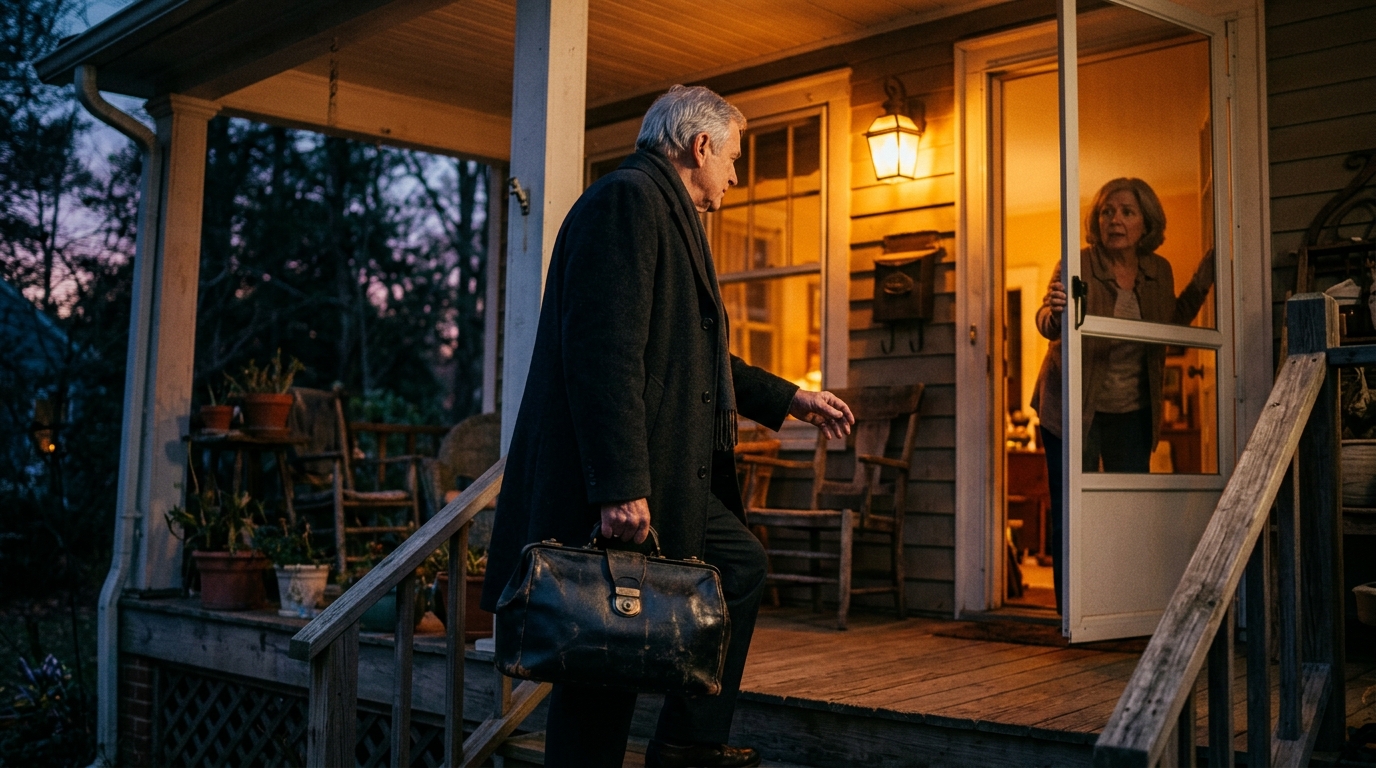
For forty years, Dr. Ames has answered his phone after dark and driven out to the sick. He has never once said no. Not in blizzards, not on Christmas Eve, not on the night his own daughter was born. This is the story of the man with the worn leather bag, told through the people who have watched his headlights turn up their driveways.
A Habit Born on a Single Night
It began in the winter of 1984, his second year in practice. A farmer’s wife called at nine o’clock to say her husband had been short of breath since supper, but the roads were glazed with ice and the ambulance was forty minutes out. Walter was tired. He had seen thirty patients that day. He remembers sitting on the edge of his bed with one boot on.
He went. The husband had pneumonia, advanced and frightening, and Walter stayed until the ambulance came, holding an oxygen mask steady and talking about nothing in particular to keep the man calm. Driving home near midnight, he made a quiet decision that he never announced to anyone: if someone in this town needed him, he would come.
“I did not think of it as a vow,” he says. “I thought of it as a Tuesday. Then it just kept being Tuesday.”
What an Evening House Call Actually Looks Like
Ask Dr. Ames what separates a house call from a clinic visit and he will tell you the difference is the kitchen table. In an exam room, a person is a patient. In their own home, with the dog nosing at your knee and a half-finished crossword on the counter, they are a whole human being. He learns things after dark that never surface under fluorescent light.
Here is how a typical late call unfolds, as described by the nurses and neighbors who have ridden along over the years:
- The phone rings. Usually between seven and eleven at night, often a worried family member whispering so as not to alarm the patient.
- The porch light. Families learned long ago to switch it on as a signal. When Walter sees it from the road, he knows he is expected.
- The sit-down. Before he opens the bag, he asks about the day. Who has been by. Whether they have eaten. He says the story of an illness usually begins hours before the symptoms.
- The quiet exam. Lamp on low, voice lower. He has delivered news at kitchen tables that would have felt unbearable in a cold office.
- The tea. More often than not, someone presses a mug into his hands. He accepts every one.
The Evening Hours Hold Their Own Kind of Honesty
People speak differently once the sun is down. The performance of being fine, which holds up so well in daylight, begins to slip. A man who insisted all week that his chest pain was nothing admits, in the lamplight, that he is scared. A widow who says she is managing fine confesses she has not slept properly since March.
Walter has built his career on that honesty. “The night strips away the small talk,” he says. “Everybody is a little more truthful at ten p.m. than at ten a.m. You can hear what they are really saying.”
Marguerite Dell, eighty-six, remembers the evening he came to sit with her husband in his final weeks. “He did not have to stay past the examination,” she says. “He stayed for two hours. He talked to Harold about fishing. When Harold fell asleep, Walter sat with me in the kitchen and did not say a word, and I have never been so grateful for silence.”
The Cost Nobody Sees
It would be easy to turn this into a legend with no shadows, but Walter is quick to say the work has asked things of his family. His wife, Eleanor, learned early to keep dinner warm and to stop asking when he would be home. Dinners were interrupted. Anniversaries were rescheduled more times than either can count. His daughter, now grown, recalls falling asleep to the sound of the front door closing softly at night and waking in the morning to find him back, boots by the door.
“I used to resent the phone,” she admits. “Then I got older and understood that every ring was somebody’s worst night. He was the one person who could make it a little less terrible. How do you resent that?”
Eleanor puts it more simply. “I married a man who cannot walk past someone in need. I knew that from the start. It would be strange to wish him different now.”
Forty Years in Numbers and in Faces
No one has an exact count, but the people of Marlow Creek have done the rough math. Roughly one after-hours call a week, fifty weeks a year, for four decades. Well over two thousand evenings spent in other people’s living rooms.
The numbers matter less than the faces. A toddler with a fever so high her parents could not stop shaking. A retired mail carrier who fell in his garden at dusk. A teenager in the middle of an asthma attack on the night of the homecoming game. A family who simply needed someone to tell them that the breathing they were hearing from their grandmother was peaceful, and that it was all right to let her go.
What the Town Does in Return
Marlow Creek has never found a way to pay Walter back, so it does the small things. Casseroles appear on his porch without a note. Someone shovels his driveway before dawn. Every December, a card arrives from a family he helped decades ago, usually with a photograph of a grown child who might not be here otherwise.
He keeps the cards in a shoebox in the hall closet. He does not display them. He says he looks at them on the nights when the phone does not ring and the house is very still.
Lessons That Settle In When the Day Goes Quiet
When asked what he has learned in forty years of driving through the dark, Walter hesitates, then offers a few thoughts he says he has never told anyone before:
- Showing up is most of it. Medicine matters, but presence matters first. A frightened person needs to know someone has come.
- Nobody should face the night alone. The scariest hours are the ones with no one beside you.
- Small kindnesses compound. A tired man in a car at ten p.m. became, over decades, the reason a whole town feels held.
- You never know whose night you are saving. Sometimes the best thing you do all day happens after everyone else has gone to bed.
An Evening Reflection for You
As the lights go down tonight, consider the people in your own life who answer the phone when it rings late. The friend who picks up on the second ring. The neighbor who notices your porch light on too long. The parent, the nurse, the stranger who stays. Heroes rarely announce themselves. They simply turn up, boots by the door, bag in hand, quietly changing the shape of someone’s longest night.
Dr. Ames is seventy-one now. He says he is thinking about slowing down. Then the phone rings, and he reaches for his coat.
Tonight, somewhere on a dark road outside Marlow Creek, a pair of headlights is turning toward a porch with its light switched on. Inside, someone is waiting, a little less afraid than they were an hour ago, because they know who is coming.