🎧 Listen to this story
Narrated by Leda · 7,838 characters
When the Waters Rose, One Man Made a Different Choice
Most people watched the news coverage of the flooding in Harlan County, Kentucky, from their living rooms. They shook their heads, maybe donated to an online fund, and went back to their evening routines. Gary Mullins watched the same footage, but he did something different. He got up, picked up his phone, and started making calls.
Gary is a 54-year-old long-haul truck driver from Corbin, Kentucky. He has spent the last 28 years behind the wheel of an 18-wheeler, hauling freight across state lines for a modest wage. He is not wealthy. He is not famous. He does not have a nonprofit organization behind him or a sponsor cutting checks. What he does have is a Class A commercial license, a deep familiarity with the back roads of Appalachia, and what his wife Linda describes as “a stubborn refusal to look away.”
In August 2022, catastrophic flooding tore through eastern Kentucky, killing dozens of people and displacing thousands more. Roads were washed out. Bridges collapsed. Entire communities were cut off from the outside world. Government aid was slow to arrive in the more remote hollows, and many families found themselves waiting days without clean water, food, or dry clothing.
Gary was not waiting.
Loading Up on His Own Time
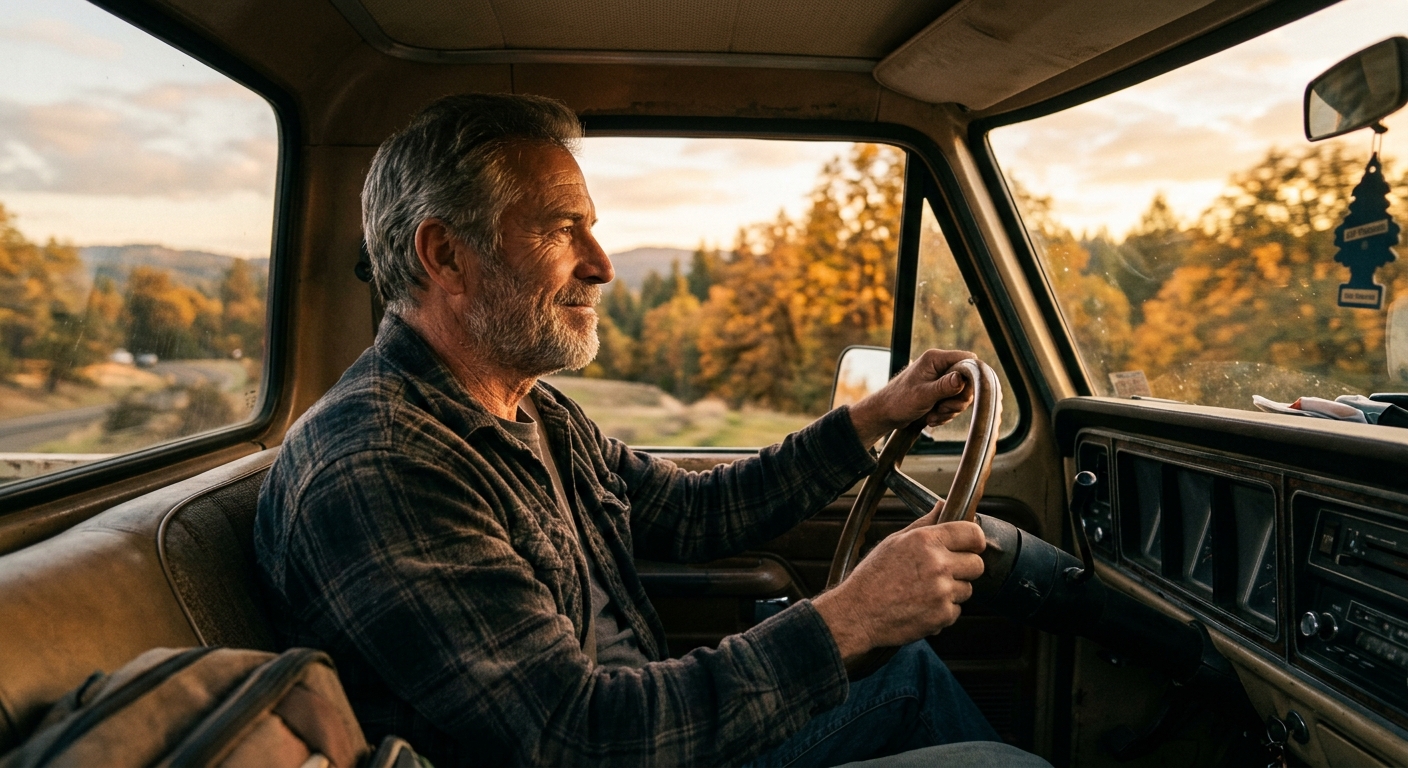
Within 48 hours of the flood hitting the news, Gary had already spent $1,200 of his own savings on supplies. He stocked up on bottled water, canned goods, diapers, baby formula, first aid kits, work gloves, and tarps. He called his dispatcher and used two weeks of saved vacation time. Then he drove his personal pickup truck, a battered 2009 Ford F-250 with 190,000 miles on it, straight into the flood zone.
“People kept asking me, ‘Why are you doing this? You don’t even know these people,'” Gary recalled in a conversation with a local reporter from the Harlan Daily Enterprise. “And I thought, what kind of answer is that supposed to be? You don’t have to know somebody to care about them.”
He made three separate trips over the course of ten days, each time loading the truck bed high with donations he had collected from neighbors, co-workers, and a GoFundMe campaign his daughter set up after she posted about his first trip on Facebook. That post went viral almost overnight.
Getting Where Others Could Not
What set Gary apart from many well-meaning volunteers was not just his willingness to show up, but his ability to navigate terrain that stopped other relief efforts cold. Decades of driving through Appalachian mountain routes meant he knew alternate paths, old logging roads, and river crossings that were not on most GPS systems.
“He got to places that even some of the emergency responders hadn’t reached yet,” said Donna Fields, a volunteer coordinator with a local Baptist church that partnered with Gary on his second trip. “He just knew those mountains. He grew up around them. That knowledge was as valuable as any truckload of supplies.”
On his second trip, Gary reached a small community called Bledsoe where roughly 40 families had been completely isolated for five days. Many of the elderly residents had run out of medications. Gary had thought ahead. Before leaving Corbin, he had stopped at a local pharmacy and worked with the pharmacist to identify the most commonly needed emergency medications, picking up supplies that could be distributed through a nurse who had stayed behind with the community.
What He Found When He Got There
Gary has never been a man of many words, but he has spoken openly about what he witnessed during those ten days. The stories stay with him.
- An 80-year-old woman named Ruth who had not eaten a hot meal in four days and cried when he handed her a package of crackers and peanut butter, apologizing for not having something better.
- A father of three who had lost his house but refused to leave because his neighbor, a disabled veteran, could not evacuate on his own. Gary helped both men get to higher ground.
- A community center that had become an informal shelter, staffed entirely by local volunteers running on no sleep, who broke down in tears when Gary pulled up with a truckload of supplies and four friends he had recruited to help unload.
“There were moments where I had to sit in the truck for a minute and just breathe,” Gary said. “Not because it was too much to handle, but because I was overwhelmed by how much people were helping each other even in the middle of losing everything. I wasn’t the story. They were.”
The Community That Carried Him Back
By the time Gary’s story spread across social media, donations to his GoFundMe had topped $47,000, far more than he ever expected. True to his character, he did not keep a single dollar for himself. Every cent went toward supplies, fuel, and coordinating with local organizations on the ground in Harlan County.
“He was almost embarrassed by the attention,” said his daughter Kayla, who helped manage the campaign. “Dad kept saying, ‘Tell people to donate to the Red Cross or the local churches, not to me.’ We had to convince him that people wanted to support what he specifically was doing because it was working in ways that larger organizations weren’t.”
Gary’s employer, a regional freight company, heard about his efforts and offered to let him use one of the company’s smaller box trucks for his third trip at no cost. Three of his fellow drivers volunteered their own time to come along. What started as one man in a pickup truck became a small convoy by the end.
What We Can Learn From Gary Mullins
Gary’s story is not a complicated one, and maybe that is exactly the point. It does not require a foundation, a social media following, or the right connections to make a difference. It requires noticing, deciding, and moving.
Here are a few things his story quietly teaches us:
1. Skill Is a Form of Generosity
Gary did not just bring supplies. He brought decades of specialized knowledge about roads, terrain, and logistics. Whatever you are good at, there is a crisis somewhere that needs exactly that skill.
2. Vacation Time Is a Resource
He used two weeks of saved paid time off to do this. No one can argue they don’t have assets to give when Gary Mullins cashed in his vacation days to drive into a flood zone.
3. You Don’t Need Permission
Gary didn’t wait for an organization to recruit him, assign him a role, or hand him a vest with a logo on it. He identified a need, assessed what he could contribute, and went.
4. Proximity Matters
He knew those roads. He knew those communities. Local knowledge and geographical closeness are genuinely powerful advantages in disaster relief, and they belong to ordinary people, not just agencies.
5. Humility Multiplies Impact
Because Gary kept redirecting attention back to the flood victims and the local volunteers, people trusted him more, donated more, and joined him. He was not building a brand. He was solving a problem.
Still Driving, Still Watching
Gary Mullins is back on the road now, hauling freight across interstate highways the same way he has for nearly three decades. He checks in occasionally with some of the families he met during those ten days in August. A few have rebuilt. Some are still struggling. He sent Christmas boxes to three of them last December, quietly, without announcing it anywhere.
When asked if he would do it again, his answer was immediate: “Already have. There was a bad ice storm in January. Loaded up the truck again.”
He laughed a little when he said it, the way people laugh when something seems obvious to them that the rest of the world is still trying to figure out.
Maybe the lesson in all of this is not that Gary Mullins is extraordinary. Maybe the lesson is that he decided, very deliberately, not to be ordinary in the moment it counted most. And that is a decision every single one of us gets to make.