🎧 Listen to this story
Narrated by Sulafat · 7,296 characters
A Small Gesture That Stopped a Town in Its Tracks
It started with an umbrella and an old woman named Dorothy.
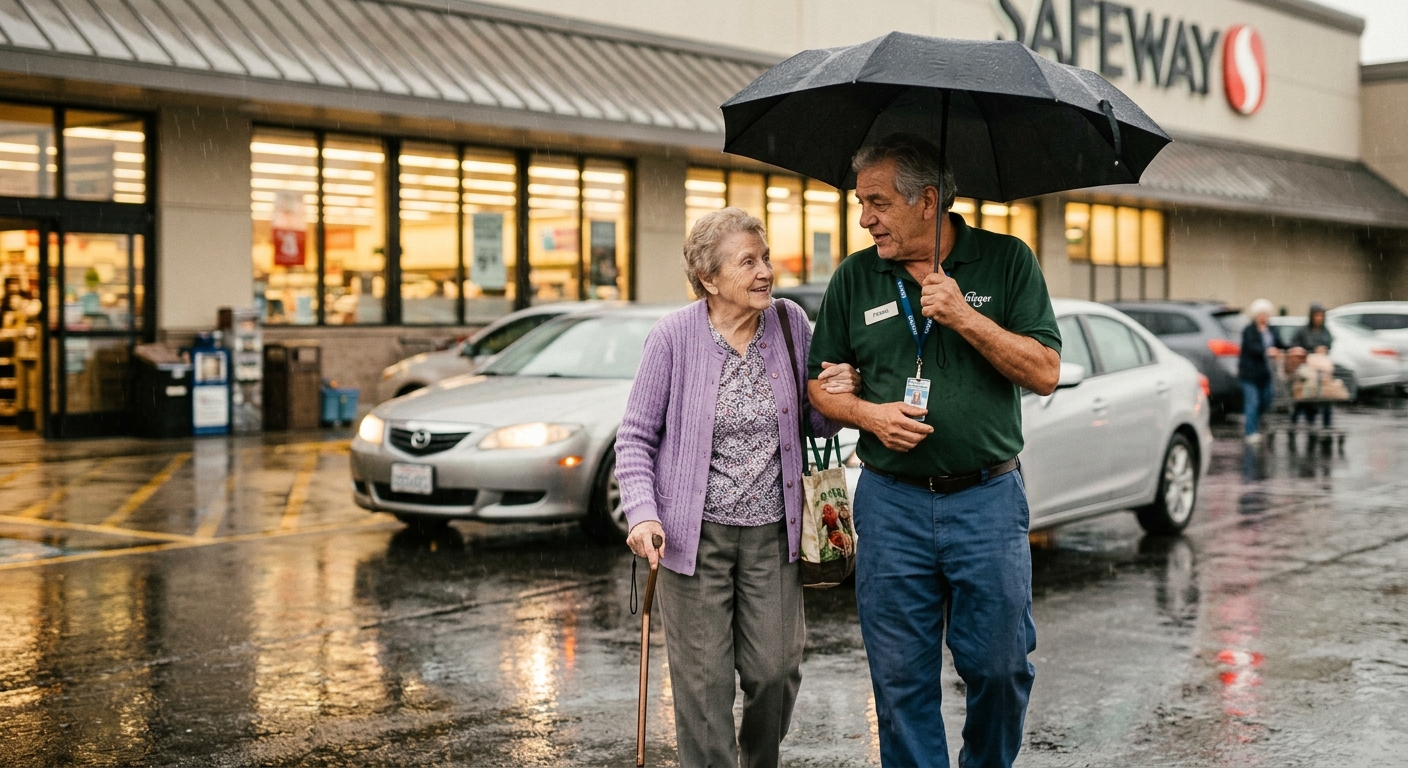
On a Tuesday afternoon in early November, the rain came down hard on the parking lot of a mid-sized grocery store in Asheville, North Carolina. Dorothy, 81 years old, stood just inside the sliding glass doors with two bags of groceries, a cane, and no umbrella. She had been standing there for about ten minutes, watching the rain bounce off the asphalt, calculating the risk of making a dash for her car. She was still calculating when Marcus Webb, a 34-year-old grocery store employee, appeared beside her with a large store umbrella and a simple question.
“Can I walk you to your car, ma’am?”
Dorothy later told her daughter it was the kindest thing a stranger had done for her in years. Her daughter posted about it on a local Facebook group. Within 48 hours, the post had been shared over 4,000 times. Marcus, who had no idea any of this was happening, showed up for his Wednesday shift to find a handwritten thank-you card taped to his employee locker.
But here is the thing about Marcus Webb: Dorothy was not the first. And she would not be the last.
A Habit Built Quietly, One Rainy Day at a Time
Marcus has worked at the store for nearly six years, most of that time in the role of floor supervisor. His responsibilities include managing stock, coordinating staff, handling customer complaints, and generally keeping things running smoothly. None of those job duties include walking elderly customers through a rainstorm to their vehicles.
He does it anyway.
“I just noticed it kept happening,” Marcus explained during a conversation with a local reporter who tracked him down after the Facebook post went viral. “Older folks would come in, get their groceries, and then just kind of freeze at the door when it was raining. You could see it on their faces. That parking lot is slippery. Some of them have walkers or canes. Some of them just aren’t steady on their feet anymore. And I thought, I have an umbrella. I have two legs that work fine. Why would I not just walk them out?”
It sounds simple. And in many ways, it is. But the consistency of it, the quiet, unremarkable way Marcus does it every time without being asked, without expecting recognition, without making a fuss, is what has turned a small act into something that feels genuinely rare.
What the Customers Say
After the post circulated, several regular shoppers came forward with their own stories of being walked to their cars by Marcus. A few of their accounts are worth sharing directly.
“He didn’t treat me like I was fragile”
Gerald, 77, a retired schoolteacher, remembers the first time Marcus walked him out. “I was fumbling with my cart and the rain was coming sideways. He just appeared. Took my bags without asking, held the umbrella over both of us, and walked me right to my trunk. Loaded everything in. The thing I remember most is that he talked to me the whole time like a normal person. Asked about my jacket, said he liked the color. He didn’t treat me like I was fragile or a burden. He just treated me like a person worth a few extra minutes of his time.”
“I cried on the way home”
Ruth, 84, had a harder time putting it into words. “I don’t drive anymore,” she said. “My grandson drops me off and picks me up. Sometimes the timing doesn’t work out and I’m waiting. One time Marcus stayed with me under that umbrella for almost fifteen minutes until my grandson pulled up. We talked about the weather and about a pie I was planning to make. When my grandson finally came and I got in the car, I just cried. Not because I was sad. Just because someone had been so patient and so kind and it had been a while since I felt that.”
The Ripple Effect Inside the Store
Something interesting has happened since Marcus’s habit became known among the staff. Other employees have started doing it too.
The store manager, Priya Anand, noticed the shift. “Marcus never told anyone to do it. He never made an announcement or sent an email. He just did it, and people saw him doing it, and slowly it became something we all do now. We keep two umbrellas by the front door specifically for this purpose. It’s not in any training manual. It just became part of our culture because one person decided it was the right thing to do.”
That is, arguably, how most good cultures are built: not through policy memos, but through visible example.
7 Things Marcus’s Story Teaches Us About Everyday Kindness
- You don’t need a title to lead. Marcus is not the CEO. He is not running a nonprofit. He is a floor supervisor who decided to notice something and respond to it.
- Consistency is what separates a gesture from a character trait. Anyone can hold an umbrella once. Doing it every rainy day, for years, tells you something deeper about who a person is.
- Kindness is contagious when it is visible. Marcus never gave a speech about compassion. He just acted compassionately where others could see him, and others followed.
- Elderly people are often invisible in public spaces. Marcus saw Dorothy when she was standing at those doors being overlooked by everyone else. Seeing people who have been made to feel invisible is itself a form of kindness.
- Small acts land differently depending on the season of life you are in. For a young, healthy person, a walk through the rain is an inconvenience. For an 84-year-old with a cane, it can feel like an impossible obstacle. Context matters.
- You don’t need to make it a big deal to make it meaningful. Marcus doesn’t announce himself. He doesn’t ask for thanks. He just walks beside people. That quiet, unpretentious approach is a big part of why it resonates so deeply.
- Gratitude travels further than we think. Dorothy’s daughter posted on Facebook. Four thousand people shared it. Ruth told her church group. Gerald told his son. One umbrella held over one elderly woman rippled outward in ways Marcus never could have predicted.
Why This Story Hits Different Right Now
We live in a moment that can feel exhausting and fragmented. News cycles compete for our worst instincts. Social media rewards outrage over warmth. And yet, stories like Marcus’s spread just as fast, sometimes faster, because they meet a hunger in people that the other stuff simply cannot satisfy.
We want to believe that most people are decent. We want evidence of it. Marcus Webb, standing in a parking lot rain with an umbrella held steady over someone else’s head, is that evidence. Multiply him by the thousands of quiet, unrecognized acts of care happening every single day in grocery stores, bus stops, hospitals, and sidewalks across the country, and you get a fuller picture of who we actually are.
What You Can Take From This Today
You probably won’t go viral. You probably won’t end up in a Facebook post with 4,000 shares. That is not the point.
The point is Dorothy standing at the door for ten minutes, calculating the risk of the rain. The point is Ruth crying in her grandson’s car, not from sadness but from relief and gratitude. The point is Gerald, who remembered the color of his jacket being noticed, because it meant someone was paying attention.
Look around you today. Who is standing at the door, watching the rain, hoping someone will notice?
You might already have the umbrella.