
🎧 Listen to this story
Narrated by Vindemiatrix · 8,868 characters
A Prescription Nobody Expected
When Cleveland-based landscape architect Dana Merrill first walked the sterile corridors of Lakeview Regional Medical Center in 2019, she wasn’t there to redesign a lobby or plant a few decorative shrubs near the entrance. She had been hired to do something far more ambitious: transform a barren, unused courtyard in the heart of the hospital into a fully functioning healing garden, accessible to patients, nurses, visiting families, and anyone else who needed it.
The hospital administration had been skeptical. Gardens cost money. Gardens require maintenance. And most critically, hospital administrators wanted to know: does greenery actually make people get better faster? Or was this just a feel-good initiative with no measurable impact?
What unfolded over the next three years gave them their answer, and it was one that quietly rewrote how the medical team thought about recovery itself.
The Science Behind the Soil
Before a single seed was planted, Merrill and the hospital’s chief wellness officer, Dr. Patricia Huang, spent months reviewing research. What they found was more compelling than either of them had anticipated.
Studies from institutions including Stanford University and the University of Exeter had been documenting for years what researchers call “restorative environments”: natural spaces that measurably reduce cortisol levels, lower blood pressure, and even shorten post-surgical recovery times. One landmark study published in the journal Science found that patients recovering from gallbladder surgery who had a window view of trees required significantly fewer painkiller doses and were discharged nearly a full day earlier than those with a view of a brick wall.
“We were not guessing,” Dr. Huang recalls. “The data had been sitting there for decades. We just finally decided to act on it.”
What the Research Told Them
- Reduced pain perception: Natural settings activate the parasympathetic nervous system, which helps the body shift out of the stress response and tolerate discomfort more effectively.
- Improved sleep quality: Patients with access to natural light and outdoor environments reported better sleep, which directly accelerates healing.
- Lower anxiety and depression rates: Post-surgical depression is a documented phenomenon, and exposure to nature has been shown to meaningfully reduce its prevalence.
- Staff burnout reduction: Healthcare workers who took even short breaks in green spaces reported significantly lower burnout scores on standardized assessments.
Armed with this research, the hospital approved a budget and gave Merrill and her team a six-month timeline.
Building Something That Actually Heals
The courtyard they were working with was not glamorous. It was roughly the size of a tennis court, paved almost entirely in concrete, and had been used primarily for storage. But it caught afternoon light beautifully, and that detail alone, Merrill says, made her certain it could be transformed.
The design process involved input from a surprisingly wide range of voices. Oncology nurses were asked what their patients said they missed most when they were hospitalized for long stretches. A palliative care coordinator described what families sitting vigil needed. A physical therapist outlined what walking surfaces would work for patients relearning to use their limbs. Even the kitchen staff weighed in when a proposal for an herb garden was floated.
“We didn’t want it to feel like a decoration,” Merrill explains. “We wanted it to feel like it belonged to the people inside that building.”
What the Garden Included
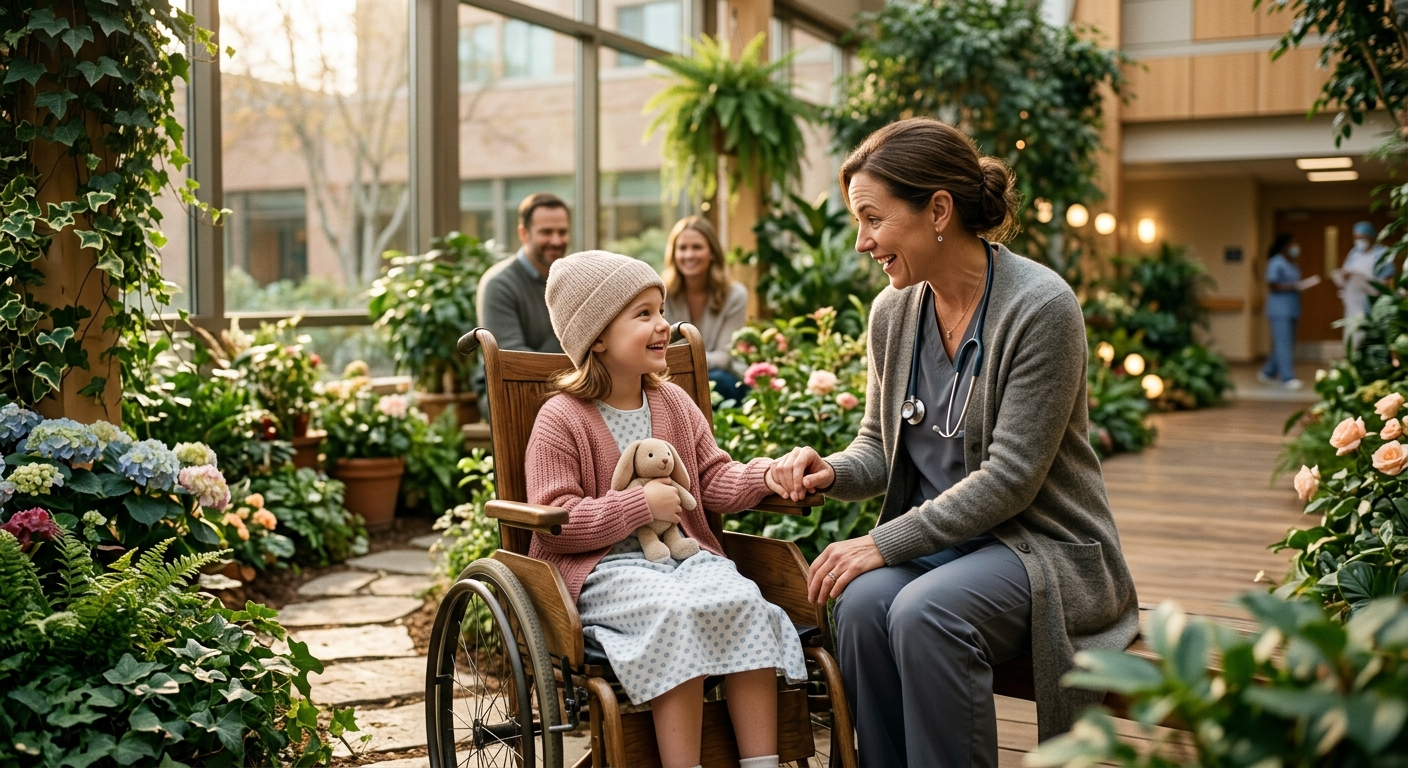
When it opened in the spring of 2021, the Lakeview Healing Garden featured several distinct zones, each serving a different purpose:
- A sensory walk: A winding path bordered by lavender, rosemary, and ornamental grasses that engaged smell, touch, and sound as patients walked slowly through it, often with a physical therapist beside them.
- A quiet reflection area: Shaded seating near a small recirculating water feature, designed for patients, families, or staff who needed a few minutes of stillness.
- A raised herb garden: Accessible at wheelchair height, tended jointly by volunteer master gardeners and interested patients, several of whom had no gardening experience and found it unexpectedly therapeutic.
- A light therapy corridor: A pergola-covered walkway specifically designed to maximize exposure to natural light during daylight hours, in consultation with the hospital’s psychiatry unit.
- Open lawn space: A simple, soft-grass area where families could sit together without the formality of a waiting room.
The Results That Followed
The hospital began tracking outcomes carefully from the day the garden opened. After eighteen months of data collection, the results were shared at a regional healthcare symposium, and they drew significant attention.
Among patients on the oncology and post-surgical floors who had direct access to the garden or garden-view windows, average length of stay decreased by 0.8 days compared to the equivalent patient population from the prior year. While that may sound like a minor figure, hospital administrators noted that across hundreds of patients, it translated into both substantial cost savings and, more importantly, faster returns to home and family.
Pain medication requests among patients who used the garden at least once daily dropped by 14 percent compared to those who did not. The palliative care unit reported that family members of patients in end-of-life care described their experience as “more peaceful” and “less clinical” in post-visit surveys, a qualitative shift that meant a great deal to the staff who worked that floor every day.
Perhaps most surprisingly, nurse retention on the units adjacent to the garden improved measurably. Staff turnover, a persistent crisis in hospitals nationwide, dropped by 22 percent on those floors in the first full year after the garden opened. Nurses cited the ability to take breaks outdoors as one of the factors they mentioned most frequently in exit and stay interviews.
The Human Stories Behind the Numbers
Statistics tell part of the story. The people inside the hospital tell the rest.
One patient, a 67-year-old retired school principal named Margaret, was recovering from a double mastectomy when a nurse suggested she spend twenty minutes in the herb garden the morning after her surgery. She was hesitant. She was tired, scared, and still in considerable discomfort. But she went.
“I sat down next to the rosemary,” she said later, in a letter she sent to the hospital, “and I rubbed one of the stems between my fingers and smelled it, and for the first time in three days I forgot, just for a moment, that I was sick. I was just a person in a garden. That moment kept me going for the rest of my recovery.”
There was also a young nurse named Tomás, who had been considering leaving the profession entirely after his third year. The pandemic years had hollowed out his reserves in ways he struggled to articulate. He started taking his lunch breaks in the garden’s quiet reflection area, sometimes alone, sometimes with a colleague. “It sounds small,” he says. “But it became the thing that let me keep showing up.” He is still working at Lakeview today.
What Other Hospitals Are Watching
Lakeview’s model has since attracted the attention of healthcare planners in several other cities. Representatives from hospital networks in Atlanta, Portland, and Toronto have visited the courtyard, asked questions, and taken notes. Two comparable projects are currently in planning stages, directly inspired by what happened in that once-forgotten courtyard.
Dr. Huang, who has now presented the findings at three national conferences, is careful to be precise about what the garden is and is not. “This is not a cure,” she says clearly. “It does not replace surgery or medication or the extraordinary work of every person on this medical team. What it does is create conditions in which the human body and the human spirit can do what they are already trying so hard to do: heal.”
A Lesson Written in Leaves
There is something quietly radical about what Lakeview did, though it doesn’t look radical from the outside. It looks like a garden. It looks like lavender and a small fountain and a wooden bench under a pergola.
But beneath that ordinary surface is an extraordinary act of institutional listening: a hospital that asked what its patients, families, and staff actually needed and then built it, one raised planter and one gravel path at a time.
The lesson is not only for hospitals. It is for anyone responsible for any space where people spend time while they are vulnerable, frightened, or worn thin. The question is always the same: what does this place need to feel more human?
Sometimes the answer is simpler, and more alive, than we expect.