
🎧 Listen to this story
Narrated by Orus · 6,824 characters
A Small Detail That Made All the Difference
Most of us move through our days without truly seeing the world around us. We glance at our phones, rush to our cars, and wave hello without really stopping to look. But for Margaret Hollis, a retired schoolteacher living in a quiet suburb of Columbus, Ohio, paying attention to the small things had always been second nature. And on a gray Tuesday morning in November, that habit saved her neighbor’s life.
This is not a dramatic story of a hero running into a burning building. It is something quieter, and in many ways, more powerful: the story of a woman who simply noticed, and then acted.
The Curtains That Didn’t Move
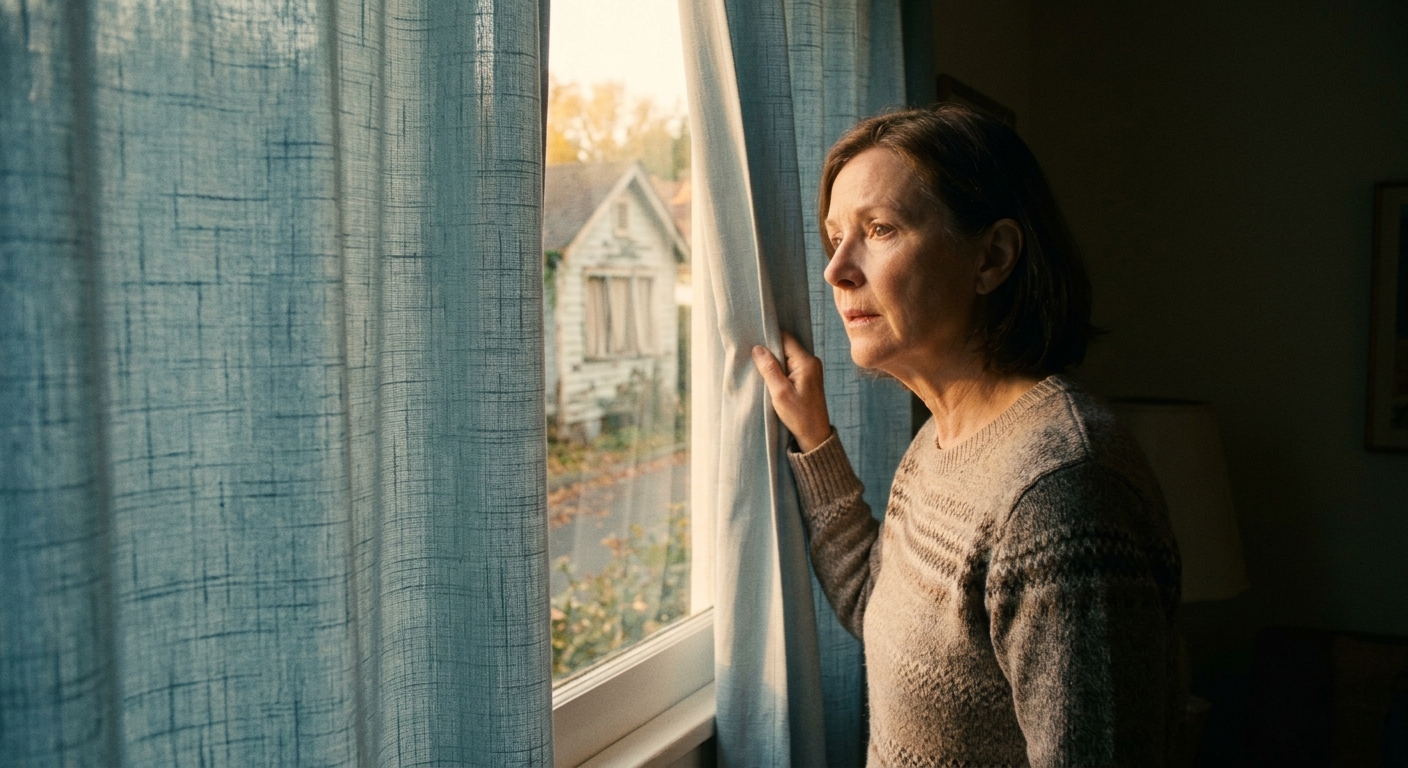
Margaret had lived next door to Frank Dempsey for eleven years. Frank was 74, a widower, and a man of almost clockwork routine. Every morning, without fail, his living room curtains would part at around 7:30 a.m. He would stand briefly at the window with his coffee mug, sometimes giving a little nod if he spotted Margaret heading to her mailbox. It was a small ritual, but one she had come to count on without ever really thinking about it.
On that particular Tuesday, the curtains stayed closed.
“I noticed it around nine,” Margaret recalled. “I told myself not to be silly, that he’d probably just slept in. But by ten-thirty, something in my gut wouldn’t let it go.”
She knocked on his door. No answer. She knocked again, louder this time. Still nothing. She called his cell phone and heard it ringing faintly from inside the house. That was the moment she dialed 911.
What Emergency Responders Found
Paramedics arrived within eight minutes. Using the spare key Frank had once given Margaret “just in case,” they entered to find him on the kitchen floor, conscious but barely. He had suffered a significant stroke sometime in the early hours of the morning and had been lying there for hours, unable to move or call for help.
The medical team was clear in their assessment: had Margaret waited even another hour or two, the outcome would likely have been very different. In stroke cases, every minute of delayed treatment can mean permanent damage. The phrase doctors use is “time is brain,” referring to the approximately 1.9 million neurons that die every minute a stroke goes untreated.
Frank spent three weeks in rehabilitation. Today, he walks with a cane and has some weakness on his left side, but he is home. He is alive. He still drinks his morning coffee, and yes, he still opens his curtains.
Why We Stop Seeing Each Other
Stories like Margaret and Frank’s have become increasingly rare, not because people are unkind, but because the architecture of modern life has quietly dismantled the everyday proximity that once made neighborhoods feel like communities.
Consider how much has changed in just a few decades:
- Fences have grown taller and hedges thicker, creating physical buffers between homes.
- Garage doors mean many people never actually walk out their front doors.
- Screen-based entertainment keeps people inside and insulated.
- Remote work has removed the rhythm of morning departures and evening returns that once gave neighbors cues about each other’s lives.
- Earbuds and smartphones signal “do not disturb” even in shared spaces.
None of these things are inherently bad. But collectively, they have reduced the incidental contact that once formed the connective tissue of community life. And in reducing that contact, we have reduced our awareness of one another.
The Concept of Passive Surveillance (And Why It Matters)
Urban planners and sociologists have a term for the kind of informal watchfulness that exists in healthy communities: passive surveillance. It describes the way neighbors naturally keep an eye out for one another simply by going about their lives, noticing when something looks off, when a pattern breaks, when a curtain stays closed.
It is not nosiness. It is not intrusion. It is the quiet background hum of human beings who are aware that they share a world with other human beings.
Margaret never thought of herself as Frank’s guardian. She was just his neighbor. But because she paid attention, she was in a position to act when it mattered most.
What We Can All Learn From This
You do not need to form a formal neighborhood watch or download a community safety app to make a difference. Sometimes the most life-saving thing you can do is simply be present and aware. Here are some small, practical ways to cultivate the kind of attentiveness that Margaret demonstrated:
1. Learn Your Neighbors’ Routines
You do not need to be best friends with the people on your street. But knowing that the elderly gentleman next door always gets his newspaper before 8 a.m., or that the young woman across the street always walks her dog at noon, gives you a baseline. When that baseline shifts, you notice.
2. Introduce Yourself to Elderly or Solo Neighbors
People who live alone, particularly older adults, are statistically more vulnerable to undetected medical emergencies. A simple introduction, a brief conversation, and an exchanged phone number can create a lifeline that costs nothing.
3. Trust Your Gut
Margaret almost talked herself out of calling for help. She worried about being “too nosy” or overreacting. This is an incredibly common hesitation, and it costs lives. If something feels wrong, it is always better to make the call and be embarrassed than to stay silent and be haunted.
4. Share a Key or an Emergency Contact
Frank had given Margaret a spare key years earlier, half-jokingly, after locking himself out. That key made all the difference. Consider whether there is someone in your life, or someone on your street, with whom this kind of simple arrangement could be made.
5. Check In After Irregular Weather or Events
After storms, heat waves, or any disruption that might affect vulnerable neighbors, a knock on the door or a quick phone call is a small act with potentially enormous impact.
Frank’s Words
When asked what he would say to Margaret if he could find the right words, Frank Dempsey was quiet for a moment. Then he smiled and said, “I’d tell her she was being nosy. And then I’d thank God she was.”
Margaret laughed when she heard that. “He’s still ornery,” she said. “That tells me he’s going to be just fine.”
The Takeaway
This story is not really about a dramatic rescue. It is about the profound and underestimated power of simply paying attention to the people around you. It is about how an eleven-year habit of noticing a small, mundane detail became the difference between life and death.
We live in a world that constantly asks us to look at screens, to optimize our time, to stay in our lanes. But every now and then, the most important thing we can do is look up, look around, and notice the curtains that haven’t been opened yet.
You might just save someone’s life.