🎧 Listen to this story
Narrated by Kore · 6,818 characters
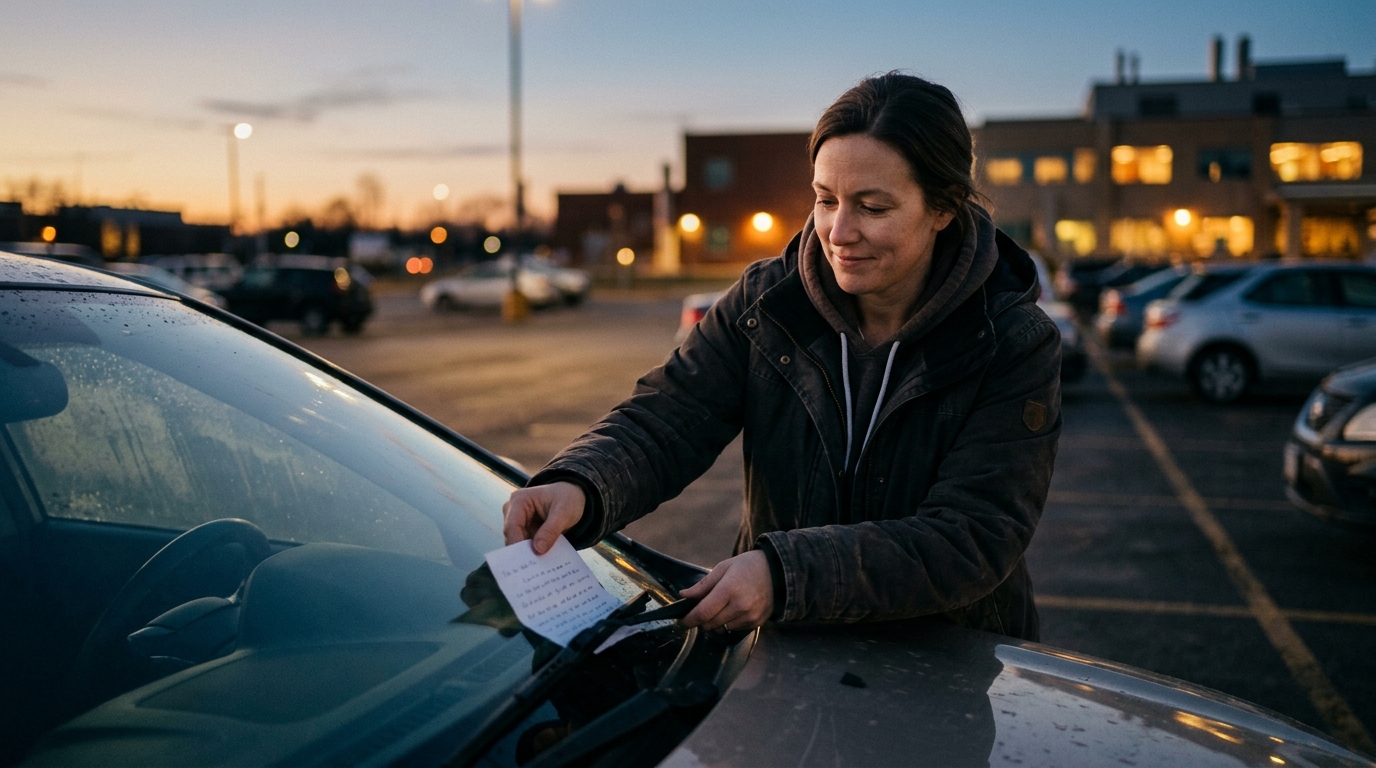
The parking structure at a regional hospital does not look like a place where anything tender happens. It is concrete and fluorescent light and the low hum of ventilation. But if you walk through Level 3 around nine in the evening, just as the day visitors thin out and the sky outside turns the color of weak tea, you might catch a woman moving slowly between the cars, tucking small folded squares of paper beneath the windshield wipers.
Her name is Marguerite, and she has been doing this, by her own count, for just over three years.
How It Started on the Worst Night
Marguerite is a retired school librarian, and she did not set out to become anyone’s quiet hero. Her husband spent forty-one days in that hospital after a stroke. She remembers the parking structure better than she remembers some of the doctors’ faces, because it was the place where she sat in the car at the end of every visit and could not make herself turn the key.
“You do all your being brave upstairs,” she told me when we spoke. “Then you get to the car, and the bravery just runs out. I would sit there with my hands on the wheel in the dark and cry until I could drive.”
One night, she came out to find a small yellow sticky note on her windshield. It was not from the hospital. It was not an advertisement. In slanted, hurried handwriting it said: Whoever you’re here for, I hope tonight they sleep well. You are doing better than you think.
She never found out who wrote it. She kept it folded in her wallet for the rest of her husband’s stay. Her husband recovered enough to come home. And when the worst of it had passed, she decided that someone should be the stranger on the other end of that note for someone else.
The Evening Ritual
What strikes you about Marguerite’s routine is how deliberately it belongs to the end of the day. She does not leave her notes in the morning, when people are rushing in with coffee and dread. She comes at dusk, because that is the hour she remembers needing them most.
“The daytime is for doing,” she said. “Evening is for feeling. That’s when it all catches up with you. When the sun goes down and you’re walking to the car, that is when a person is softest. That’s when a kind word can actually get in.”
Her process is simple, and she is happy to describe it:
- She writes the notes at her kitchen table in the late afternoon, usually a dozen or so, with a cup of tea beside her.
- She drives to the hospital as the light starts to fade and walks the levels slowly, choosing cars that look like they have been parked a long time.
- She never reads license plates or tries to guess who anyone is. The note is meant for whoever finds it.
- She keeps the wording gentle and never prescriptive. No advice, no religion, no forced cheer.
What the Notes Actually Say
She showed me a few from the stack in her tote bag. They are short, written on plain index cards, and they are the opposite of greeting card clichés.
- You showed up today. That counts for more than you know.
- It is okay to sit here for a minute before you drive. Take your time.
- Whatever happened in there today, you do not have to carry all of it tonight.
- Someone you have never met is thinking of you and hoping for good news.
“I try not to promise that everything will be fine,” she said. “I do not know that. Nobody does. I just want them to know somebody noticed they were here.”
The Lesson That Settles In at Night
There is a thing that happens when the noise of a day fades. The small worries drop away and the larger truths show up quietly, the way stars do. For Marguerite, one of those truths is that people in hospital parking lots are almost all carrying something invisible.
“You see a man in a business suit sitting in his car with the engine off, and you do not know if he just got a diagnosis or just became a father,” she said. “Either way, he is having the biggest night of his life, and he is doing it alone in a concrete box. I just wanted to make the box a little warmer.”
That idea, that kindness does not have to be large or traceable to matter, is the heart of what she does. She does not want thanks. She does not leave a name. She has told almost no one, and her grown daughter only found out when she spotted the index cards in the car.
The Note That Came Back
Marguerite insists she never expected any response, and for years she got none. That was fine with her. The point was never a reply.
But last winter, she found something tucked under the wiper of her own car after an evening of leaving notes. It was a folded piece of paper, written in a shaky hand she did not recognize. It said: I found one of yours on a night I thought I could not do this anymore. I am still here. Thank you, whoever you are.
She does not know how the writer figured out it was her, or whether they simply left it on every car they could in the hope of reaching her. She sat in her car under the buzzing light for a long while after reading it, and this time, the crying was a different kind.
“That one I keep next to the yellow sticky note,” she said. “The circle is closed now. I got mine, and somebody got theirs.”
What We Can Take Home With Us
It would be easy to treat Marguerite’s story as something special that only a retired librarian with endless patience could pull off. But the more I thought about it, the more I realized how little it actually requires. A pen. A few minutes. The willingness to be anonymous and unthanked.
If her story sits with you tonight, here are a few small ways to carry it forward:
- Notice the tired people. At the end of the day, look for the person who seems to be running on empty, at a bus stop, in a grocery line, in a parking lot, and offer a kind word.
- Write it down. Words on paper last longer than words in the air. A short note can be reread on a hard night.
- Do not wait for the perfect sentence. Marguerite’s notes are plain. Plain is often what a heavy heart can actually absorb.
- Let it be anonymous. Some of the purest kindness is the kind that asks for nothing back, not even a name.
A Quiet Ending
The last time I saw Marguerite, the sun had slipped below the roofline of the parking structure, and the sky beyond the open edges was going from amber to deep blue. She had one note left in her bag. She stood for a moment beside a dusty gray sedan with a child’s car seat in the back, then slid the card under the wiper with two careful fingers and smoothed it flat.
She did not look back. She walked toward the elevator, tote bag light on her shoulder, and the fluorescent lights hummed on above her.
Somewhere upstairs, someone was sitting beside a bed they did not want to leave. And in a little while, they would come down into the dark, tired and hollowed out, and find that a stranger had been thinking of them all evening.
That is the kind of thing worth sleeping on tonight.