🎧 Listen to this story
Narrated by Kore · 7,699 characters
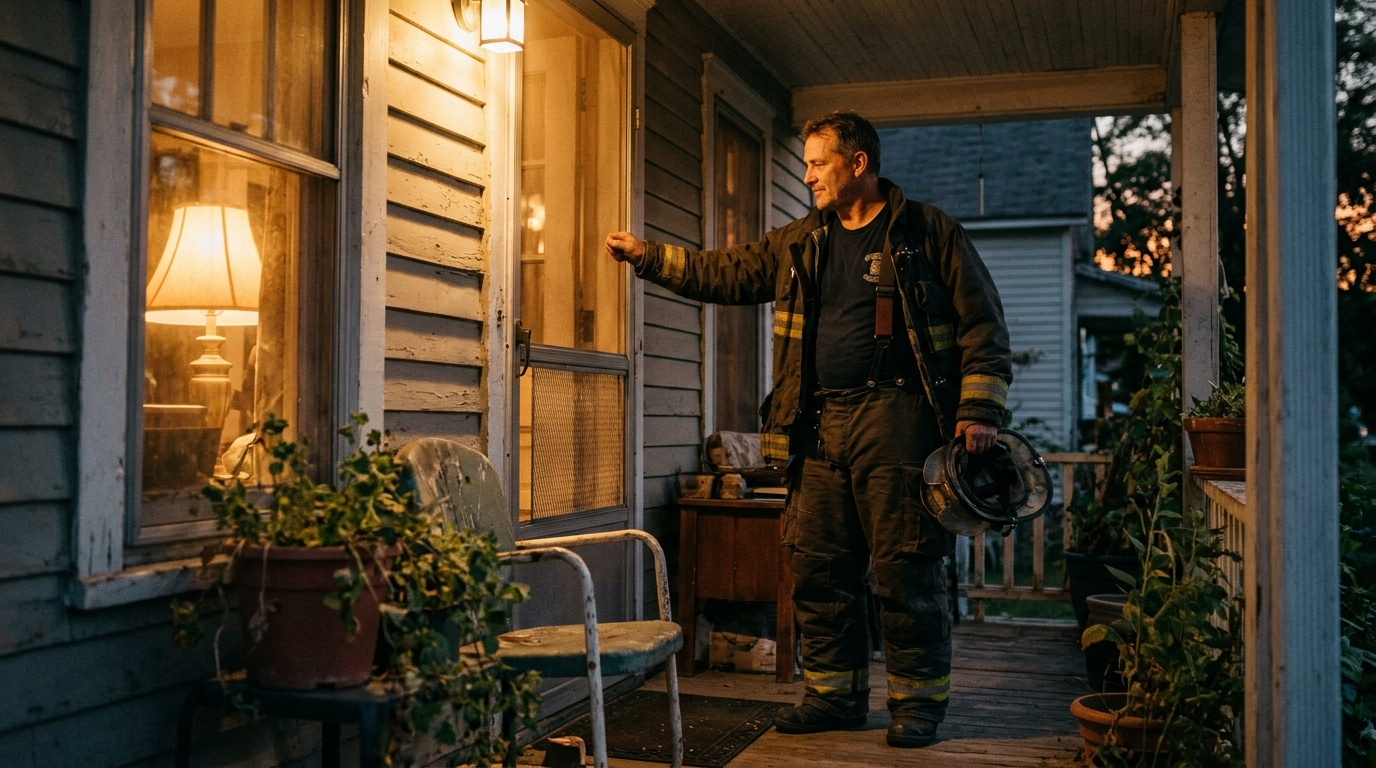
The sun is already sliding behind the rooftops on Alder Street when Captain Dale Rourke pulls his pickup to the curb. His shift ended forty minutes ago. His boots still smell faintly of smoke and diesel. His wife has kept dinner warm. And yet here he is, standing on a porch with a paper sack of groceries, knocking twice on a door painted the faded green of old money and older loneliness.
Inside, a television murmurs. A chair creaks. Then a voice, thin but unmistakably glad: “Is that you, Captain?”
This is the part of the day that no one puts in a firefighter’s job description. And for Dale, it has become the part that matters most.
Where It Started
Dale has been with the department for twenty-six years. Like most firefighters, he can recite the statistics: a large share of the medical calls his crew answers involve older adults who live alone. Falls. Dizzy spells. Missed medications. And, more often than anyone likes to admit, calls where there was nothing wrong at all, except that someone just needed to hear another human voice.
“We’d get called out to check on a man who’d pressed his medical alert button,” Dale told me, settling into a worn kitchen chair as the evening light turned amber against the window. “We’d get there, he’d be fine. Totally fine. And he’d keep us for twenty minutes talking about the weather. Then he’d say, ‘Thanks for coming, nobody’s visited in a while.’ That one stuck with me.”
The turning point came on a gray October evening. Dale was driving home after a long shift when he passed the house of a woman his crew had helped earlier that month. A light was on in the front window, and a single figure sat motionless in the glow. He pulled over. He knocked. She cried, not from fear, but from surprise that anyone would stop.
“I told myself I’d just do it once,” he said. “That was four years ago.”
The Evening Route
Dale’s route is not official. No one pays him for it. No department policy requires it. He simply keeps a small notebook in his glove compartment with a handful of names and addresses, and on most evenings after his shift, he visits two or three of them.
He calls it “the long way home.”
What does an evening visit look like? It is less dramatic than you might imagine, and far more tender.
- The knock. Two soft raps, always the same, so the person inside learns to recognize him.
- The check. A quick, casual glance for trip hazards, burned-out bulbs, expired medicine, or anything that looks off.
- The small errand. A loaf of bread. A replaced lightbulb. A smoke detector battery swapped out, because he is, after all, a firefighter.
- The sit-down. Ten, twenty, sometimes forty minutes of simply being there. Listening to a story he has heard before. Laughing at the same punchline.
“The groceries aren’t the point,” he said. “The groceries are my excuse. The point is that somebody knows if the light doesn’t come on.”
Why Evening Matters
I asked Dale why he does this at night rather than during the day, and his answer has stayed with me.
“Mornings are busy for everybody. The world is moving, and a quiet house doesn’t feel so quiet,” he said. “But evening is different. The light goes soft, the street empties out, the neighbors close their curtains. That’s when the loneliness gets loud. That’s when someone sits down to supper for one and the silence starts to press on them.”
It is a truth many of us recognize without having words for it. The evening is when the day’s distractions fall away and we are left alone with our thoughts. For a person who has buried a spouse, outlived friends, or watched children move across the country, that hour can feel endless.
So Dale arrives at exactly that hour. Not to fix anything. Just to meet the quiet with a little company.
The People Behind the Doors
Margaret, 84
Margaret taught third grade for thirty-eight years. She still corrects Dale’s grammar, gently, over tea. Her husband passed six winters ago, and her daughter lives overseas. Dale brings her the crossword section from his department’s newspaper subscription, and they work through it together, Margaret holding the pen like a baton.
Walter, 91
Walter served in the Navy and has a story for every harbor on the Pacific. He no longer drives. On Thursday evenings, Dale picks up his prescription and stays for one story. Just one, Walter insists, though it is never just one.
Rosalind, 78
Rosalind does not say much. She is shy, and she lives with a cat named Biscuit who is the true host of every visit. Dale sits on her couch while Biscuit climbs onto his lap, and sometimes neither of them says a word for twenty minutes. “She told me once it was the best part of her week,” Dale said. “Sitting there not talking. Because it was the kind of quiet with someone in it.”
What Margaret Told Me
I spoke with Margaret by phone the next morning. Her voice was bright, a little teasing.
“People think firefighters only run toward burning buildings,” she said. “But Dale runs toward the fires nobody can see. The ones that go out slowly, in a quiet house, when no one is watching.”
She paused, and I could hear a kettle somewhere behind her.
“He’s not my son. He’s not my neighbor, really. But when I hear that double knock at dusk, I feel something I had stopped expecting to feel. I feel expected. Do you know how rare that is at my age? To be expected?”
The Ripple
Word travels in small neighborhoods. Over time, a few things began to change around Dale’s route.
A teenager next door to Walter started mowing his lawn. A retired nurse two streets over began bringing soup to Rosalind. A local hardware store quietly started setting aside free batteries and bulbs. Nobody organized any of it. Kindness, it turns out, is contagious in the gentlest way.
Dale shrugs when I mention this. “I just knocked on a door. Everybody else did the real work.”
But anyone who has ever felt invisible knows that the first knock is the hardest one to give.
A Quiet Lesson for Our Own Evenings
As I wrapped up my visit and the last streak of orange faded from the sky, Dale offered something that felt less like advice and more like an invitation.
“You don’t have to be a firefighter,” he said, tucking his notebook back into the glove compartment. “You just have to notice who’s gone quiet. There’s probably someone on your street. Maybe it’s been a while since you saw their light on, or since you saw them at all. Go knock. Bring them a lemon bar. Ask how they’re doing, and then stay for the answer.”
Here are a few small ways to carry that idea into your own evening:
- Make a short list. Think of two or three older people in your life or neighborhood who live alone.
- Pick one evening a week. Consistency matters more than grand gestures.
- Bring something small. A plate of food, a book, a handwritten note, or simply your time.
- Listen more than you talk. The gift is the attention.
- Come back. The second visit tells someone the first one was real.
When the Porch Light Goes On
Dale drove away as the streetlamps flickered awake, one by one. In the rearview mirror, I watched a small porch light switch on at the green door, a warm yellow square against the deepening blue.
Somewhere inside, a woman was probably setting out two cups instead of one. A man was probably clearing his throat to begin a story. A cat was probably curling into a lap that wasn’t there yesterday.
And a firefighter, finally, was driving home to a warm dinner and a wife who has long since stopped asking where he’s been. She already knows. She leaves the porch light on for him, too.
As you settle in tonight, as the dishes dry and the house grows still, take a moment to wonder: whose light is on down the street, and who might be waiting, quietly, to be expected?