🎧 Listen to this story
Narrated by Kore · 7,561 characters
There is a particular kind of quiet that settles over a small town around nine o’clock at night. The shops are dark, the porch lights glow amber, and the day’s errands finally release their grip. It was in that hour, in the town of Marlow Creek, that a church doorway became the most important place in the whole community.
The Fire Nobody Saw Coming
Saint Brigid’s Fellowship Church had stood on the corner of Alder and Fifth for ninety-one years. It was never a grand building. It had a modest bell tower, wooden pews worn smooth by generations of Sunday sleeves, and a fellowship hall that smelled faintly of coffee and old hymnals. When an electrical fault ignited in the attic on a cold November night, the congregation lost nearly all of it within hours.
Reverend Tomas Albright remembers standing across the street in a borrowed coat, watching the bell tower lean and fall. He was not weeping, he says. He was too tired for that. What he remembers most is how silent the crowd became. People who had been married beneath that roof, who had buried parents from its front steps, simply stood together in the cold with nothing to say.
The insurance would cover some of the rebuild, but not all. The congregation was small, around sixty regular members, mostly retirees, farmers, and young families stretching every paycheck. Many assumed the church would quietly fade, its members drifting to larger congregations in nearby towns.
A Question Asked at Dusk
Weeks after the fire, a woman named Dolores Whitfield, a retired school bus driver who had attended Saint Brigid’s for forty years, stayed behind after a makeshift meeting in the library basement. As the others gathered their coats, she asked a question that changed everything.
“When the fire started, where did people go?” she said. “The night it happened, I mean. Where did the neighbors go to be together?”
Nobody had an answer. The street had been full of people with nowhere to stand, nowhere warm, nowhere open. They had simply stood in the dark.
Dolores had driven that town’s children for thirty-one years, and she knew something about the hours when people are most alone. “Everyone gets through the day,” she said. “It’s the evenings that are hard. That’s when the house gets too quiet, and nobody has a place to just be.”
The Doors Became the Design
When the architect sat down with the congregation to plan the rebuild, Reverend Albright said something unusual. He did not ask for stained glass or a taller steeple. He asked for doors.
The old church had been locked every night, as most buildings are. The new one, he explained, would be different. The congregation wanted an entrance designed to stay open, welcoming, and safe long after the sun went down.
The final design included several thoughtful details:
- A covered, heated vestibule where anyone could step in from the cold, even when the sanctuary was closed.
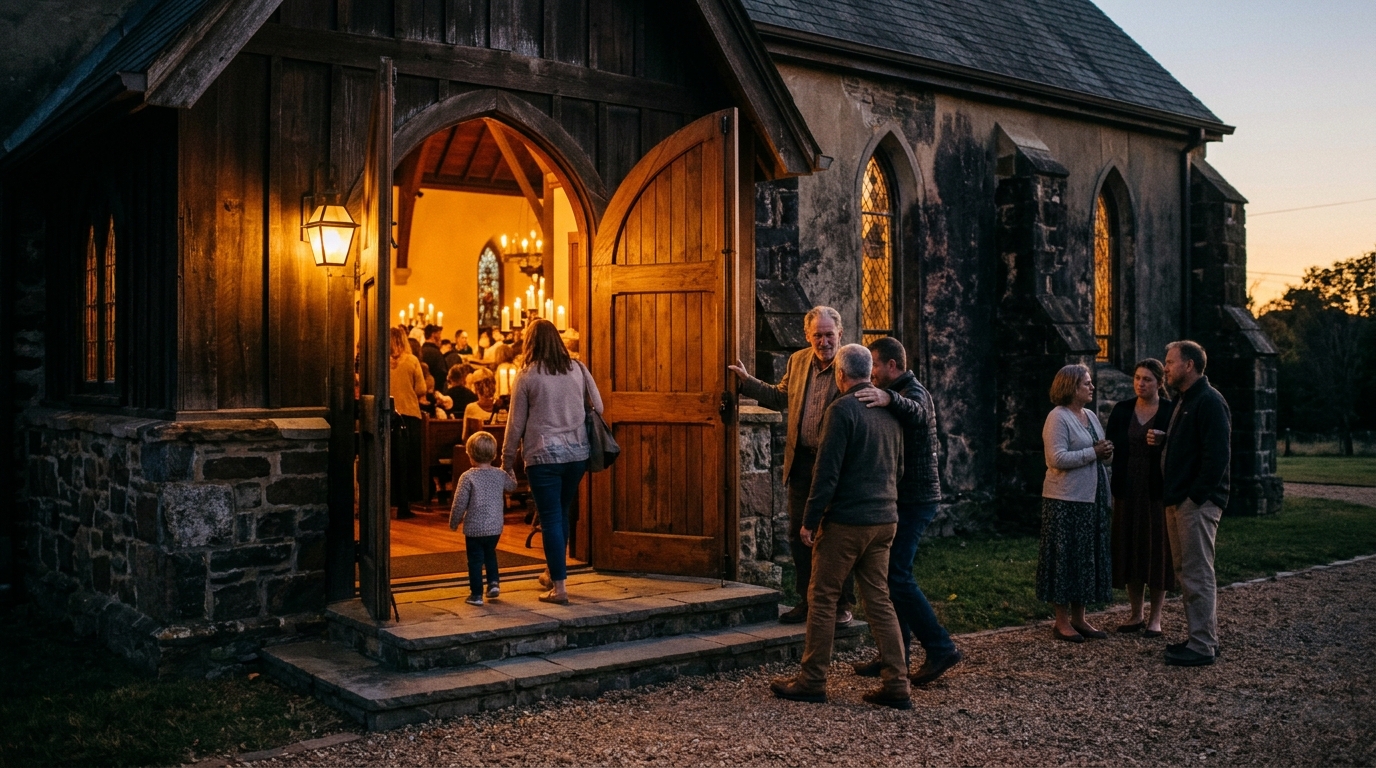
- Wide, wheelchair-friendly double doors with warm lighting that spills onto the sidewalk after dark.
- A quiet reading nook by the entrance, stocked with blankets, tea, and a shelf of donated paperbacks.
- A softly lit prayer room with no schedule, no sermon, and no expectations, open to anyone at any hour.
- A volunteer sign-up rotation so that no single person carried the burden of keeping watch.
The congregation raised funds through bake sales, a community quilt auction, and small donations that arrived in envelopes with no return address. A local carpenter named Henry Oyelaran, who had never once attended a service, offered to craft the new front doors by hand from reclaimed oak salvaged from the fire.
What Happens After the Sun Goes Down
The church reopened eighteen months after the fire. On the first night, Reverend Albright left the doors unlocked, turned on the porch lamps, and sat in a chair in the vestibule with a thermos of cocoa. He expected nobody to come.
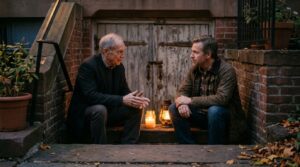
Around ten o’clock, a young man in a delivery uniform pushed the door open, looking embarrassed. He had finished a double shift, he said, and his apartment was empty and loud with silence. He just wanted somewhere warm to sit for a few minutes before going home. He stayed for an hour, drank two cups of cocoa, and left without saying much more.
He came back the next night. And the next.
Over the following months, the vestibule became something nobody had planned. Night-shift nurses stopped in before heading home. A widower named Gerald, who had stopped eating dinner at the table since his wife passed, began arriving at dusk to read the paper beside strangers. Teenagers who had nowhere to go found a place that asked nothing of them. A mother awake with a colicky baby at midnight walked the quiet hall and felt, for the first time in weeks, not alone.
Evening Reflection: The Gift of a Lit Window
There is something about the end of the day that strips away our pretenses. In the morning we are busy, armored in our schedules and obligations. But at night, when the dishes are done and the noise recedes, we are left with ourselves. For many people, that is the loneliest hour of all.
Dolores Whitfield understood this long before the blueprints were drawn. She now volunteers on Tuesday and Thursday evenings, sitting in the reading nook with a crossword puzzle, available to listen or to say nothing at all. “People don’t always need advice,” she told me. “Sometimes they just need to know someone left a light on for them.”
That phrase has become the unofficial motto of the congregation. Not a creed or a slogan, just a simple truth: somewhere in town, a light is on, and the door is open.
Lessons from a Rebuilt Doorway
The story of Saint Brigid’s offers quiet lessons for anyone who has ever lost something they thought was irreplaceable.
1. Loss can reveal what was missing all along
The old church was loved, but it was also locked at night. The fire forced the congregation to ask who they were really building for, and the answer turned out to be wider than their own pews.
2. Small, consistent presence outweighs grand gestures
The church did not launch a program or hire a counselor. It simply stayed open. Showing up, night after night, proved more powerful than any elaborate plan.
3. Healing is rarely a solo project
The ones keeping watch were healing too. Many of the volunteers had lost spouses, jobs, or a sense of purpose. Sitting up for others gave them something to hold.
4. Rebuilding does not mean restoring the past
The new church is not a replica of the old one. It is something different, shaped by what the community learned in the dark.
The Bell That Still Rings
One detail from the fire survives. The old bell, blackened but intact, was recovered from the rubble. It now hangs in the new bell tower, and every evening at dusk, Reverend Albright rings it once. It is not a call to worship. It is a quiet signal across the rooftops of Marlow Creek: the doors are open, and you are welcome here.
On a recent evening, I stood on the sidewalk as the sky turned the color of warm honey. The oak doors glowed from within. A man in a work jacket paused at the threshold, glanced up at the bell tower, and stepped inside. The door closed softly behind him, and the porch lamp kept on burning.
As you settle in tonight, perhaps with a cup of something warm, consider the people in your own life for whom the evening is the hardest hour. A phone call, an unlocked door, a porch light left on: these small offerings cost almost nothing, and they may mean everything to someone watching the clock.
Somewhere, a light is on. May we all be the ones to leave it burning.