🎧 Listen to this story
Narrated by Rasalgethi · 8,555 characters
The Morning Everything Changed
Maya Ellison was thirty-two years old, training for her third half-marathon, and finishing the last chapter of what she thought would be her debut novel, a romantic comedy about a florist in Portland. She had just made coffee. She remembers that detail with striking clarity: the smell of dark roast, the particular slant of early November light through her kitchen window.
Then her left hand stopped working.
“It was like someone had simply unplugged it,” Maya told us during a recent interview. “Not painful. Just gone. And then the room tilted, and I couldn’t find the words for what was happening to me. I knew the word ‘phone.’ I knew I needed it. But I couldn’t make my mouth say it.”
What followed was a four-hour window that her neurologist, Dr. Priya Suresh, later described as “the most critical of her life.” Maya had suffered an ischemic stroke. She was young, fit, had no family history, and no obvious risk factors. She was also, by any statistical measure, someone the medical system was not fully prepared to recognize.
The Invisible Patient: When Strokes Don’t Look the Way We Expect
Stroke is widely understood as something that happens to older people. The cultural image is familiar: an elderly man clutching his chest, falling. The reality is far more complex. According to the American Stroke Association, stroke rates among adults aged 18 to 44 have been rising steadily over the past two decades. Yet awareness, both among patients and medical professionals, has not kept pace.
Maya experienced this gap firsthand. At the emergency room, she was initially assessed for anxiety and dehydration. It took nearly ninety minutes before a neurologist ordered the imaging that revealed the clot.
“Ninety minutes is a long time when your brain is under attack,” she said quietly. “I’m not angry about it anymore. But I was angry for a long time. And that anger became fuel.”
Writing From the Inside of Something Terrifying
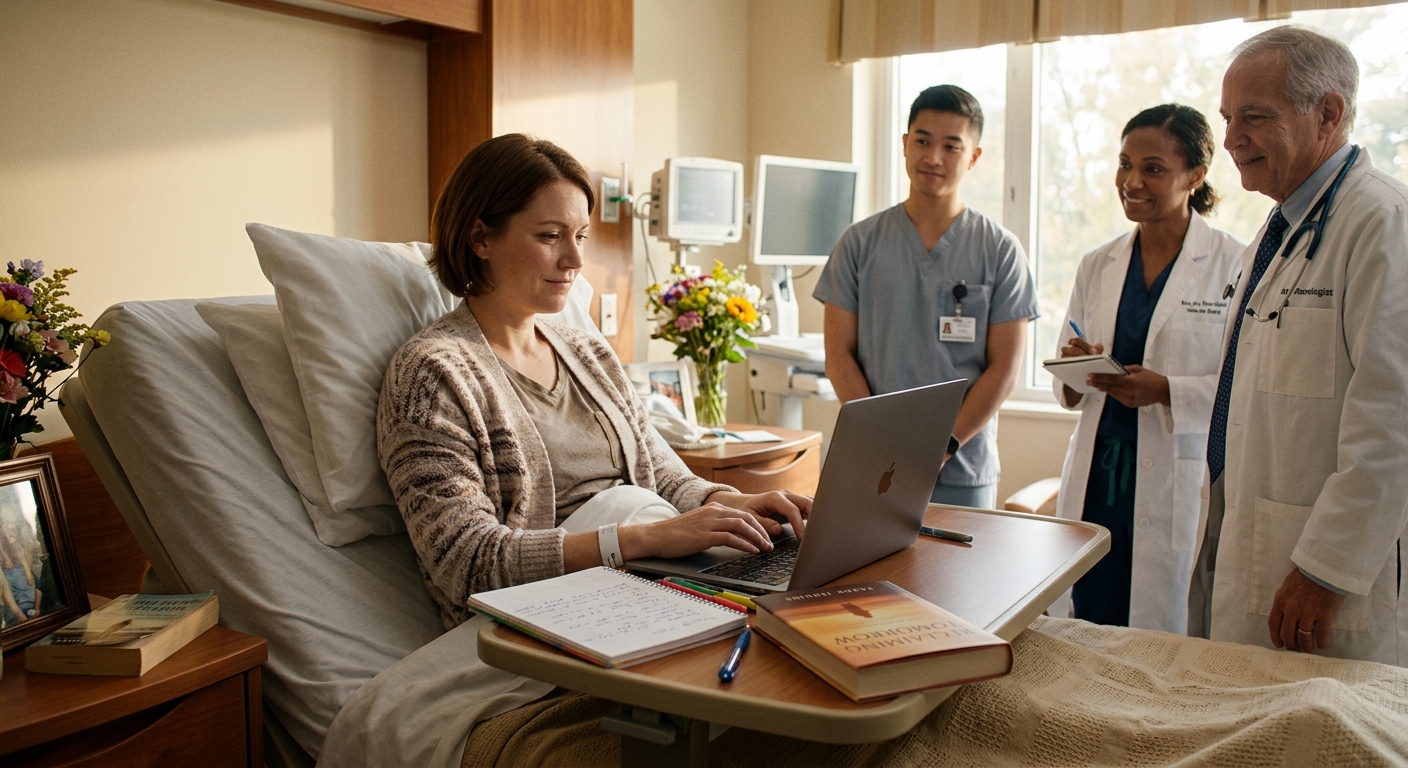
During her six weeks of inpatient rehabilitation, Maya started keeping a journal. It began as a coping mechanism, something her occupational therapist suggested to help with her aphasia, the partial loss of language that lingered in her recovery’s early weeks. The journal entries were halting at first. Single words. Fragments. Sentences that took forty minutes to construct.
But they were precise. Devastatingly, remarkably precise.
“I had nothing else to do but pay attention,” she said. “So I paid attention to everything. The way fatigue after a stroke feels different from any other tiredness I’d ever known. The way nurses talked around me as if I might not understand them. The terror of not knowing which parts of myself would come back. And honestly, the grace of small moments too: a CNA who brought me a real blanket from home, a roommate who made me laugh until I cried.”
Those journals became the foundation for her book, Left Side Down: A Young Stroke Survivor’s Anatomy of Recovery, published eighteen months after her hospitalization. It was not the romantic comedy she had planned to write. It was something far more urgent.
What the Book Actually Does
Maya’s book is structured in an unusual way for a memoir. It alternates between her raw personal narrative and annotated medical explainers that she researched obsessively during her recovery. Each chapter pairs an emotional truth with a clinical one. Chapter three, for example, is titled “Language” and moves between her experience of aphasia and a clear, accessible breakdown of how Broca’s and Wernicke’s areas of the brain function and what happens when they are damaged.
The result is something that reads like a conversation between a patient and a textbook, but warmer than either.
Dr. Suresh, who treated Maya and later contributed a foreword to the second edition, describes the book’s value this way: “We train medical students in pathophysiology, in imaging, in intervention. What we don’t train them in is what it actually feels like to be thirty-two and told your brain had an event. Maya’s book fills that gap in a way no clinical text can.”
The book is now part of the curriculum at four medical schools across the United States and two in Canada, used primarily in neurology rotations and patient communication coursework. Several nursing programs have also adopted it.
What Medical Students Are Learning From a Memoir
When professors assign Left Side Down, they’re not asking students to read it as literature, though many report being moved by it. They’re asking students to read it as testimony. To sit with the experience of a patient who was dismissed, who lost language, who had to relearn how to hold a pen, and who still found ways to be curious about her own condition.
Here are some of the key lessons educators say the book teaches:
- Age is not a reliable risk filter. Maya’s case illustrates how assumptions about who gets strokes can delay diagnosis in younger patients.
- Aphasia does not equal confusion. One of the most-discussed passages in medical classrooms is Maya’s description of knowing exactly what she wanted to say while being unable to say it. The lesson: a patient who cannot speak is not a patient who cannot think.
- The emotional timeline of recovery does not follow a clinical timeline. Discharge is not the end. Students learn to think beyond the hospital stay.
- Small acts of dignity matter enormously. Maya writes at length about interactions with healthcare workers that either preserved or eroded her sense of self during recovery. These passages are used in communication skills training.
- Patients are often their own best researchers. Maya’s deep dive into her own condition, born of fear and determination, became a resource for others. The book models an engaged, informed patient relationship with medicine.
The Recovery She Doesn’t Romanticize
One of the things that makes Maya’s book unusual in the genre of health memoirs is its refusal to wrap recovery in a tidy narrative of triumph. She is candid about what she calls the “invisible residuals”: the fatigue that still sometimes flattens her, the cognitive load of busy environments, the months of depression that followed what everyone else seemed to consider her miraculous return to normal.
“People wanted the story where I bounced back,” she said. “And in some ways I did. I run again. I write again. I live a full life. But I’m also a different person than I was before, and that’s okay. I think it took me a long time to say that it’s okay to be changed by something.”
She does not present herself as an inspiration object, a phrase she uses with gentle but firm intention. “I’m not here to make anyone feel better about suffering,” she said. “I’m here to make suffering more legible. That’s what I can do.”
A Ripple Effect She Never Anticipated
Since publication, Maya has received thousands of letters and emails from stroke survivors of all ages, from their caregivers, and from medical professionals. A recurring theme in the messages from healthcare workers moves her the most: doctors and nurses writing to say that they approached a patient differently because of something they read in her pages.
“That’s the thing I never saw coming,” she said. “I wrote the book to process my own experience, and to maybe help other survivors feel less alone. The idea that it’s sitting on a syllabus somewhere, that a twenty-five-year-old medical student is reading my worst days and learning something from them, that’s something I genuinely cannot fully hold in my head. It’s too large.”
She is currently working on her second book, which will focus on the experiences of stroke survivors from communities that face additional barriers to care, including language access, insurance gaps, and geographic isolation. She is also a regular speaker at neurology conferences and patient advocacy events.
The Lesson That Lives Beyond the Classroom
Maya Ellison did not plan to become a voice for stroke awareness in young adults. She planned to write a romantic comedy about a florist. Life, as it so often does, had a different outline in mind.
What she built from the wreckage of a single November morning is something that continues to ripple outward in ways she cannot fully track: into exam rooms, into clinical rotations, into the hands of newly diagnosed patients who pick up her book and feel, for the first time, that someone has seen what they are going through.
Sometimes the most powerful things we create are not the things we planned. Sometimes they are the things we had no choice but to write.