🎧 Listen to this story
Narrated by Kore · 7,738 characters
When Marguerite Delacroix-Hale talks about the worst part of her cancer, she does not mention the needles, the nausea, or the hair that fell out in the shower. She talks about 9:47 p.m.
“That was when the house went quiet,” she says. “The treatment was done for the day, my family had gone to bed, and suddenly there was nothing between me and my own thoughts. That’s when the fear showed up. Every single night, like clockwork.”
Marguerite, now fifty-three and four years cancer-free, agreed to sit down with us on a porch swing just as the light was turning amber. What she shared was less a medical story and more a story about the hours after the doctors go home, and how a small, unglamorous habit rebuilt the part of her that no scan could measure.
The Diagnosis Was Only the Beginning
Marguerite was diagnosed with stage two breast cancer at forty-nine. She describes the first weeks as a blur of appointments, consent forms, and well-meaning advice. Her body had a team of specialists. Her mind had no one.
“Everyone asked about my white blood cell count,” she says. “Nobody asked what it felt like to lie in bed at night and rehearse worst-case scenarios until two in the morning.”
She is not alone in this. Many survivors describe a gap between physical treatment and emotional recovery, a stretch of time when the body is being cared for but the mind is left to fend for itself. For Marguerite, that gap was the evening.
How the Ritual Began, By Accident
Three weeks into chemotherapy, Marguerite could not sleep. She wandered into her kitchen around ten at night and, for no reason she can explain, filled the kettle. She made a cup of chamomile tea, carried it to the back step, and sat down in the dark.
“I wasn’t trying to start a ritual,” she laughs. “I was just trying not to lie in bed panicking. But I sat there, the air was cool, the neighbor’s porch light was glowing, and for about ten minutes my chest unclenched. I remember thinking, oh. That’s what quiet feels like when it isn’t frightening.”
She did it again the next night. And the next. Within a week, it had a shape.
The Four Parts of Her Evening Ritual
Marguerite is quick to say there is nothing magical here. She calls it “boring on purpose.” But the structure mattered, she says, because during treatment almost everything else in her life felt chaotic and out of her hands. Here is what she did, in order:
- The kettle. She filled it, waited for it to boil, and refused to check her phone while she waited. “Those three minutes were the first time all day I wasn’t waiting on someone else’s results.”
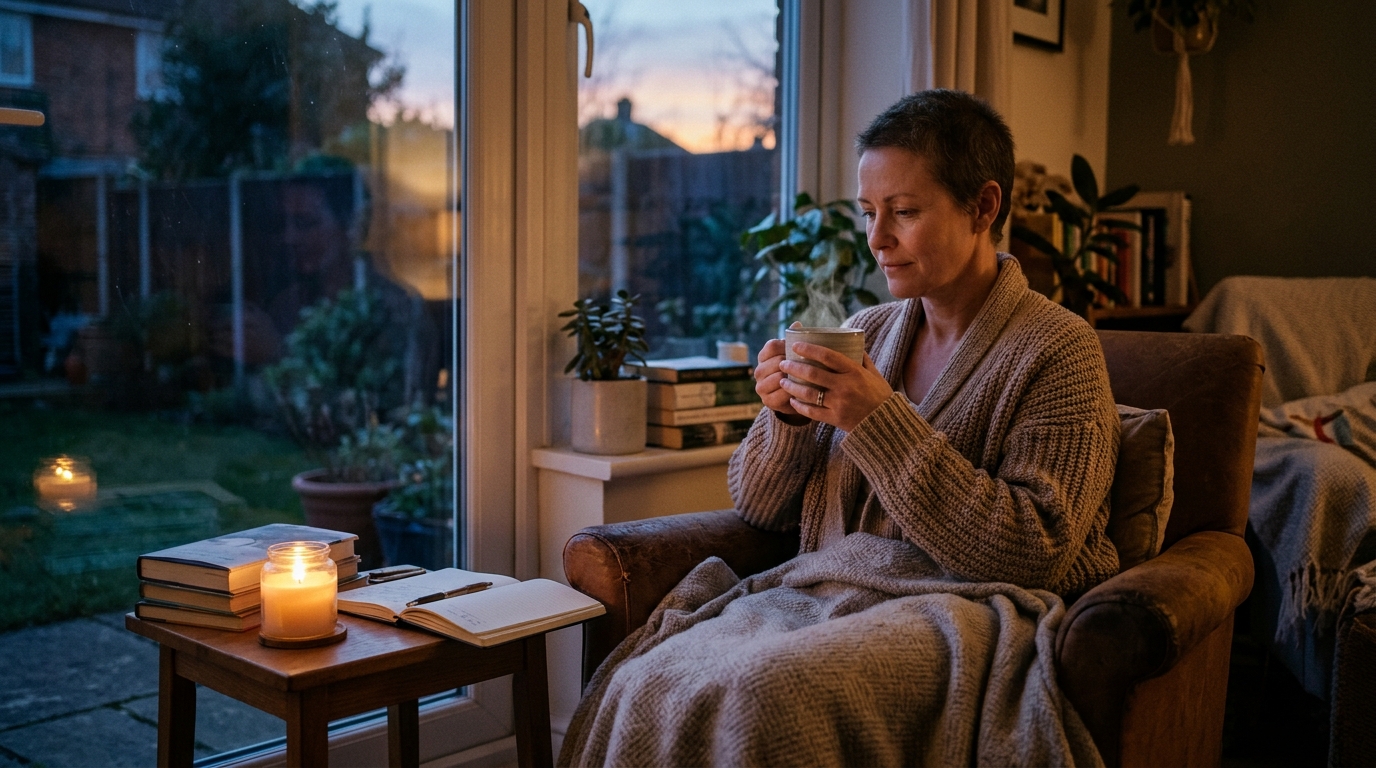
- The porch. Rain or shine, she sat outside, even if only for five minutes. She wrapped herself in a gray wool blanket that her sister had mailed her.
- The three-line journal. She wrote exactly three lines: one thing that hurt, one thing that helped, one thing she was looking forward to, however small.
- The closing breath. Before going in, she looked at the sky, took one slow breath, and said out loud, “That’s enough for today.”
Why Three Lines and Not Three Pages
Marguerite once tried writing long, sprawling entries. It backfired. “I’d write myself right back into the fear,” she says. “Three lines kept me from spiraling. It gave the day a tidy edge. A beginning, a middle, and a finish.”
Looking back over four years of those notebooks, she says the “one thing that helped” lines are the ones that undo her. A nurse who remembered her dog’s name. A neighbor who left soup on the step. A song that came on the radio at just the right moment.
What Evening Gave Her That Daytime Couldn’t
There is a reason this ritual lived in the evening and not the morning, Marguerite believes. Mornings were for logistics: rides to the clinic, pills, appointments. Afternoons were for exhaustion. But evening was the one stretch of the day that belonged to no one but her.
“Dusk is a kind of mercy,” she says, watching the sky behind her garden soften from gold to rose. “The day is finished whether you handled it well or badly. There’s a built-in forgiveness in that. Nothing more is being asked of you.”
That idea, that the evening offers a natural permission to stop, became the emotional center of her recovery. On the days when treatment went badly, she would sit on that step and remind herself that the day was over, and that the person who survived it deserved rest, not criticism.
The Quiet Science Behind the Calm
While Marguerite is not a doctor, she did eventually ask her oncology social worker why such a small habit felt so powerful. The answer, she says, was reassuringly simple.
Predictable routines can lower anxiety by giving the mind something stable to hold onto during uncertain times. Gentle, repeated cues, like warm tea, cool evening air, and a familiar blanket, can signal to the body that it is safe to wind down. And brief, structured writing can help move worries out of the mind and onto the page, where they feel more manageable.
“She told me I’d essentially built a landing strip for my nervous system,” Marguerite says. “I just thought I was drinking tea.”
The Night It Almost Broke
Not every evening was peaceful. Marguerite is honest about the night her scan results came back unclear, and she sat on the step for an hour without touching her tea. She did not write three lines. She wrote one word: afraid.
“I thought the ritual had failed,” she remembers. “But my sister called, and I told her I couldn’t even do the one thing that was helping. And she said, ‘Maybe the ritual isn’t about feeling better. Maybe it’s about showing up for yourself even when you can’t.'”
That reframing changed everything. The porch step was never a cure for fear. It was a place to meet the fear with a blanket and a warm cup instead of alone in the dark of a bedroom.
What She Wants Other Survivors to Know
As the porch light flickered on and the first crickets began, Marguerite offered a few thoughts for anyone walking a similar road:
- Start smaller than you think. Five minutes counts. One cup of tea counts. One breath counts.
- Make it repeatable. The comfort comes from sameness, so choose something you can do even on your worst day.
- Protect it fiercely. “I told my family this was my fifteen minutes, and they honored it. That was a gift I gave myself and a gift they gave me.”
- Let it change. Some months she added music. Some months she added silence. The ritual bent so it wouldn’t break.
- Tell someone about it. Saying it out loud made it real, and made her accountable to the person she was becoming.
Four Years Later, Still on the Step
Marguerite has been cancer-free for four years now, and her oncologist has stretched her checkups to once a year. The scares have faded, but the ritual has not. She still fills the kettle most nights. She still sits on the back step with her gray wool blanket, even though the crisis that created the habit has passed.
“People ask why I keep doing it,” she says. “Isn’t the hard part over? And I tell them: the ritual was never really about the cancer. It was about learning that I could sit with myself and be okay. That’s a skill, and I’m not about to give it up.”
She lifts her mug as the last of the light slips behind the fence line, and for a moment she says nothing at all. Then she smiles, takes a slow breath, and says the words she has said hundreds of times.
“That’s enough for today.”
A Gentle Invitation for Your Own Evening
You do not need a diagnosis to deserve a quiet fifteen minutes. Tonight, when the dishes are done and the noise begins to fade, consider stepping outside, or sitting by a window, with something warm in your hands. Notice what hurt today. Notice what helped. Notice one small thing waiting for you tomorrow.
Then take a slow breath, and let the day be finished.