🎧 Listen to this story
Narrated by Kore · 6,323 characters
There is a particular kind of quiet that settles over a house around eight in the evening. The dishes are done, the phone has stopped buzzing, and the day finally lets go of your shoulders. It is the hour when old things float up, the way sediment does when water stops moving. I have spent many of those hours avoiding the thing that floated up for thirty years. Last autumn, I stopped avoiding it.
The Night the Sun Went Down on Us
I was twenty-six when my mother and I had the fight. I will not retell every word, because the words matter less than the shape of it. She had disapproved of the man I was about to marry, and she said so over a Sunday dinner, plainly and in front of my aunt. I said something back that I knew, even as it left my mouth, I could never take back. I told her she had never once been proud of me, and that I would build a life where I did not need her to be.
I walked out before the sun had fully set. I remember the sky behind her maple tree, orange bleeding into purple, and the sound of the screen door slapping shut behind me. I remember thinking I would call in a few days, when we had both cooled down.
Days became weeks. Weeks became a year. Pride is a patient architect, and it built a wall between us one careful brick at a time. She sent a card on my birthday some years. I sent one at Christmas. We were polite, like two strangers who happened to share a last name.
What Thirty Years Teaches You Without Asking
I want to be honest about something: I did not spend thirty years suffering in dramatic fashion. Life got full. I married the man she disliked, and we had a good marriage for eleven years before it ended for reasons that had nothing to do with her prediction. I raised two children. I buried my father. I built a career. The silence with my mother became furniture, something I walked around so often I stopped noticing it was there.
But evenings have a way of exposing furniture. Around the time my own daughter turned twenty-six, something shifted. She came home for dinner one Sunday, and in the middle of an ordinary conversation, she said something sharp about how I was handling her own life choices. I felt the old heat rise in my chest. I heard my own mother’s voice in my head, and then, with a jolt, I heard my own younger voice answering it.
I realized I was standing in my mother’s shoes, and that those shoes had never been as cruel as I remembered. They had been afraid. She had looked at her daughter walking toward a decision she feared would hurt me, and she had not known how to say it with love, so she said it badly.
The Evening I Drove to Her House
It was a Thursday in October. I had no plan. I got in the car after dinner, around seven, with the light going soft and gold across the fields. I told myself I was just going for a drive. My hands knew where they were going before my mind admitted it.
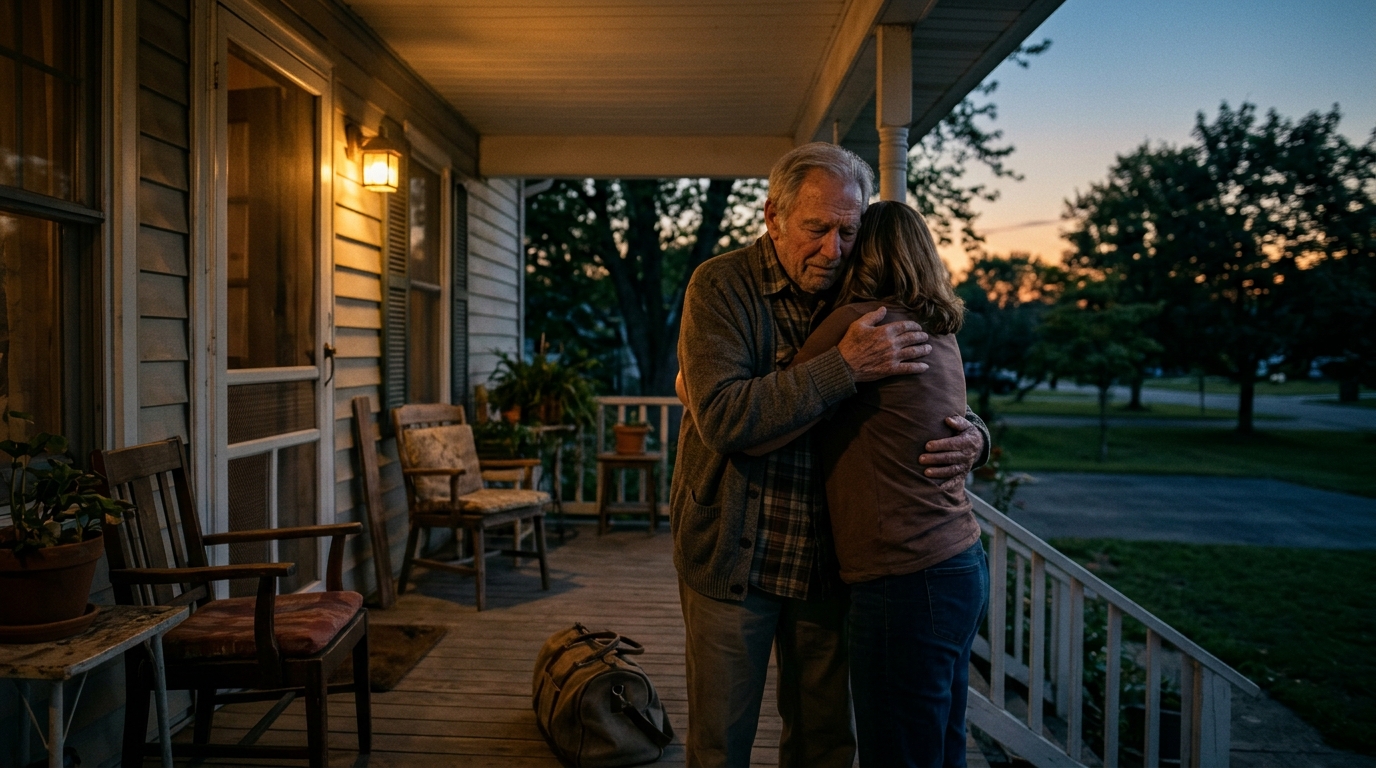
Her porch light was on. She is eighty-three now, and she leaves that light burning every night, a habit from the years when my father worked late shifts. I sat in the driveway with the engine off for nearly twenty minutes, watching moths circle the bulb. I rehearsed speeches. I discarded all of them.
When I finally knocked, she opened the door slowly. She looked smaller than I had pictured, and her hair had gone completely white. For a long moment neither of us spoke. Then she said, very quietly, “I left the light on.”
I did not know what she meant until later. She told me she had left it on every night for thirty years, in case I ever came back. She had not told anyone. She had not wanted to be foolish about it.
What We Said, and What We Did Not Need To
We sat at her kitchen table with cups of tea neither of us drank. I said I was sorry for what I had said that night. She said she was sorry too, and that she had replayed it a thousand times, wishing she had simply said, “I just want you to be happy.”
That was all. There was no grand reckoning, no cinematic tears, though a few did come. We talked about my children, whom she had met only a handful of times. We talked about the maple tree, which had been struck by lightning and replaced. We talked about my father, and she laughed at a memory I had forgotten, and I laughed with her.
Somewhere in that hour, the thirty years did not vanish, but they stopped weighing what they had weighed. Forgiveness, I learned, is rarely a single dramatic act. It is more like setting down a bag you did not realize you were still carrying.
The Lessons That Settled In After Dark
I have thought a great deal about why it took so long, and what I would tell anyone standing where I stood. These are the things that came to me in the quiet hours afterward:
- Waiting for the other person to move first is a trap. We both waited, and we both lost three decades to it.
- Pride feels like strength but behaves like fear. It protected me from a hard conversation and cost me a relationship.
- The other person is usually carrying their own version of the story. Mine was one of hurt. Hers was one of regret. Neither was the whole truth.
- Becoming a parent changes how you read your own childhood. I could not forgive her until I understood how easily love can come out wrong.
- It is almost never too late, but it is always later than you think. My mother was eighty-three. I will carry the gratitude for that October evening for the rest of my life.
A Gentle Word for the Quiet Hours
If you are reading this in the evening, with the house winding down around you, I want to ask you something softly. Is there a porch light somewhere that someone has left on for you? Is there a name that floats up when the day goes still, a name you keep pushing back under the surface?
You do not need a perfect speech. You do not need to have forgiven everything or to have settled who was right. You only need to drive over, or pick up the phone, or write the first awkward line. The hardest part is the first knock, and it is smaller than it looks from the driveway.
I go to see my mother every Sunday now. We have dinner at six, while there is still light. Afterward, I help with the dishes, and before I leave, we stand together on the porch and watch the sun go down behind the new maple tree. The light is still on when I drive away, but now I do not feel like it is waiting. I feel like it is just welcoming me home.