🎧 Listen to this story
Narrated by Kore · 7,644 characters
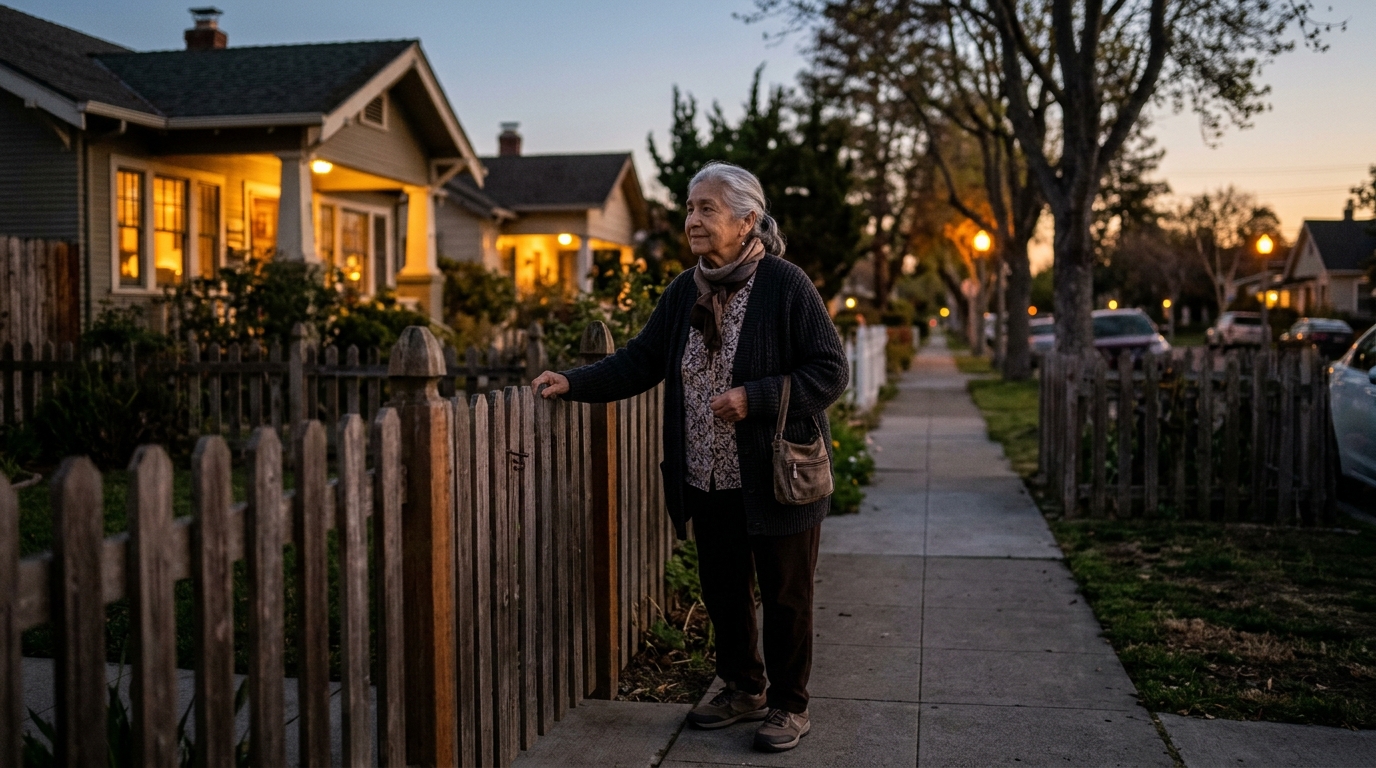
The streetlights on Dellwood Avenue flicker on one at a time, and somewhere around the third lamp, you can usually spot her: a small woman in a faded green cardigan, a canvas tote on her shoulder, walking at the unhurried pace of someone who has nowhere to be and somewhere very important to go.
Her name is Rosa Alvarez. She taught fourth grade at Pinewood Elementary for thirty-four years. She retired eleven years ago. And almost every evening since, as the sky softens to peach and the day’s noise drains out of the neighborhood, she walks the same loop of streets, checking on the children she once taught, many of whom are now grown adults with children of their own.
This is the story of how an ordinary habit became the quiet heartbeat of a community.
How It Started
It began, as many good things do, without a plan. Shortly after her retirement party, with its sheet cake and its handmade cards, Rosa found herself restless. Thirty-four years of mornings built around a school bell does not dissolve overnight. The evenings, in particular, felt strangely hollow.
So she started walking. One dusk, she passed a house where a former student, a boy she remembered as painfully shy and gifted at drawing, was sitting alone on the porch steps. He was twenty-six now. His mother had recently passed away. Rosa did not say much. She sat beside him for a while, and they watched the light go out of the sky together.
“I didn’t go over there to fix anything,” she told me when I met her on her porch one evening, a pot of chamomile between us. “I just thought, he shouldn’t have to sit with that alone. Nobody should.”
He mentioned it to a neighbor. The neighbor mentioned it to someone else. And slowly, the porch lights on her route began to feel less like decoration and more like invitations.
What the Rounds Look Like
There is no clipboard. There is no schedule. But there is a rhythm, and it has become as familiar to the neighborhood as the sound of the evening train.
Here is a typical walk, as she described it to me:
- The corner house on Maple: A former student, now a nurse who works night shifts, often leaves a wave in the window. Rosa waves back. Some evenings, a thermos of coffee is waiting on the porch rail with a note that says “for the walk.”
- The blue duplex: A young father she taught in 2004. He is raising two kids alone. Rosa checks whether the porch light is on, which is their quiet signal that it has been a good day. When it is off, she knocks.
- The yellow bungalow: A woman who struggled with reading as a child and now owns a small bakery. She leaves Rosa a paper bag of day-old bread every Thursday, and neither of them ever mentions it.
- The house with the crooked mailbox: A man who once got into trouble as a teenager, and who, Rosa says, “just needs someone to remember who he was before all that.”
She does not give advice unless asked. Mostly, she listens. Sometimes she carries a library book or a jar of her homemade lemon curd. Sometimes she carries nothing but her attention, which, she says, is the thing most people are starved for.
Why Dusk?
I asked her why evenings. Why not the bright middle of the day, when people are awake and busy and cheerful?
She thought about it for a moment, watching a porch light blink on across the street.
“Because that’s when it gets heavy,” she said. “During the day, everyone’s performing. They’re at work, they’re picking up kids, they’re answering emails. But at dusk, the performing stops. That’s when the worries come out. That’s when a person is most alone with themselves. If I can knock on a door right then, just for ten minutes, it changes how the whole night feels.”
It is a truth that anyone who has lain awake at 2 a.m. understands. The day’s noise fades, and what is left is the truth of how we are really doing. Rosa figured out, long before she retired, that the most important moment to show up for someone is not when they are celebrating. It is when the light is going out and they are bracing for the dark.
A Story She Doesn’t Tell Often
There is one evening she mentions only reluctantly, and only after I asked directly.
Several years ago, she was walking past a house on Larkspur Lane when she noticed the porch light was off and the curtains were drawn in the middle of a gentle spring dusk. The woman who lived there, a former student named Danielle whom Rosa had taught as a nine-year-old with an enormous laugh, had been quiet for weeks.
Rosa knocked. No answer. She knocked again, and then she did something she had never done on her rounds: she sat down on the porch steps and said, loudly enough to carry through the door, “I’m not leaving. I’ve got a thermos and nowhere to be.”
Twenty minutes later, the door opened.
Danielle had been struggling more than anyone knew. Rosa did not offer a speech or a solution. She came inside, put the kettle on, and stayed until the stars were out. The next morning, Rosa quietly connected her with a counselor she knew from the school district. Danielle is doing well now. She volunteers at the very elementary school where she once sat in Rosa’s classroom.
“I didn’t save her,” Rosa insists, shaking her head. “I just refused to let her be invisible for one more night.”
What Teaching Really Teaches
When you spend three decades with children, you learn that most of what you teach has nothing to do with fractions or spelling lists. You learn to notice the kid who stops raising her hand. You learn to read the silence at the back of the room. You learn that being seen is, for many people, the first form of being loved.
Rosa never stopped noticing. She simply moved the classroom outdoors.
“People think retirement means you stop being useful,” she said. “But a teacher is never really off the clock. Those kids are still my kids. They’re just taller now.”
Small Lessons from the Evening Walk
Spending an evening alongside Rosa left me with a handful of reminders I have been turning over ever since:
- You do not need a title to care for people. The role ended; the responsibility of the heart did not.
- Consistency is its own kind of kindness. People find comfort in knowing that someone will show up at the same time, in the same way, without needing to be asked.
- Presence beats solutions. Most of the time, a person does not need to be fixed. They need company in the dim light.
- Evenings are when people need us most. The quiet hours reveal what the busy ones conceal.
- Remember who people used to be. Holding a gentle memory of someone’s best self can help them find their way back to it.
The Lights Along the Route
As our conversation wound down, the sky over Dellwood Avenue had deepened to a dusty violet. Rosa stood, smoothed her cardigan, and slung the canvas tote over her shoulder.
“I’ve got a few stops left,” she said, with the easy certainty of someone who knows exactly where she belongs.
I watched her walk away, a small figure passing from one pool of lamplight to the next. Behind her, porch lights glowed in the windows she had passed, each one a small yellow promise that someone, somewhere, was paying attention.
Tonight, as the day loosens its grip and your own thoughts begin to surface, you might ask yourself a simple question: who is sitting alone on a porch step in your life? Who might be bracing for the dark? A text, a knock, a ten-minute visit. It may be the smallest thing you do all day, and it may be the one that is remembered.
Rosa Alvarez has never won an award for her evening rounds. There is no plaque, no ceremony. But on Dellwood Avenue, when the streetlights come on, the whole neighborhood knows what that quiet footstep means: you have not been forgotten.