🎧 Listen to this story
Narrated by Kore · 7,912 characters
There is a particular hour in a hospital that most visitors never see. The family members have gone home to sleep. The cafeteria has shuttered its steam trays. The long hallways hum with a lower, steadier sound, the soft electronic breathing of monitors and the squeak of rubber soles on polished floors. It is the hour when the day shift hands off to the night shift, and it is the hour when one nurse, by her own choice, does something no job description requires.
For the purposes of this story, we will call her Marguerite. She asked that her real name stay out of print, and the details here come from a colleague who spoke with us about her, along with the kind of patterns that nurses on palliative and medical floors will recognize instantly. Marguerite has worked in hospital care for more than two decades. Her shift ends at seven in the evening. For years, on certain nights, she has not gone home at seven.
The Chair in the Corner
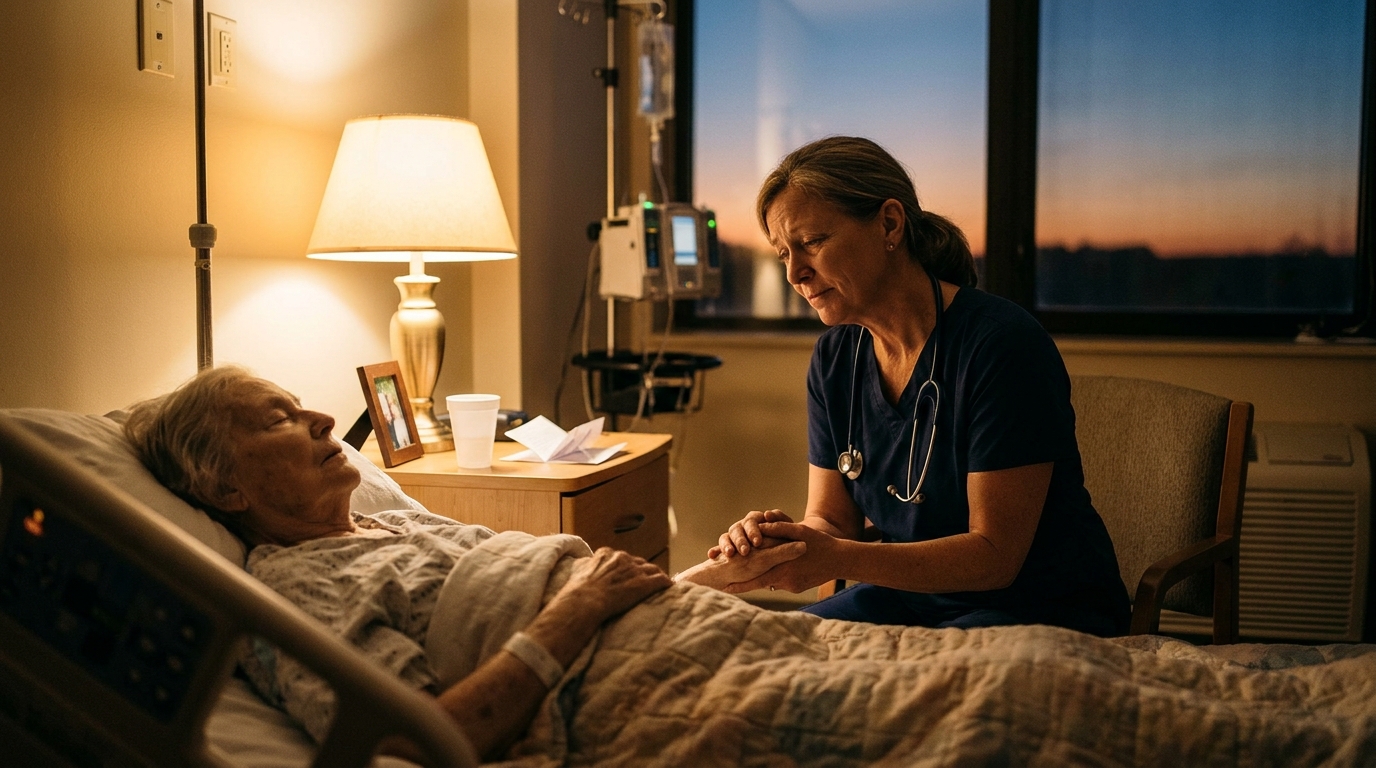
It began, as many quiet things do, by accident. Early in her career, a patient on her floor was declared actively dying late in the afternoon. No family could be reached. The man had outlived his wife and his only brother, and the emergency contact on his chart led to a phone number that rang and rang. Marguerite’s shift was ending. The night nurse was already juggling a full assignment. She looked at the clock, then at the man, and then she pulled a vinyl chair from the corner of the room and sat down.
She stayed for three hours. She did not do anything clinical. She held his hand when he seemed to want it held. She talked softly about nothing in particular: the weather, the way the light was fading orange against the window, a song she thought he might have liked. He died a little after ten, and she was there.
She drove home that night in silence. She told us, through her colleague, that she expected to feel crushed. Instead she felt something she had trouble naming, a heavy, tender peace. She had been a witness. For one person, at the very end, the room had not been empty.
What Evening Does to the Dying
Anyone who has worked with the very ill will tell you that evenings are different. Daylight carries a kind of structure: rounds, meals, visitors, procedures, the busy choreography of getting through a day. When the light goes, the scaffolding falls away. The mind turns inward. Fears that were manageable at noon grow larger at dusk.
Hospice workers have a name for a related phenomenon, sometimes called sundowning in the context of dementia, where confusion and anxiety deepen as daylight fades. But even among patients who are lucid, there is often a restlessness at the end of the day, a wish not to be alone with the dark. Marguerite noticed this early. The nights, she realized, were when people most needed someone to simply be there.
That is the thing about being present. It is not a treatment. It does not appear on any chart. But it may be one of the oldest forms of care human beings have.
How It Works, in Practice
Marguerite does not sit with every dying patient. She is careful about that, because she is also a person with a family and a body that needs rest. Over the years she has developed a quiet system, one she shares only reluctantly because she does not want it to sound like a performance.
- She checks in with the night team first. She never takes over the work of the nurses on duty. Her presence is an addition, not a substitution, and she is clear about that boundary.
- She prioritizes those with no one coming. If a patient has family on the way or already at the bedside, she steps back. Her vigil is for the ones who would otherwise face the end alone.
- She asks permission. When a patient is awake and able, she asks whether they would like company. Some say yes immediately. Some say no, and she respects that completely.
- She follows their lead. Some want conversation. Some want silence. Some want a hand to hold or a hymn hummed under the breath. She does not decide in advance.
- She keeps the room gentle. Lights dimmed, voices low, the blanket tucked, the pillow adjusted. Small comforts that say: you matter here.
The Things She Has Learned
When we asked what sitting at so many bedsides had taught her, Marguerite’s colleague relayed a few reflections, offered in her typically understated way.
People rarely say what you expect
She had imagined that final hours would be full of grand statements. Mostly they are not. People ask for water. They ask what time it is. They mention a childhood kitchen, a dog long gone, a mother’s voice. The last words are often small and domestic, and that smallness, she says, is its own kind of beautiful.
Fear softens in company
She has watched agitation ease when a hand is held. She is careful not to overclaim, because every death is its own thing and she is not a scientist making promises. But she has seen, again and again, that a person who is not alone seems to breathe a little easier.
The witness is also changed
She is honest that it costs her something. There are nights she cries in the parking lot. There are faces she carries. But she describes the cost as a fair price for something deeply worth doing, and she says that sitting with the dying has made her far less afraid of her own ending.
A Colleague’s Quiet Testimony
The nurse who told us about Marguerite described coming on shift one night and finding her still in the room of an elderly woman, long past the end of her own day. The patient had been unresponsive for hours. Marguerite was sitting with her chin on her hand, speaking in a murmur.
“I thought she was charting,” the colleague said. “Then I realized she was just telling her about the evening. The sunset, the way the sky had turned that deep pink. She said, I wanted her to know what a beautiful night it was.”
The woman died shortly afterward, peacefully. Marguerite stayed another few minutes, straightened the blanket, turned off the overhead light, and left the small lamp on, as though the room should not be plunged into darkness all at once.
Why This Matters Beyond the Hospital
It is easy to read a story like this and file it under the heading of heroes, as though what Marguerite does belongs to some rare and distant category of people. But the heart of it is something almost anyone can practice, in smaller ways, in ordinary lives.
Most of us will not sit at a deathbed this week. But most of us know someone who is lonely tonight. A neighbor whose spouse has passed. An aging parent who is too proud to ask for company. A friend going through something hard who has stopped answering the phone. The principle is the same: presence is a gift that costs nothing but time, and time is the one thing we are all so quietly desperate to spend well.
A Small Evening Practice
As the day winds down, consider carrying a little of Marguerite’s spirit into your own evening. You do not need to do anything dramatic. Try one of these:
- Call someone who might be alone and simply listen for ten minutes.
- Sit with an elderly relative without a screen in your hand.
- Write a note to someone who is grieving, even just two lines.
- Notice who in your life tends to be overlooked, and move toward them rather than away.
The Lamp Left On
When Marguerite finally walks out to her car after a night like that, the parking lot is quiet and the sky is usually dark. She sits for a moment before turning the key. She does not call it prayer exactly, but it is something close to it, a settling, a gratitude for having been useful in the one way that mattered.
Somewhere behind her, on the fourth floor, a small lamp may still be glowing in an empty room. It is a modest light. But for someone, in the last hours of their life, it was enough to know that they were not alone in the dark.
Tonight, as your own day grows quiet, you might ask yourself a simple question: who could use a little company, and what would it cost you to be the one who stays?