🎧 Listen to this story
Narrated by Kore · 7,216 characters
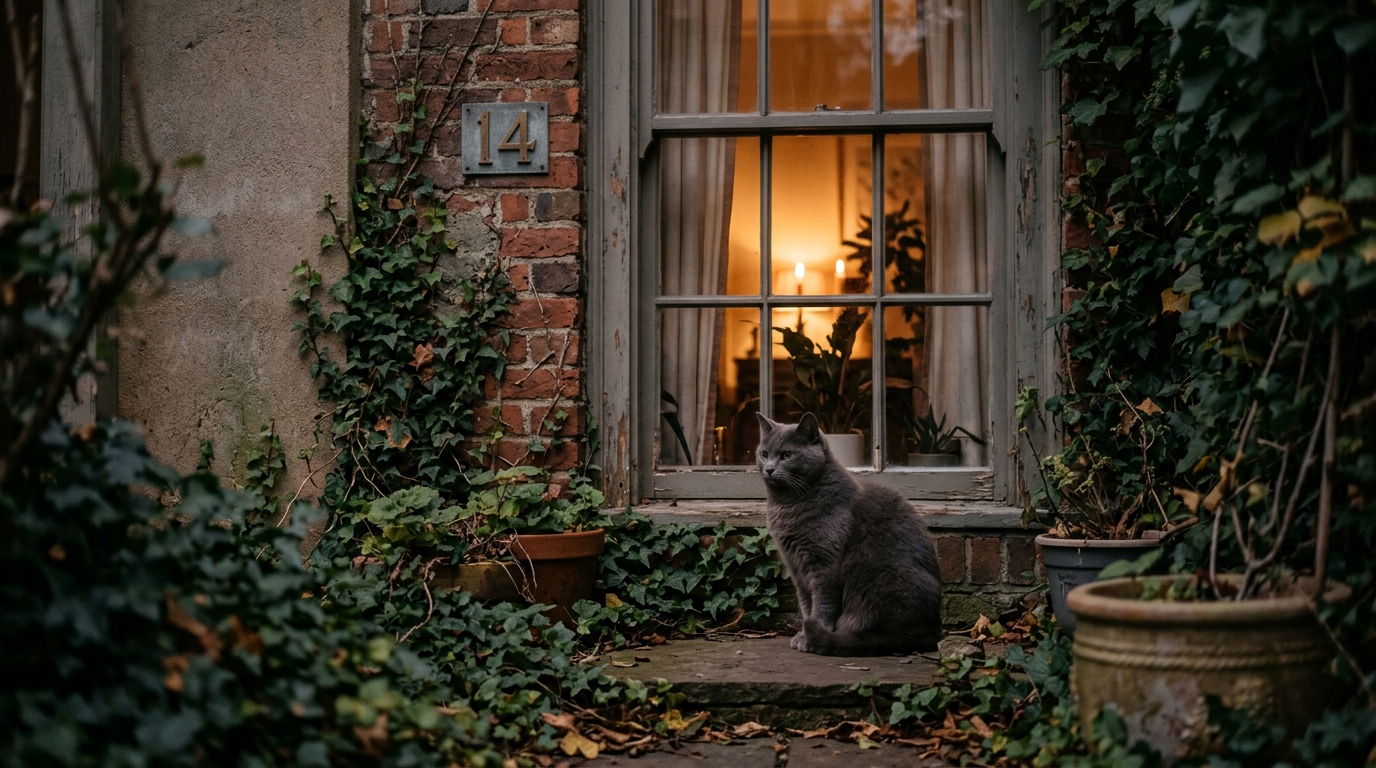
The staff at Maple Grove Care Home can tell you the time without looking at a clock. When the sun slips low enough to turn the parking lot amber, a small gray cat steps out from beneath the hydrangeas, crosses the lawn with the unhurried confidence of someone who has done this a thousand times, and settles herself on the flat stone beneath the window of Room 14.
She doesn’t meow. She doesn’t scratch at the glass. She simply sits, tail curled around her paws, face turned up toward the curtain, and waits.
This is the story of that cat, and of the man she waits for. It’s one of those quiet stories that makes you feel a little softer about the world when you finish it.
The Cat No One Owned
Nobody at Maple Grove remembers exactly when she arrived. A groundskeeper named Denise thinks it was early spring, a few years back, when she first noticed a thin gray shape slipping between the shrubs near the east wing. The cat was wary, ribs showing, one ear notched the way community cats often are after a trip to a trap-neuter-return program.
She had no collar and no tag. The staff left out a bowl of water, then a little food, then a flattened cardboard box lined with an old towel beneath the overhang by the kitchen door. The cat accepted all of it, but on her own terms. She never came inside and never let anyone pick her up.
What she did do, every single evening, was go to one window.
The Man in Room 14
Walter is eighty-seven. He spent forty-one years as a railroad signalman, and he still wakes before dawn out of habit, though there are no trains to meet anymore. His wife, Irene, passed six years ago. His son lives across the country and calls on Sundays. His days at Maple Grove are gentle and slow, built around meals, a crossword, and the window.
The first time Walter noticed the cat, he thought she was a trick of the light. Then she came back the next evening, and the one after that. He started leaving his window open a hand’s width, even when the nurses fussed about the draft. He began saving a little piece of his dinner chicken in a napkin. He talked to her through the screen in a low, easy voice.
“She doesn’t ask me anything,” he told one of the aides, a young woman named Priya. “She just keeps me company. At my age, you’d be surprised how rare that is.”
Why Evening Matters
Ask anyone who works in elder care and they will tell you the hardest hour is not the middle of the night. It is the hour just before it. As daylight fades, a quiet settles over a care home, and for many residents that quiet is heavy. The visitors have gone. The activities are over. The hallway lights hum. It is the time of day when loneliness has the most room to stretch out.
Staff even have a name for it: the long dusk.
For Walter, the long dusk used to be the part of the day he dreaded. Now it has a shape. At 6:15, he pulls his chair to the window, sets the napkin on the sill, and waits for a small gray shadow to come across the grass.
“It gives the evening somewhere to go,” Priya said. “Before, it was just something he had to get through. Now he looks forward to it.”
What the Staff Noticed
The change was subtle at first, and then it was hard to miss. Priya and her coworkers kept a mental list of the small differences:
- Walter began eating more of his dinner, because he was saving a portion for the cat.
- He started going to bed at a steadier hour, because his evening now had a clear ending: the cat leaves, and he turns in.
- He talked more, and not only to the cat. He began telling the other residents about her at the dinner table.
- His crossword habit returned. He said the cat “likes to hear me work out the clues.”
None of this was medicine, and no one claimed it was. But anyone who has spent time around older people knows that purpose does not always arrive in a grand form. Sometimes it arrives on four small paws.
A Few Words on Community Cats
It is worth saying plainly: the cat at Maple Grove is not a pet in the usual sense, and the staff are careful to treat her that way. She is what animal welfare groups call a community cat, one who lives outdoors, often around the same buildings and the same kind people. Many are neutered and vaccinated through local programs, and many form quiet, lasting bonds with the humans in their territory without ever becoming house cats.
That distinction matters here. Walter did not adopt her, and she did not choose a home. What they have is something older and simpler: a ritual, kept by two creatures who found each other at the right moment.
The Evening the Cat Didn’t Come
There was one night, last winter, when the gray cat did not appear. A cold front had blown in, and the lawn was crusted with frost. Walter sat at the window until well past seven, long after the staff had told him it was too cold for any sensible animal to be out.
“I wasn’t worried exactly,” he said afterward. “I just thought, well, she’s got her life too. But I’ll tell you, I didn’t sleep much.”
The next evening she was back, a little damp, a little thinner-looking, sitting on her flat stone as if nothing had happened. Walter said later that he felt something loosen in his chest. Priya, who happened to be passing the room, said she saw him press his hand flat against the window glass, and she looked away to give him the moment.
The following week, the staff quietly built a small insulated shelter and placed it beneath the window, tucked beside the stone. The cat investigated it for three days, then began sleeping in it on the coldest nights.
What an Ordinary Ritual Teaches
There is a lesson tucked inside this story, and it is not a dramatic one. It is the kind that settles into you slowly, the way the light does at the end of a day.
We tend to think comfort has to be big. We imagine it needs a grand gesture, a rescue, a dramatic turn. But so much of what holds a life together is small and repeatable. A cup of tea at the same hour. A walk to the same corner. A familiar face at a familiar window.
Walter’s days are not dramatic. Neither is the cat’s. But between the two of them, every evening, something quietly sacred happens: one creature shows up for another, and neither is alone.
A Gentle Evening Practice, Inspired by Walter and the Cat
- Choose one small ritual. Something you can do at the same time each evening, like watering a plant or sitting on the porch.
- Let it be unhurried. The point is not to accomplish anything. The point is to arrive.
- Share it if you can. A ritual becomes warmer when someone, or something, is waiting on the other side of it.
- Notice who shows up for you. Often the quietest companions are the ones we overlook.
Before the Lights Go Out
Tonight, around 6:15, the sun will lower over the parking lot at Maple Grove, and the hydrangeas will rustle. A gray cat will cross the lawn and take her place on a flat stone beneath a window that is open just a hand’s width.
Inside Room 14, an eighty-seven-year-old man will already be in his chair, a folded napkin on the sill, ready to say the same thing he says every evening.
“There you are,” he’ll murmur. “I was hoping you’d come.”
And she will blink up at him, slowly, the way cats do when they mean something kind, and the long dusk will not feel so long at all.