
🎧 Listen to this story
Narrated by Callirrhoe · 8,026 characters
I Didn’t Know It Would Be the Last Real Conversation I Ever Had With Her
I am not a person who cries easily. I grew up in a household where emotions were practical things, tools you used when necessary and packed away when the job was done. So when my aunt Miriam squeezed my hand in that hospital room and asked me to pull my chair closer, I thought I was prepared. I thought I could handle whatever came next.
I was wrong. And I am grateful every single day that I was.
Miriam was 61 years old. She had been diagnosed with pancreatic cancer eight months before that night, and she had fought with everything she had. She was a retired schoolteacher, a gardener, a collector of terrible puns, and the kind of woman who remembered your coffee order after meeting you once. She was, in every sense of the word, present. And in her final hours, she was more present than I had ever seen her.
What she said to me in that small, fluorescent-lit room changed the architecture of how I live. Not in a sweeping, dramatic way. Not overnight. But slowly, like water reshaping stone.
The Six Things She Said, and Why They Still Haunt Me in the Best Way
I am going to share her words as honestly as I can. Some of them I wrote down on a napkin in the hospital parking lot afterward, hands shaking, because I knew I could not afford to forget them. Others are burned into my memory in a way that no forgetting could touch.
1. “Stop waiting for permission to enjoy your life.”
Miriam told me she spent her thirties waiting. Waiting until the mortgage was paid off. Waiting until the kids were older. Waiting until summer, until retirement, until things settled down. She said that by the time she stopped waiting, she had burned through two full decades of her life standing at the gate.
“The gate was never locked,” she said. “I just kept assuming it was.”
I think about this every time I catch myself saying “maybe next year” or “when things calm down.” They do not calm down. The gate is open. I try to walk through it now.
2. “The people who irritated you most probably needed you the most.”
This one stung. Miriam talked about a colleague she had kept at arm’s length for years because the woman was, in Miriam’s words, “exhausting to be around.” Clingy. Needy. Always asking for help.
Later, she found out the woman had been going through a brutal divorce and was quietly falling apart. She had been reaching out because she had no one else.
“I gave her professionalism when she needed humanity,” Miriam said. “I have never stopped regretting that.”
I now try to look at difficult people differently. Not as problems to manage, but as puzzles with hidden context I have not yet seen.
3. “Say the loving thing out loud. People cannot hear what you only think.”
She told me she had always been better at feeling love than expressing it. She assumed the people in her life knew how she felt because she showed up, because she stayed, because she was there. What she realized at the end was that showing up is not the same as saying so.
“Tell them,” she said. “Tell them specifically. Not just ‘I love you.’ Tell them WHY. Tell them what they did that mattered.”
I have since made a habit of sending what I privately call “specific love notes,” messages or calls where I name exactly what I appreciate about someone. The responses I get back have taught me that almost everyone is starving for this kind of specific acknowledgment.
4. “Your body is not a project. It is the vehicle for everything you love.”
Miriam had spent years, she admitted, at war with her own body. Too much of this, not enough of that. She exercised out of guilt and ate in shame spirals. It was only after her diagnosis that she shifted her relationship with her physical self from criticism to something closer to gratitude.
“I wish I had spent less time trying to fix it and more time appreciating what it could do,” she said.
This did not make me abandon health goals. It changed the motivation behind them. I move my body now because I am thankful for it, not because I am punishing it into a shape I find acceptable.
5. “Forgiveness is not for them. It is infrastructure.”
She used that word specifically: infrastructure. The thing that holds everything else up. She said she had carried a grudge against her own mother for decades, and that holding it had cost her enormous amounts of energy she could have spent elsewhere.
“Forgiving her did not mean what she did was okay,” Miriam said. “It meant I stopped letting her live rent-free in the middle of my chest.”
I have returned to this framing more times than I can count. Forgiveness as infrastructure. Not a gift you give someone else. A structure you build for yourself to stand on.
6. “Do not confuse being busy with being alive.”
Her final point was the quietest, and perhaps the most devastating. She looked at the ceiling for a long moment before she spoke.
“I was so busy,” she said. “I kept a full calendar like it was a sign of a full life. It was not. A full calendar is just a full calendar.”
She told me that the moments she treasured at the end were almost never the scheduled ones. They were the accidental dinners that stretched to midnight. The spontaneous drives. The phone calls with no agenda. The afternoons with no plan at all.
What I Actually Changed After That Night
I want to be honest here: I did not walk out of that hospital and immediately transform into a wiser, better human being. Grief does not work like that. For weeks, I was mostly just sad.
But her words kept surfacing. In traffic. In meetings. In moments when I was about to snap at someone or skip a call I knew I should make.
Over the following year, I made some concrete changes:
- I started leaving one evening per week completely unscheduled, to see what wanted to happen.
- I called my father every Sunday, not to check in, but to tell him something specific I was grateful for about him.
- I wrote a letter to someone I had wronged years ago. I did not send it immediately. I sat with it first.
- I quit a committee I had stayed on out of obligation for three years. The relief was immediate and enormous.
- I started a small garden, the way Miriam had always done, because she once told me that growing things teaches you that patience and attention are the same verb.
Why Deathbed Wisdom Hits Differently
There is a particular quality to words spoken at the edge of life. They have been stripped of performance, of social nicety, of all the layers we normally use to cushion our truths. When someone has nothing left to protect, they stop protecting it.
Miriam had no reason to be anything other than completely honest with me that night. And because of that, her words carried a weight that no motivational quote or self-help framework has ever matched for me. They were not philosophies. They were dispatches from the end of a life, looking back clearly.
I think most of us know, somewhere deep, the things that matter. We just let the noise drown it out. Proximity to death turns the volume all the way down on the noise.
The Gift She Left Me With
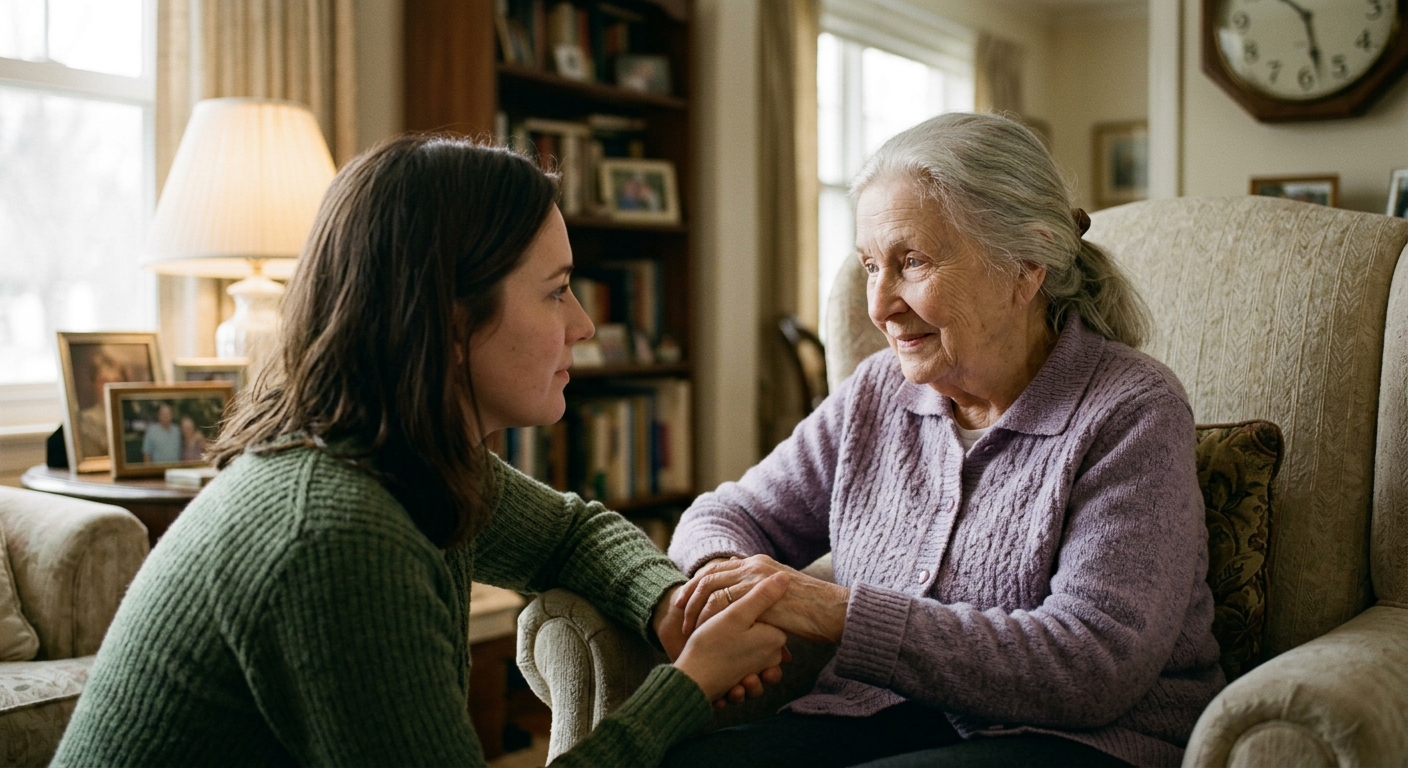
Miriam died six hours after we spoke. In the end, her sister was holding one hand and I was holding the other. It was quiet. It was, by some grace, peaceful.
At her memorial, her former students came in numbers that surprised everyone. They told stories about how she had made them feel seen, specific, named. Clearly, the lesson she had wished she learned sooner was one she had actually been living for years, just without knowing to call it wisdom.
I carry her with me. Not in a heavy way. In the way a compass is light in your pocket but changes the entire direction of your walk.
If someone in your life is close to their end, and you have the chance to sit with them and just listen, please take it. Bring a napkin. You may need to write things down.
And if no one in your life is near the end right now, ask yourself this anyway: What would you say to someone you love if you had six hours left? And then go say it. Today. Before the calendar fills up again.