
🎧 Listen to this story
Narrated by Rasalgethi · 7,539 characters
The Day Everything Shifted
There is a specific kind of silence that only exists at funerals. It is not the silence of an empty room or a quiet morning. It is heavy and full, pressed down by grief and memory and all the things people wish they had said while there was still time. I know that silence well. I sat inside it for three hours on a gray Tuesday in November, staring at a mahogany casket draped in white lilies, making a promise I had no idea would reshape the entire architecture of my daily life.
His name was Gerald. He was seventy-one years old, a retired schoolteacher, my neighbor for eleven years, and one of the most genuinely present people I have ever met. He died of a sudden heart attack on a Wednesday morning, mid-sentence during a crossword puzzle, coffee still warm on the table beside him. His daughter told me that detail at the reception, and I have never forgotten it. Mid-sentence. There is something both terrifying and strangely beautiful about that.
What Gerald Taught Me Without Trying
Gerald had a habit that I used to find mildly amusing and now consider one of the most radical acts of daily living I have ever witnessed. Every single morning, without exception, he would sit on his front porch with his coffee and simply watch the neighborhood wake up. He would wave at the mail carrier. He would call out to children heading to the bus stop by name. He would notice things. A new flower in someone’s yard. A car that hadn’t moved in a few days. A face that looked tired or worried.
He was not doing anything extraordinary by most measures. He was just paying attention. But paying attention, it turns out, is an extraordinary thing in a world that profits enormously from our distraction.
I used to rush past his porch most mornings, coffee in hand, phone already open, mentally three steps ahead of wherever I physically was. He would wave. I would wave back. Sometimes I would stop and we would talk for five or ten minutes, and those conversations were always, without fail, the best part of my day. But I never made time for them consistently. I always had somewhere to be.
Until he was gone. And then I had nowhere to be except standing at his graveside, wishing I had waved more slowly.
The Promise
I did not plan to make a promise at his funeral. It was not a dramatic moment with swelling music. It was quiet and internal and it happened somewhere between the third hymn and the pastor’s closing remarks. I looked at the rows of people around me, each one holding their own version of the same regret, and I thought: I do not want to be here again for someone I love and feel like I missed it.
So I made myself a promise. Small in words, enormous in practice. The promise was this: every single day, I will be where I am. I will look up. I will notice one thing I would have otherwise walked past. I will say the thing I am thinking when I think it, whether it is a compliment, a check-in, or simply an acknowledgment that another person exists and matters.
That was four years ago. I have kept it every day since.
What Keeping the Promise Actually Looks Like
I want to be honest here, because inspiration without specificity is just noise. Keeping this promise does not look cinematic. It does not always feel profound. Sometimes it is inconvenient. Sometimes it feels small to the point of being silly. But it has compounded into something I can only describe as a fundamentally different relationship with my own life.
Here is what it has looked like in practice:
- Putting my phone face-down at meals, not because screens are evil, but because the person across from me is finite and the internet is not.
- Saying the compliment out loud. If I think someone’s laugh is wonderful or their work is impressive or their kindness just made my day easier, I say it. Gerald used to do this constantly and people lit up every single time.
- Sitting outside in the morning, even just for seven minutes, with no agenda other than to exist in the neighborhood I live in and notice what is happening in it.
- Writing one sentence every evening about something specific that happened that day. Not a journal of feelings, just a record of moments. A yellow umbrella. A kid who helped a stranger pick up dropped groceries. The way the light hit the window at 4pm.
- Calling instead of texting when someone crosses my mind. Not always. But more often than before.
- Asking follow-up questions. Gerald was a master of this. He remembered what you told him last week and he asked about it. That is not magic. That is just caring enough to listen the first time.
The Compounding Effect of Small Attention
What I did not expect when I made this promise was how much it would change my relationships, not by grand gestures, but by accumulation. My friendships are deeper. My conversations are longer and less performative. I have reconnected with three people I had been meaning to reach out to for years, simply because I stopped waiting for the perfect moment and made contact when the thought arrived.
I have also found that presence is contagious in the most wonderful way. When you slow down and actually look at someone, they tend to slow down and look back. Conversations that would have been surface-level become real. People tell you things. They trust you with the actual texture of their days, not just the highlight reel.
There is also something it has done for my own internal life that I find harder to put into words. A kind of low-grade anxiety that I had normalized for years, that constant background hum of feeling like I was always behind, always missing something, began to quiet. Not because my life became less busy, but because I stopped experiencing it from a distance.
Gerald’s Porch Is Empty Now
A young couple moved into Gerald’s house about eight months after he passed. They have a toddler who occasionally toddles to the edge of their yard and stares at things with the complete and total focus only very small children and very wise old men seem to manage. I wave at them when I see them. Sometimes I stop and say hello.
I think Gerald would like that.
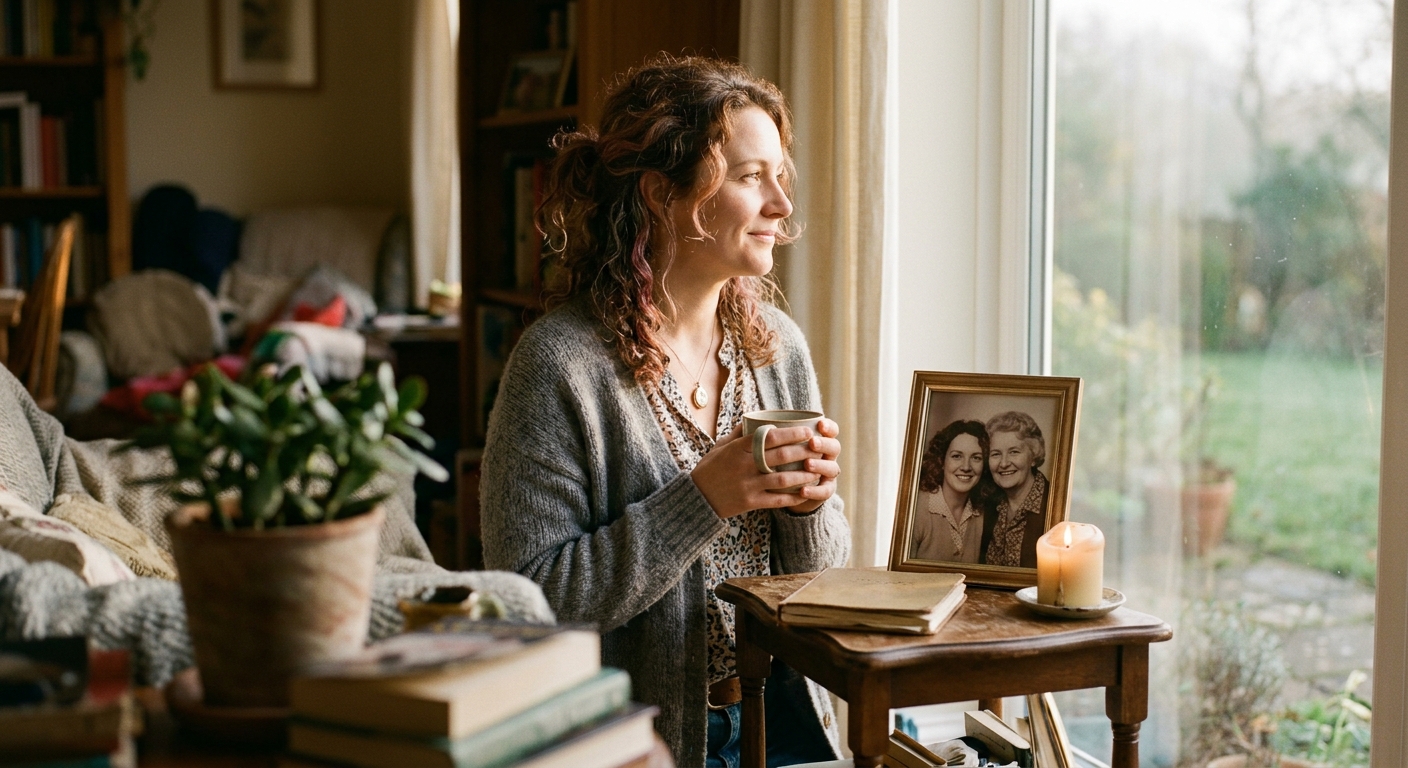
His porch sits empty most mornings now. No one has put a chair back out there yet. But I have started sitting on my own porch more often, coffee in hand, watching the neighborhood wake up, trying to be even a fraction as present as he was. Trying to earn the waves I give and the conversations I have and the days I am lucky enough to move through.
The One Thing I Know for Certain
I cannot tell you that keeping this promise has made me a perfect person or a perfectly present one. I still pick up my phone too quickly sometimes. I still get distracted in conversations. I still have days where I move through hours without really inhabiting them. But the difference is that now I notice. And noticing, I have come to believe, is the entire game.
Gerald did not leave behind a fortune or a famous name or a monument of any kind. He left behind a neighborhood full of people who felt genuinely seen by him, and who are, I suspect, a little kinder and a little more awake because of it. That is not a small legacy. That might actually be the largest kind there is.
If you are reading this and there is someone in your life you have been meaning to slow down for, I am asking you directly: do not wait for a funeral to make the promise. Make it now. Keep it tomorrow. Keep it the day after that.
Mid-sentence is not a bad way to go, but it is a very good reminder that the sentence is happening right now, and it is worth finishing well.