
🎧 Listen to this story
Narrated by Aoede · 7,858 characters
The Moment the Map Disappeared
It started, as most great disasters do, with overconfidence. I had been traveling solo through Japan for six days, and I had begun to feel like I had the whole thing figured out. I knew how to bow correctly at convenience store clerks. I had mastered the IC card tap-in system on the subway. I had even stopped panic-checking Google Maps every thirty seconds.
Then my phone died somewhere between Shinjuku and a ramen shop I was absolutely certain I could find again.
I was in Tokyo, one of the largest, most labyrinthine cities on the planet, with a dead phone, a pocket full of yen, zero Japanese language skills beyond “arigatou gozaimasu,” and the growing, uncomfortable realization that I had absolutely no idea where I was.
What happened in the next four hours changed something fundamental in the way I understand myself. And I did not expect that at all.
The Panic Spiral (And Why It Is Actually Useful)
Let me not romanticize the first twenty minutes. They were awful. I stood on a narrow street lined with vending machines and telephone poles draped in wires, watching pedestrians move with the confident purposefulness of people who belonged somewhere, and I felt completely, utterly untethered.
My instinct, like most people raised in the age of smartphones, was to reach for the device that was no longer useful. I picked it up three times. I pressed the power button each time with the desperate optimism of someone who believes that wanting something hard enough will make it happen. It did not turn on.
Here is the thing about panic that nobody tells you: it is not just an obstacle. It is also information. Once I let myself actually feel it instead of fighting it, something interesting happened. My brain, denied its usual digital crutches, started paying attention differently. I began to actually see where I was.
There was a konbini on the corner. A shrine visible at the end of the block. The sun was low and to my left, which meant I was facing roughly north. I had walked downhill to get here, which meant my hotel was uphill somewhere. Small facts. Useless individually. Together, a beginning.
What Nobody Teaches You About Navigation
We have outsourced our sense of direction so completely that most of us have forgotten we ever had one. But human beings navigated continents long before GPS existed. We read shadows, memorized landmarks, watched how water moved. The capacity is still there. It is just rusty.
I started walking with intention rather than certainty, which is a completely different thing. I looked for patterns. I noticed that streets in this neighborhood seemed to angle toward a larger road I could hear but not yet see. I followed the sound of traffic. I looked up at building signage, not to read it, but to notice which logos repeated, which meant I was staying in a commercial corridor rather than drifting into residential side streets.
And then I did something I had been quietly avoiding the entire trip: I asked for help.
The Kindness Hidden in Getting Lost
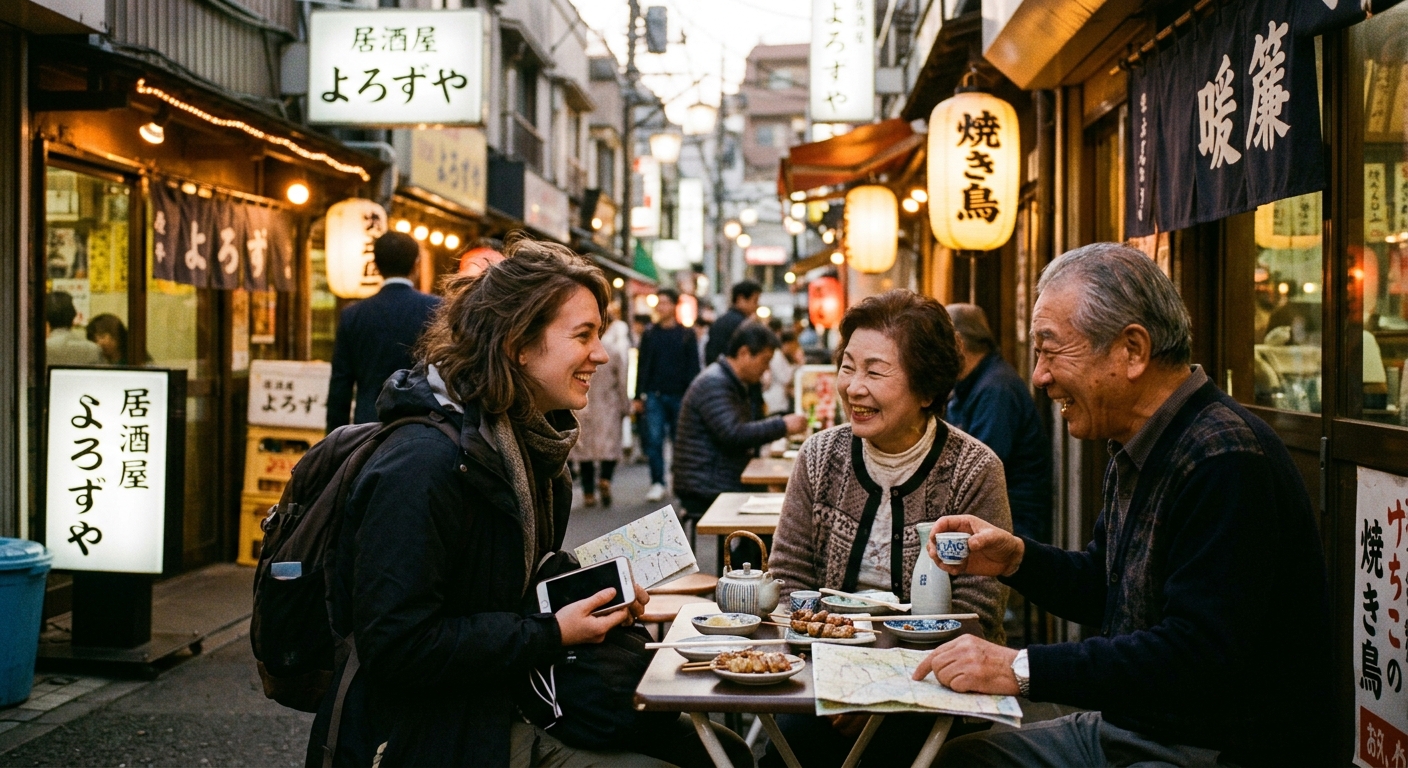
His name, as best I could understand through a combination of gestures and phone translation (his phone, thankfully), was Kenji. He was maybe sixty years old, wearing a rain jacket despite clear skies, and waiting for a bus that apparently was not coming anytime soon.
When I approached him holding a crumpled receipt I had written my hotel name on, he did not look annoyed. He looked delighted. He studied the paper. He made a few sounds. He pointed in a direction, then changed his mind and pointed in a different direction. Then he did something I did not expect: he gestured for me to follow him, walked me four blocks out of his way, and pointed directly at the entrance of a subway station I recognized.
We could not really talk. But there was a moment at the top of those subway stairs where we both just stood there and laughed, and it felt like a conversation. He waved me off like someone seeing a friend onto a train. I bowed about six times more than was probably necessary. He walked back toward his bus stop.
That was it. Five minutes, total. The kind of human interaction that leaves no trace except the feeling it puts in your chest.
Seven Things Getting Lost Taught Me About Trusting Myself
- Discomfort is not the same as danger. I was uncomfortable. I was never actually unsafe. Learning to distinguish between those two sensations is one of the most liberating skills a person can develop.
- Your brain is more capable than your phone has let it be. The moment I stopped waiting to be rescued by technology, I started solving the problem with tools I already had.
- Asking for help is not a failure of self-reliance. It is actually the most self-aware thing you can do. Knowing when you need assistance and being willing to seek it out is its own kind of confidence.
- Slowing down reveals what rushing hides. I had walked through parts of Tokyo for days without really seeing them. Being lost forced me to look, and I noticed things I would have scrolled past: a woman arranging flowers outside a tiny gallery, a cat asleep on a warm transformer box, a temple tucked behind a parking garage.
- You have survived every hard moment so far. This sounds obvious until you are standing on a foreign street feeling like you might not. Your track record for getting through difficult days is, currently, one hundred percent.
- Most people want to help you. We are socialized toward suspicion of strangers, especially in cities. But Kenji was not an exception. In the four hours I was lost, three different people noticed my confusion and offered assistance without being asked. Humans are, by default, pretty decent.
- The moments you did not plan are often the ones you remember. I have forgotten most of the temples I carefully researched and scheduled. I have not forgotten Kenji, or the vending machine I leaned against while I caught my breath, or the specific quality of the late afternoon light on that narrow street where I first realized I was truly, completely on my own.
The Deeper Lesson I Almost Missed
Here is what I have been sitting with since I got home: I spent most of that trip, and honestly most of my adult life, trying to minimize uncertainty. Planning obsessively. Researching every restaurant, every transit route, every contingency. Not because I am unusually anxious, but because that is what our culture tells us competent people do. You prepare. You control. You do not get lost.
But getting lost, truly lost, stripped away every layer of that prepared persona and left me with just myself. And here is the surprising part: myself was enough. Imperfect, a little panicked, bad at reading Japanese signage, but resourceful and observant and capable of asking a stranger for help and finding the way home.
That is the thing about trust. You cannot build it in comfortable conditions. You build it in the moments when the comfortable conditions disappear and you discover what was underneath them all along.
A Note to Anyone Who Feels Lost Right Now
Maybe you are not lost in Tokyo. Maybe you are lost in a career transition, or a relationship that no longer fits, or a version of your life that made sense for a while and no longer does. The specific geography does not matter as much as the feeling: that untethered, disoriented sensation of not knowing which way to go.
What I want to tell you, from the steps of a Tokyo subway station with a stranger’s kindness still warm in my chest, is this: you already have more than you think you do. The capacity to navigate is in you. It has always been in you. Sometimes it just takes a dead phone battery and a city that does not speak your language to remind you of that.
Keep walking. Look for the landmarks. Ask for help when you need it. And pay attention, because the view from being lost, it turns out, is one of the best ones there is.