🎧 Listen to this story
Narrated by Kore · 7,148 characters
The light goes amber first, then rose, then a deep blue that settles over the garden like a folded blanket. For most people, this is the hour of dinner dishes and half-watched television. For a retired railway signalman named Walter, it had become the hardest hour of all. It was the hour his wife used to hum while she pulled the curtains closed.
This is the story of what arrived at his back gate, night after night, once the light began to fade. It is told the way Walter’s neighbor, a district nurse named Ines, told it to me over a long phone call: slowly, with pauses, as if she were still working out why it moved her so much.
The Quiet After the Funeral
Walter lost his wife, Margaret, after forty-six years of marriage. Their children lived overseas and called on Sundays. Friends came in the first weeks with casseroles and careful words, and then, as friends do, they drifted back into their own lives. By the second winter, Walter’s world had shrunk to the size of his house and the long, narrow garden behind it.
Ines noticed it first in small things. The porch light that stayed off. The bins that went out a day late. The way he would stand at the kitchen window at dusk, not looking at anything in particular.
“He wasn’t sad in a loud way,” Ines told me. “He was sad in a way that made the whole house go quiet around him.”
The Thin Visitor at the Gate
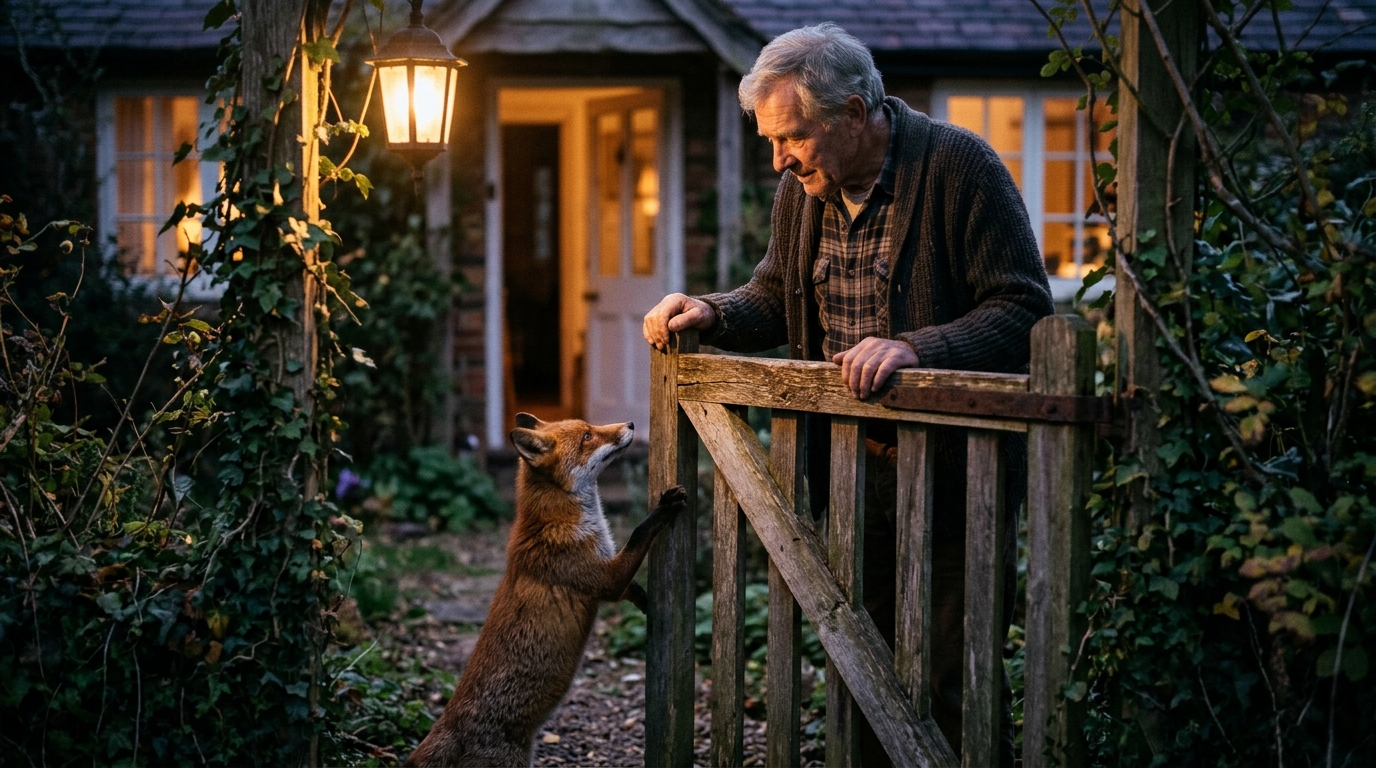
It began with a sound. One evening in late autumn, Walter heard a scratching near the compost heap. He assumed it was a stray cat. Instead, in the last gray light, he saw a young red fox, ribs showing, one hind leg held awkwardly off the ground.
Walter did not call anyone. He did not make a fuss. He did what Margaret would have done: he went inside, found a tin of sardines, and set it down at the edge of the lawn. Then he sat on the back step in his coat and waited.
The fox came forward an inch at a time. It ate. It looked at him, then slipped away into the hedge.
A Wildlife Rescue Steps In
Over the next few evenings, the fox returned at the same hour. Concerned about the injured leg, Walter finally phoned a local wildlife rescue group. A volunteer came, gently examined the animal from a distance, and confirmed what he suspected: an old snare injury, healing badly, and a young animal too weak to hunt well.
The rescue team treated the fox, kept it for several weeks, and released it back at the edge of Walter’s garden once it was strong again. They told him plainly that wild animals do what they like and that he should not expect anything. Foxes are not pets, and they should never become dependent on handouts.
Walter nodded and said he understood. But the next evening, at dusk, the fox was at the gate.
A Small Ritual Takes Shape
What grew between them was never domestic. The fox never entered the house, never let him touch it, never lingered longer than it chose. But a gentle rhythm formed, and rhythm, it turns out, is a kind of medicine.
Walter began setting out a small dish of water and a handful of dry dog food, in line with the rescue team’s advice to offer only modest amounts and never to encourage dependence. Then he would take his tea out to the back step and sit.
- Around dusk: the fox would appear at the gap in the hedge, always the same spot.
- For a few minutes: it would eat, ears flicking at every small sound.
- Before full dark: it would look at Walter, a long, unhurried look, and vanish.
Ines, glancing over the fence one evening, saw her neighbor smiling at nothing she could see. Then she saw the fox.
What the Dusk Gave Back
There is something about the evening hour that makes loneliness louder. The day’s noise falls away, and a person is left alone with their thoughts. For Walter, that hour had been a place he dreaded. Now it held an appointment.
He started leaving the porch light on. He started wearing a proper jacket on the step instead of his dressing gown. He began telling Ines small stories over the fence: the fox had arrived two minutes early today, the fox had stopped to scratch behind one ear, the fox had been joined, once, by a smaller shadow that might have been a cub.
“He said it was the first thing since Margaret that he looked forward to,” Ines said. “Not the fox exactly. The waiting. The having somewhere to be at the end of the day.”
The Lesson of Keeping Things Wild
It matters to say what Walter never did. He never tried to tame the animal or lure it indoors. He never named it in a way that claimed it. When Ines asked what he called his visitor, he said, after a pause, “Nothing. It doesn’t belong to me. It just comes.”
That restraint is part of why the story feels so true. The comfort did not come from ownership. It came from a gentle, mutual noticing, two creatures keeping an unspoken appointment at the edge of the dark.
When the Seasons Turned
The fox did not come every night. In deep winter there were gaps, and Walter would sit on the cold step a little longer, telling himself it was fine. In spring, the visits grew sparse, as they do when a young animal finds its own territory and its own way. Eventually, the gate stayed quiet for a long stretch.
Walter was not heartbroken. That is the part Ines remembers most. He said the fox had done what it was meant to do: gotten strong and gone back to being wild. And something in him had quietly followed the same path.
By then, he had joined a Thursday walking group that Ines had mentioned once, almost in passing. He had started a small vegetable bed where Margaret’s roses used to grow. He phoned his daughter on a Wednesday, not a Sunday, just to tell her about the fox.
Gentle Lessons From the Garden Step
I keep returning to this story in the evenings, and a few things settle in the longer I sit with them:
- Company does not have to be loud to be real. Sometimes presence is simply two living things sharing the same patch of fading light.
- Small rituals can hold a person up. A dish, a cup of tea, a step in the cold: these are tiny anchors, and tiny anchors matter.
- Kindness works best when it asks for nothing. Walter fed a stranger without expecting a thing in return, and was repaid in ways he never planned.
- Wild creatures deserve to stay wild. If you ever find an injured animal, call a licensed rescue and follow their guidance rather than trying to keep it yourself.
Before You Close Your Eyes Tonight
If you live somewhere quiet, step outside for a minute at dusk. Notice the hush, the color draining from the sky, the small rustles at the edge of things. You might not find a fox at your gate. But you may find that the evening, when you stop bracing against it, has company of its own.
And if someone near you is moving through a long, quiet stretch of grief, consider this your gentle nudge. A knock at the door, a shared cup of tea, a note over the fence. You do not have to fix anything. You only have to turn up, at the hour when the light goes soft, and let them know the day is not ending alone.
Walter still sits on his back step most evenings. Sometimes there is a shadow at the hedge. Sometimes there is only the dark, deepening blue, and a man with his tea, no longer waiting for anything, simply glad to be there.