🎧 Listen to this story
Narrated by Kore · 6,724 characters
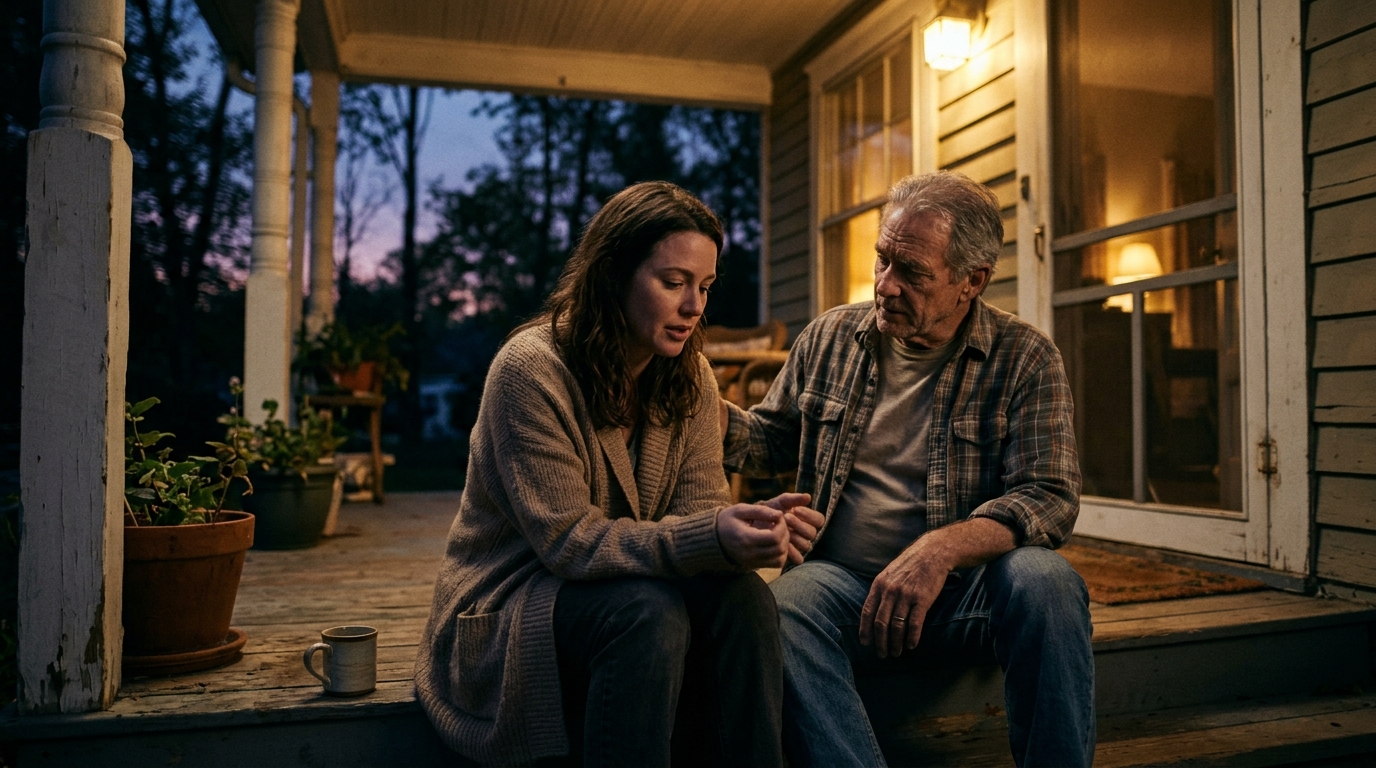
It was 10:47 on a Tuesday night when my father finally said the sentence he had been carrying for eleven years. We were sitting on his back steps, the porch light buzzing above us, moths circling it like tiny, stubborn planets. I had come over to return a casserole dish. I stayed for two hours.
I have thought about that night more than almost any conversation in my adult life, and about a question that came out of it: why do the hardest conversations always seem to happen after dark?
The Day Is a Performance, and Evening Is the Curtain Call
During the day, most of us are playing a role. We are the efficient coworker, the patient parent, the capable friend. We answer emails and carry grocery bags and say “I’m fine” about forty times before lunch. The daylight hours reward composure. Everything has a schedule and a purpose, and an unplanned emotional conversation feels like an interruption, like spilling something on a clean floor.
Then evening comes. The calendar empties, the phone quiets, and something in us loosens. A psychologist I once spoke with described it as the “end of the performance.” By nightfall, we are tired in a way that dissolves our defenses. We no longer have the energy to hold up the version of ourselves we show the world, and what is left underneath is more honest.
What Changes When the Light Fades
- The pace slows. There is no next meeting, no errand waiting. Silence stops feeling awkward and starts feeling spacious.
- Our guards drop. Fatigue strips away the polish. We say things plainly because we are too worn out to dress them up.
- The setting invites softness. Lamplight, a quiet kitchen, a dark car with the engine off. None of these feel like a conference room.
- We are not face to face. Many night conversations happen side by side, on a couch or in a parked car or on a porch step, which makes honesty easier.
The Night My Father Spoke
My father is not a talker. He is a man who shows love by checking your tire pressure and refilling your windshield fluid without being asked. For most of my life, the closest thing to an emotional conversation we ever had was a long pause followed by “You need anything?”
Eleven years earlier, we had a falling out. It was not dramatic. It was one of those slow, quiet fractures: a missed wedding toast, a harsh word about a career choice, a silence that stretched into months and then simply became normal. We spoke on holidays. We were polite. We were strangers who happened to share a last name.
That Tuesday, I handed him the casserole dish, and he said, almost to the porch rail, “Sit a minute.”
We sat. The crickets were loud. A neighbor’s television flickered blue through a curtain across the street. And my father, who had never once said it in daylight, said, “I think about that wedding all the time. I should have stood up. I was just scared I’d cry in front of everybody.”
I did not say anything clever. I did not have a speech prepared. I just said, “I know, Dad.” And then we both sat there, two grown adults, looking at the dark yard while eleven years loosened and slipped away.
Why the Dark Makes Honesty Safer
I have turned this over many times since, and I believe there is a real reason the dark helps. In daylight, a hard conversation feels like a confrontation. Eyes meet, faces are read, reactions are scanned and judged. In the evening, with softer light and fewer distractions, the same conversation feels more like a confession, something offered rather than demanded.
There is also something about the edge of sleep that humbles us. The day’s problems feel smaller when you are about to rest. The grudge you were defending at noon seems exhausting at ten o’clock. Pride is heavy, and by evening we are simply too tired to keep carrying it.
The Quiet Courage of the Late Hour
I do not want to romanticize this too much. Late-night conversations have their risks. Exhaustion can make us say things we do not mean, and anyone who has argued at 1 a.m. knows that fatigue can sharpen words as easily as soften them. But I have noticed a difference between the conversations that go wrong at night and the ones that go right. The ones that go right usually start with someone choosing to be gentle, not someone choosing to win.
What That Night Taught Me
I drove home slowly that night, windows down, the streetlights passing over the dashboard like slow breaths. I felt lighter than I had in over a decade. And I made a few promises to myself that I have tried to keep.
- Do not wait for the perfect moment. My father and I almost never found one in eleven years. The imperfect moment, a casserole dish and a porch light, turned out to be enough.
- Pay attention to the invitation. “Sit a minute” is not a small sentence. When someone slows down near you and the room goes quiet, that is often the door opening.
- Let silence do some of the work. I used to rush to fill every pause. Now I understand that the pause is where the hard truth gathers its courage.
- Choose gentleness over being right. I have rarely regretted softening my voice. I have often regretted raising it.
- Take the conversation as it comes. It does not have to resolve everything. Ours did not. It simply began something.
A Small Practice for the Evening Hours
If there is someone in your life with whom a hard conversation has been waiting, I would offer you a quiet, low-pressure way to begin. Not a big announcement. Not a scheduled “we need to talk.” Just a small opening at the end of a day.
- Offer to sit together without an agenda. A walk after dinner, tea on the porch, a drive with no destination.
- Keep the lights low and the phones away.
- Start with something true and small, like “I’ve been thinking about us lately.”
- Listen longer than you speak.
- Let it end when it ends, even if it feels unfinished.
The Light We Leave On
My father and I are not perfect now. We still communicate mostly through tire pressure and casserole dishes. But something shifted on those back steps. He calls on Sunday evenings now, just as the sky goes amber, and we talk about nothing and everything. Sometimes he is quiet for a long time, and I have learned to simply wait. The silence between us used to feel like a wall. Now it feels like a porch.
I think about that buzzing light above us, the one that drew moths and neighbors’ glances and, somehow, my father’s courage. Maybe the hardest conversations happen after dark because dark is when we finally stop pretending. The day asks us to be impressive. The night only asks us to be present.
So tonight, if you find yourself in a quiet room with someone you love and a truth you have been holding, consider leaving the light on and sitting a minute. You may be surprised what the dark is willing to carry for you.