🎧 Listen to this story
Narrated by Kore · 7,297 characters
The phone rings at 10:47 on a Tuesday night, and Marcy Delgado does not sigh. She does not check the clock and calculate how many hours of sleep she is about to lose. She sets down her tea, reaches for the keys on the hook by the door, and says the same thing she has said for eleven years: “Tell me where you are.”
Marcy is an animal control officer in a mid-sized county, and by every official measure her shift ended at five o’clock. But she has made a quiet promise to herself, one that appears nowhere in her job description: no scared animal in her county waits until morning if she can help it.
The Hour When the World Gets Smaller
There is something about nightfall that changes how everything feels, especially fear. A dog that wandered off during the afternoon seems manageable in daylight. By dusk, the same lost dog is trembling under a porch, unable to find the way home, startled by every passing headlight. A cat trapped in a storm drain at noon is an inconvenience. At midnight, it is a small life running out of patience and warmth.
“Daytime has its own noise,” Marcy told me when I sat down with her on her back steps one evening. “People, traffic, errands. An animal can hide in all of that. But when it gets dark and quiet, they realize they’re alone. That’s when they panic. That’s when I get the calls.”
She has learned to listen for the particular tone in a caller’s voice. Daytime calls are often brisk and procedural. Night calls are softer, more hesitant, sometimes apologetic. People feel they are bothering someone. They are usually worried sick.
How One Night Changed Everything
Marcy does not like telling this part of the story, but she agreed to share it.
Early in her career, she followed the schedule exactly. A call came in after hours about an injured dog on a rural road. The after-hours line routed to a recording, and the message was simple: someone would respond in the morning. Marcy never knew about the call until she arrived at work the next day and read the log.
The dog had been alive when the caller phoned. By sunrise, it was gone.
“I couldn’t stop thinking about it,” she said, quietly. “One phone call. One person who cared enough to try. And the system told them to wait. I decided that night I would never be the reason someone had to wait.”
She asked her supervisor whether she could carry an after-hours phone on a voluntary basis. He said yes, though he warned her it would cost her sleep. It has. She would not trade it back.
What a Typical Night Looks Like
People imagine the work as dramatic rescues, and sometimes it is. More often, it is a long string of small, tender moments. Here is a sample of what Marcy has handled in a single week of evenings:
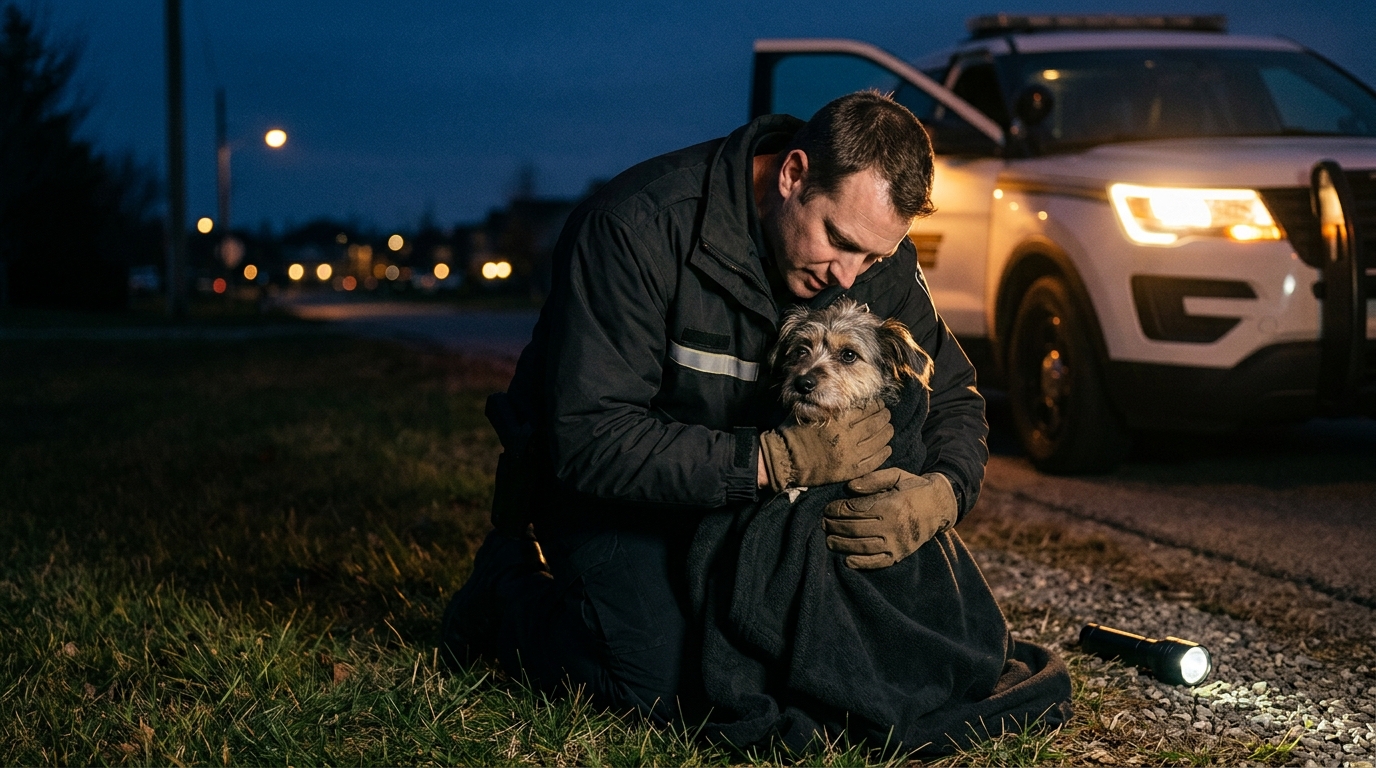
- The porch dog: An elderly terrier mix, shivering on a stranger’s doorstep for hours, with a collar so faded the tag was unreadable. Marcy sat on the cold concrete for twenty minutes before the dog would let her close enough to scan for a microchip.
- The storm drain cat: A young tabby stuck in a drain after a rainstorm, crying loud enough that a neighbor heard it from two houses away.
- The fawn by the highway: A baby deer, motionless near a guardrail, whose mother turned out to be waiting calmly in the tree line. Sometimes the kindest thing is knowing when to leave an animal alone.
- The escaped parrot: A pet bird, loose in a cul-de-sac, answering every attempt at coaxing with a perfect impression of a smoke alarm.
She treats every one with the same unhurried gentleness. “They can’t tell me what’s wrong,” she says. “So I have to slow down enough to hear it anyway.”
The Skills Nobody Teaches You
Over the years, Marcy has built a small collection of quiet habits that make the difference between a terrified animal who bolts and one who finally lets a stranger help. She shared a few of them, and they apply well beyond animal rescue:
- Get low and look away. Direct eye contact reads as a threat to a frightened animal. She crouches, angles her body sideways, and lets the animal come to her.
- Lower your voice, not just your volume. A calm, steady tone matters more than the words. She often just hums.
- Bring a little warmth. A towel from her truck, warmed on the heater vent, has settled more shaking animals than she can count.
- Never rush the last few feet. The final stretch of trust cannot be hurried. It is the animal’s to give.
A Lesson That Settles In at Night
When I asked her what she has learned from all of it, Marcy was quiet for a moment, watching the sky go from amber to violet over her neighbor’s fence.
“Fear is loudest when you think nobody is coming,” she said. “The animals, they don’t know whether help is real. People are the same. Most of what I do is just showing up and proving that someone did.”
The Ones Who Make It Worth It
She keeps a small corkboard in her garage, nothing official, just photographs and handwritten notes people have sent over the years. There is a picture of a gray cat curled on a windowsill, healthy and round-bellied. There is a card from a little girl who drew Marcy as a stick figure holding a leash, with a crooked sun overhead and the words “THANK YOU FOR FINDING MAX.”
Max, it turns out, was a beagle who had been missing for two nights. Marcy found him at nearly one in the morning, curled in a hollow beneath a neighbor’s shed, ribs showing, tail giving the smallest hopeful thump when her flashlight found him. She drove him straight to his family’s house instead of waiting for business hours. The mother answered the door in her robe, took one look, and burst into tears.
“That’s the part I keep,” Marcy said. “Not the exhaustion. That doorway.”
What Her Work Quietly Teaches the Rest of Us
Marcy would be the first to tell you she is not a hero. She is a person who decided that a small, inconvenient kindness was worth repeating. But sitting with her at the end of the day, with the porch light flickering on and crickets starting up in the yard, I could not help noticing how much her philosophy has to offer anyone winding down after a long day of their own.
- Kindness does not keep office hours. The need rarely arrives at a convenient time, and the people who help anyway are the ones we remember.
- Showing up is the whole message. You do not always need to fix everything. Sometimes being present is the rescue.
- Patience is a form of respect. Rushing a frightened creature, or a frightened person, only pushes them further away.
- Small acts accumulate. One towel, one flashlight, one late-night drive. A life of quiet service is built exactly this way.
Before You Turn Out the Light
Tonight, somewhere in the dark, a dog is lost and a cat is stuck and a small, frightened creature is wondering whether anyone is coming. And somewhere, a phone is about to ring.
As you settle in for the evening, maybe take a moment to think of the people whose work begins when ours ends. The ones who keep their boots by the door. The ones who answer on the second ring, never asking what time it is.
Marcy’s phone buzzed once while we were talking. She glanced at the screen, stood up, brushed off her jeans, and smiled the way people do when they are exactly where they mean to be.
“Duty calls,” she said. “Somebody’s waiting.”
And off she went, into the blue hush of the evening, so that no one would have to wait until morning.