
🎧 Listen to this story
Narrated by Aoede · 6,803 characters
A Quiet Problem Nobody Was Talking About
Margaret Eloise Tanner, 79, had lived in the same pale yellow house on Birchwood Lane for over fifty years. She had watched the neighborhood grow up around her, waved at children who were now grown with children of their own, and tended a garden that her late husband Harold had started the year they moved in. But after a fall last winter that left her partially reliant on a wheelchair, something changed. The front steps, all four of them, became a wall.
She did not complain. That was not her way. But her neighbor, Karen Osei, noticed that Margaret had not been seen outside in weeks. No trips to the mailbox. No morning coffee on the porch. Just curtains and silence where there used to be waves and warmth.
Karen mentioned it casually one afternoon to her twelve-year-old son, Devin. She did not expect much. Kids that age are usually buried in screens and schedules. But Devin surprised her. He looked up and said, simply, “We should fix that.”
From a Conversation to a Construction Crew
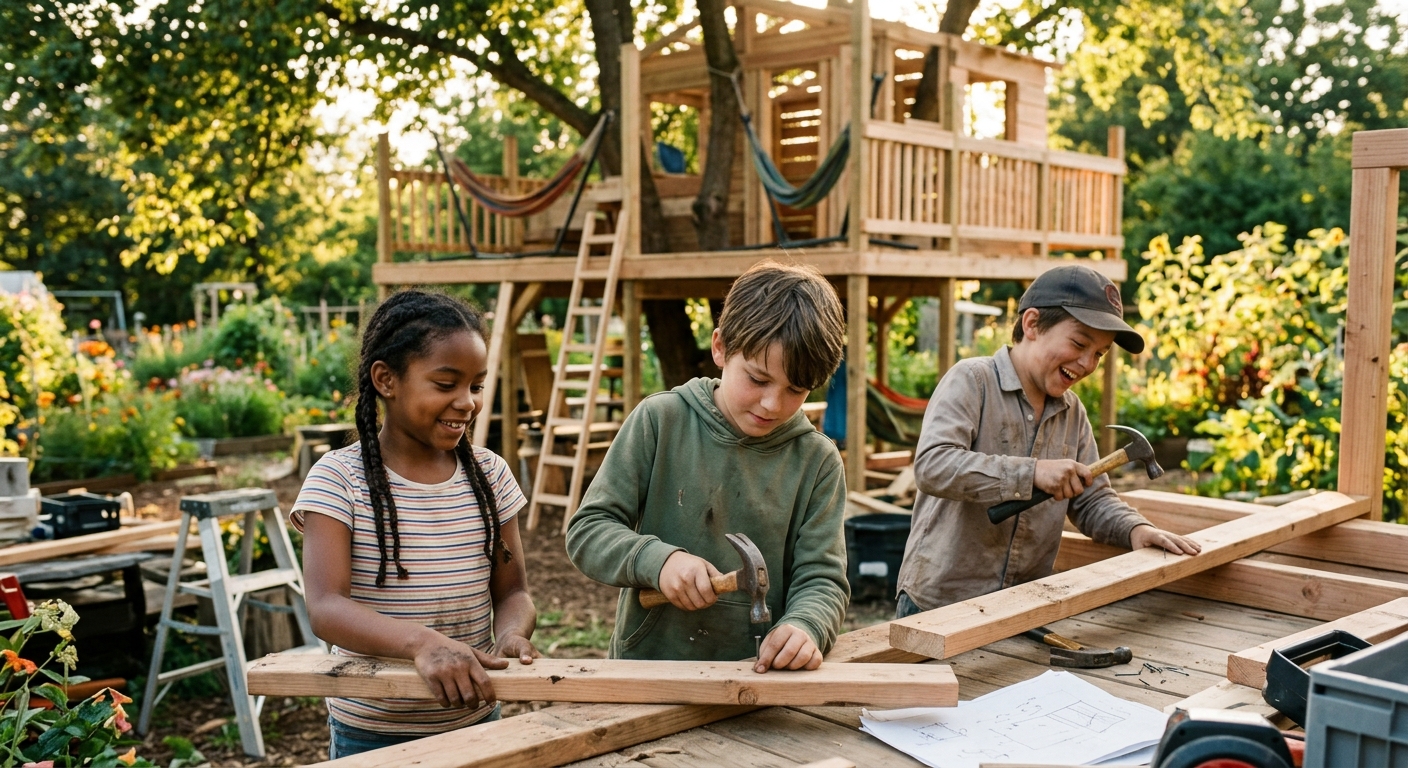
What followed was not a grand organized effort backed by a nonprofit or a viral social media campaign. It started with Devin texting three friends on a Friday night. By Saturday morning, five kids between the ages of ten and fourteen had shown up at Karen’s house with questions and energy and absolutely no experience building anything.
Devin had spent Friday evening watching YouTube tutorials on wheelchair ramp construction. His friend Priya had printed out ADA guidelines for ramp slope ratios. Another friend, a quiet boy named Sam who rarely spoke up in school, turned out to have a father who worked in construction. Sam made a call. By 9 a.m. Saturday, Sam’s dad, Roderick, had pulled up with a truck bed full of pressure-treated lumber, screws, and tools.
“I told them I’d supervise,” Roderick said later, “but honestly, after the first hour, I mostly just watched. These kids had a plan.”
What the Weekend Actually Looked Like
Building a proper wheelchair ramp is not a small task. It requires precise measurements, structural support, a slope that is gradual enough to be safe, and handrails that can bear real weight. Here is how the weekend unfolded:
- Saturday morning: Measuring the porch height, calculating the ramp length needed for a safe 1:12 slope ratio, and sketching a rough plan on notebook paper.
- Saturday afternoon: Cutting lumber with Roderick guiding every saw stroke, assembling the frame, and anchoring it to the base of the porch.
- Saturday evening: Realizing the first section was slightly off-level and taking it apart to correct it, a moment that tested everyone’s patience and commitment.
- Sunday morning: Laying the decking boards, sanding rough edges, and installing side rails.
- Sunday afternoon: A final coat of weatherproof sealant and a test run with Roderick’s own rolling office chair.
Margaret had no idea any of this was happening. Karen had kept it a secret, telling her only that there was “some work being done next door” to explain the noise.
The Moment Margaret Came Outside
When Karen knocked on Margaret’s door Sunday evening and asked her to come see something, Margaret assumed it was a garden update or a stray cat situation. She wheeled herself to the doorway, looked out, and went completely still.
A clean, solid ramp stretched from her front door down to the walkway, its wood still pale and smooth, handrails on both sides, exactly the right width for her chair. On the ramp itself, the kids had lined up a small row of potted marigolds they had picked up from a garden center that morning, her favorite flower, which Devin had learned about from Karen.
“I just kept looking at it,” Margaret said afterward, her voice catching. “I thought someone had hired professionals. Then I saw those kids standing in the yard, all dirty and proud, and I just fell apart in the best way.”
She rolled down the ramp on her own for the first time. The kids cheered like she had crossed a finish line. In a way, she had.
What These Kids Understood That Many Adults Forget
There is a tendency, when we see a problem in our community, to wait. To wait for someone else to step in, for a program to be created, for funding to arrive, for the right moment. These kids did not wait. They assessed what was needed, found the resources they had access to, learned what they did not know, and did the work.
Priya, when asked why she gave up her weekend for a neighbor she barely knew, shrugged and said, “She couldn’t get out of her house. That’s not okay.”
That’s it. That was the whole moral framework. It was not okay, so they changed it.
Lessons Worth Carrying From Birchwood Lane
The story of Margaret’s ramp has some things to teach all of us, regardless of age:
- Noticing is the first step. Karen noticed Margaret’s absence. Devin listened when she mentioned it. Paying attention to the people around us is the beginning of everything.
- You do not need expertise to start. None of these kids had built anything before. They found tutorials, asked for help, and learned as they went.
- Kids are capable of far more than we expect. When we give young people real problems to solve and trust them with real tools, they often rise in ways that humble the adults around them.
- Small communities contain enormous resources. One call to Sam’s dad unlocked lumber, tools, and professional guidance. The help was already there. It just needed to be asked for.
- The detail matters. Those marigolds. Someone thought to ask what Margaret’s favorite flower was, and someone else went and bought them. Kindness with specificity is kindness that lands.
What Happened After
The story did not end on Sunday evening. In the weeks that followed, Margaret began coming outside again, often in the mornings when the light was soft. She started talking to the neighborhood kids, sharing stories about what the street looked like in 1974, pointing out where old trees used to stand.
Devin started stopping by on his way home from school. Then Priya. Then Sam. Margaret, who had been quietly disappearing into her house, became something of an unofficial neighborhood historian and an unlikely friend to a group of middle schoolers who now had a project they were proud of for the rest of their lives.
Roderick, Sam’s dad, said it best: “I’ve worked on a lot of builds. I don’t remember most of them. I will remember this one forever.”
A Final Word
We spend a lot of time looking for inspiration in big places. In speeches and movements and historic moments. But sometimes it arrives on a Saturday morning in the form of a twelve-year-old with a printed ADA guideline and a group of friends who decided that a woman they barely knew deserved to get out of her own front door.
The ramp is still there on Birchwood Lane. It is holding up well. So is Margaret.