
🎧 Listen to this story
Narrated by Callirrhoe · 7,031 characters
Nobody Was Supposed to Notice
Maria Gonzalez has worked as a hotel housekeeper at a mid-sized hotel in Tucson, Arizona for eleven years. She changes sheets, scrubs bathrooms, restocks toiletries, and vacuums carpets. It is physically demanding, often invisible work. Most guests never see her face. They simply arrive to a fresh room and move on with their day.
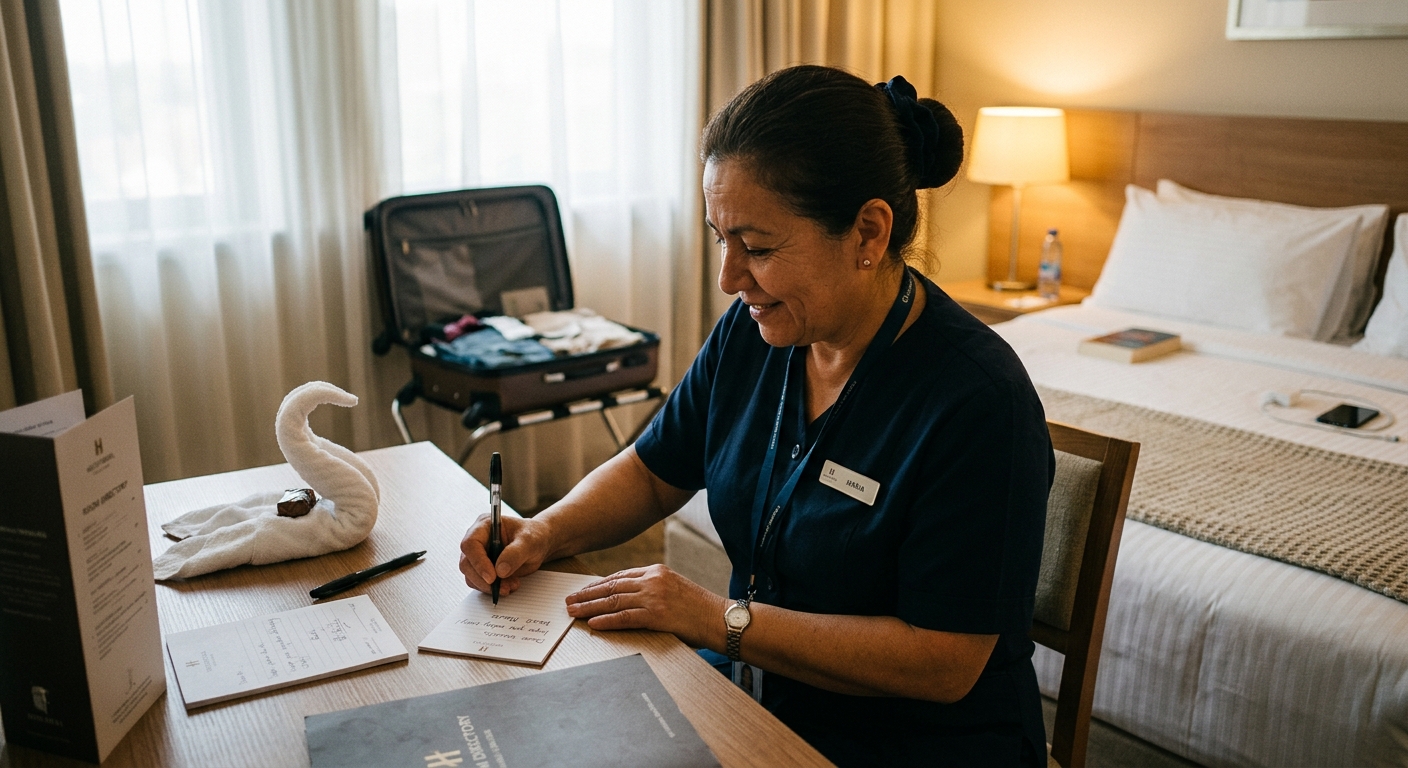
But for the past four years, Maria has been doing something that her employer never asked her to do, that no training manual ever suggested, and that most guests never expected. Every single room she cleans, she leaves behind a small handwritten note of encouragement.
A sticky note on the bathroom mirror. A folded card tucked beside the lamp. A few words written on a small piece of paper placed on top of a neatly made bed. The messages are simple, genuine, and entirely her own.
“You are stronger than you think.”
“Whatever brought you here, I hope today is a good day.”
“You are not alone. Someone is cheering for you.”
She has no way of knowing who will read them. A traveling salesperson running on three hours of sleep. A family passing through after a funeral. A young woman celebrating a birthday alone. A couple on the edge of falling apart. She does not know. She simply writes, folds, and leaves the note behind.
How It Started
Maria did not wake up one morning with a grand plan. The idea came quietly, the way most meaningful things do.
“I was going through a really hard time myself,” she explained in an interview with a local community newsletter that first picked up her story. “My mother had just passed, and I was grieving and still coming to work every day because I had to. And I kept thinking about how many people must be walking through these doors carrying something heavy. Grief, stress, loneliness. You can see it sometimes in how a room is left.”
She noticed things. A crumpled tissue on the nightstand. A half-eaten meal left untouched. A Bible open to a specific page. A pair of tiny baby shoes left behind, clean and unworn.
“Rooms tell stories,” she said. “And I thought, what if I could leave just a little something back? Not much. Just a reminder that somebody sees them, even if they never see me.”
She bought a small pack of index cards and a blue pen on her lunch break. The next day, she started writing.
The Notes That Hit Hardest
Most guests said nothing. But some did. And those responses became the fuel that kept Maria writing, day after day, for four years straight.
A front desk manager at the hotel shared a few of the guest comments that had come in over the years:
- A man traveling for a job interview wrote in a review that he had been paralyzed by anxiety the night before, and the note on his mirror that said “You already have everything you need” made him take a deep breath and walk into that interview with confidence. He got the job.
- A woman who had been sitting alone on the edge of her bed, seriously considering not going home, found a note that read “Today, you matter. Please keep going.” She later called the hotel just to ask who had left it. She wanted to say thank you.
- A teenage boy traveling with his parents told the front desk that the note in their room had made his mom cry in the best way possible because she had not felt seen in a long time.
Maria heard about these responses, but she never sought them out. She kept her head down and kept cleaning. She kept writing.
What Her Coworkers Think
At first, some of her colleagues thought it was a little unusual. A few were charmed by it. Others worried she might get in trouble for using hotel supplies or leaving unauthorized items in rooms.
“I bring my own paper and my own pen,” Maria said simply. “It costs me almost nothing. And I do it on my own time, during my breaks or before I leave a room.”
Her supervisor, after learning what had been quietly happening in Maria’s section of the hotel for months, did not reprimand her. She cried. Then she told the hotel manager. And the manager, rather than shutting it down, asked if Maria would be willing to share what she did with the rest of the housekeeping staff, not as a requirement, never as a requirement, but as an invitation.
A few of her coworkers started leaving notes of their own. Not everyone. But a few.
The Bigger Picture: Why Small Gestures Are Not Small
There is a temptation to call what Maria does a “small act of kindness.” But researchers and psychologists who study human connection would push back on the word “small.”
Studies in positive psychology have consistently shown that unexpected expressions of warmth, especially from strangers, can have outsized effects on a person’s mood, sense of belonging, and even their willingness to help others. The concept is sometimes called “elevation,” a warm, uplifting feeling triggered by witnessing or receiving moral beauty.
In other words, a sticky note that takes thirty seconds to write can activate something real in the human nervous system. It is not a small thing dressed up as a big one. It is genuinely significant.
Maria, who has never read a psychology study in her life, already knew this intuitively.
“We are all just passing through,” she said. “Hotels remind me of that. Everyone is on their way somewhere. And sometimes, on the way somewhere, people just need to know they are not invisible.”
7 Things We Can All Learn from Maria’s Simple Habit
- Kindness does not require permission. Maria did not wait for her employer to create a kindness program. She just started.
- You do not need to know someone to encourage them. In fact, encouragement from a stranger can feel even more powerful because it carries no agenda.
- Consistency matters more than grand gestures. Four years. Fourteen rooms a day. That is thousands of notes. The habit was never dramatic. It was just steady.
- Your own pain can become your compass. Maria started this because she was grieving. She turned her own loneliness into a bridge toward others.
- Invisible work is not insignificant work. Housekeepers, janitors, cafeteria workers, bus drivers. The people we often overlook are sometimes the ones quietly holding communities together.
- You may never know the full impact of what you give. Most guests never responded. Maria kept going anyway.
- The smallest tools can do the deepest work. A pen. An index card. Two sentences. That is all it took.
A Note for You
If Maria were cleaning your room today, she would probably leave you something like this:
“Hi. I don’t know what today holds for you. But I hope you find one small reason to smile. You are more appreciated than you know. Safe travels.”
And she would tuck it beside your lamp, smooth out the corner of your bedsheet, and wheel her cart quietly to the next room. She would not wait to see your reaction. She would not need to.
Because for Maria Gonzalez, the act of leaving kindness behind is not about recognition. It is about responsibility. A belief that if you have a chance to make someone feel less alone in this world, even for a single moment, you take it.
Every single time.