🎧 Listen to this story
Narrated by George · 7,214 characters · approx. 8 min read
The Day She Stopped Pretending Rehab Was Working
Maya Sorenson had been through three rounds of inpatient rehabilitation by the time she was thirty-one. Three times she had packed a bag, said goodbye to her daughter, Lily, and walked through the doors of a facility that promised her a new beginning. Three times she had relapsed within six months of leaving.
She is not sharing this story for sympathy. She is sharing it because she wants people to understand something that the addiction recovery community does not always say out loud: for some people, the clinical model alone is not enough. And admitting that does not make you a failure. It makes you honest.
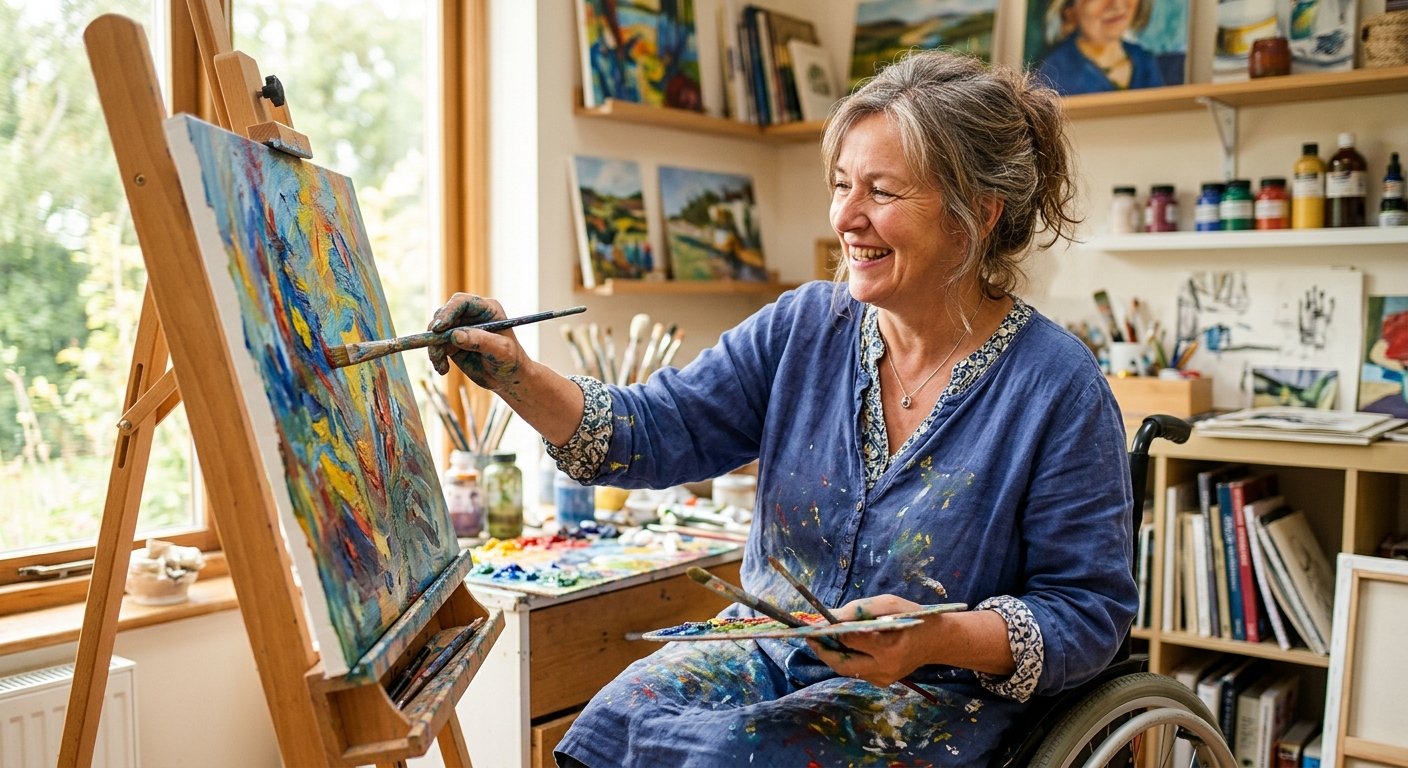
“I was doing everything they asked,” Maya told us over coffee in her Portland, Oregon studio, surrounded by canvases in varying stages of completion. “The group sessions, the affirmations, the medication. I genuinely wanted to get better. But I kept leaving those places feeling emptier than when I arrived. Like I had been cleaned out but not filled back up.”
That emptiness, she now believes, was the missing piece that no checklist or twelve-step program could address on its own. She needed something to pour herself into. She needed a reason to stay.
A Sketchbook Left on a Park Bench
The turning point came from the most ordinary of moments. After her third relapse, Maya was spending an afternoon in a public park near her apartment, trying to simply exist without using. A woman nearby was sketching the trees. When the woman left, she accidentally left her sketchbook behind on the bench.
Maya picked it up. She flipped through the pages, fully intending to find a name or number to return it. Instead, she sat there for nearly an hour, transfixed by the quiet, confident lines on each page. The sketches were not perfect. They were sometimes wobbly, sometimes incomplete. But they were alive in a way she had not felt herself to be in years.
She left a note on the bench with her number in case the woman returned. Then she walked to the nearest drugstore and bought a five-dollar sketchbook and a pack of pencils.
“I didn’t know what I was doing,” she laughed. “I hadn’t drawn anything since middle school. I just started drawing the park. The bench. My own hand. I didn’t even go home for dinner that night.”
Why Art Reaches Where Therapy Sometimes Cannot
What Maya experienced is not unique to her, and it is increasingly being validated by research in the field of addiction recovery. Art therapy has grown significantly as a complementary treatment, with studies suggesting that creative expression activates parts of the brain associated with reward, emotional regulation, and identity formation, the very systems that addiction hijacks.
Dr. Carla Mendez, a licensed clinical psychologist specializing in addiction and trauma, explains it this way: “Talk therapy is enormously valuable, but it relies on language. And a lot of what happens in addiction lives beneath language. It lives in the body, in shame, in the pre-verbal. Art gives people a way to externalize and examine experiences they literally cannot put into words.”
For Maya, this rang deeply true. “When I was using, I couldn’t explain why. People kept asking me why and I didn’t have an answer. But when I started painting, things started coming out of me. Grief I didn’t know I was carrying. Fear. This deep sense of not belonging anywhere. The canvas became a place where I could look at myself without flinching.”
Building a New Identity, One Canvas at a Time
Over the following months, Maya painted obsessively. She started with pencil sketches, then moved to watercolor, then to large, expressive acrylic pieces that she describes as “arguments I was having with myself on canvas.” She was not thinking about sobriety in those early months. She was thinking about the next painting.
That shift, she says, was everything.
“Recovery programs kept telling me to focus on not using. But focusing on the absence of something is exhausting. You are always fighting a negative. When I started making art, I was focused on something I wanted to build. That was a completely different energy.”
She also found community in unexpected ways. She began attending a free open studio night at a local community arts center. She met other people who were working through things, not all of them in recovery, but all of them using creativity as a kind of honest labor. She made friends for the first time in years that were not connected to using.
What She Wants People to Know
Maya has now been sober for four years. Her daughter Lily, now nine, sometimes paints alongside her on weekend mornings. Maya recently had her first small gallery showing, and she continues to facilitate a free weekly art session for people in recovery at the community center where she first found her footing.
She is clear-eyed about what worked for her and careful not to prescribe it as a universal solution. “I’m not saying rehab doesn’t work. It absolutely works for many people. I’m saying it didn’t work for me alone. And if you’re someone who keeps relapsing and keeps feeling like something is missing, maybe the missing thing is not willpower. Maybe it’s a creative outlet. Maybe it’s music, or woodworking, or gardening. Something that makes you want to be here tomorrow.”
Key Lessons From Maya’s Journey
- Abstinence alone is not a destination. Long-term recovery often requires building a life that feels worth protecting.
- Traditional treatment is a starting point, not the only point. Combining clinical care with creative or expressive therapies can address dimensions of addiction that talk alone misses.
- Identity reconstruction is central to healing. Addiction often erodes a person’s sense of self. Creativity offers a way to rebuild one that feels genuine and earned.
- Community matters, but it does not have to come from recovery groups exclusively. Finding belonging in any shared, purposeful space can be profoundly stabilizing.
- Progress is not linear, and relapse is not the end of the story. Maya’s three failed attempts were not failures. They were part of a longer arc still unfolding.
The Painting on Her Studio Wall
Before we left her studio that afternoon, Maya pointed to a large painting hanging near the door. It was chaotic and dark in the lower half, deep blues and blacks layered over each other in thick, urgent strokes. But the upper portion broke open into warm golds and soft oranges, the colors thinning out toward the edges as if dissolving into light.
“That’s the first painting I made when I realized I wasn’t going to use again,” she said quietly. “I didn’t plan it. I was just painting how I felt. And somewhere in the middle of it, something shifted. I looked at what I was making and thought, I want to see what this becomes. I want to be around to finish it.”
She has finished hundreds since then. And she is very much still here.
If you or someone you love is navigating addiction and feeling like conventional paths are falling short, know that there are complementary resources available. Organizations like the American Art Therapy Association (arttherapy.org) can help connect people with licensed art therapists who specialize in trauma and recovery.