🎧 Listen to this story
Narrated by Leda · 8,013 characters
A Morning Like Any Other, Until It Wasn’t
Dale Huffman had been ranching the same stretch of land in eastern Colorado for over four decades. Every morning, rain or shine, he walked the fence line, checked on his cattle, and spent a quiet hour with his horses before the rest of the world woke up. It was a ritual as dependable as sunrise.
But on a crisp Tuesday morning in late October, something went terribly wrong. Roughly 400 yards from his farmhouse, Dale suffered a massive cardiac event. He collapsed into the dry grass, alone, with no phone, no neighbors within earshot, and no way to call for help. By all accounts, the situation was fatal. And yet, Dale Huffman is alive today. His family credits one unlikely guardian: a chestnut quarter horse named Copper.
What the Family Found When They Came Looking
When Dale did not return for breakfast, his wife, Patricia, assumed he had simply lost track of time. That was not unusual for a man who loved his land the way most people love their families. But by mid-morning, with no sign of him anywhere near the barn or the house, she began to worry.
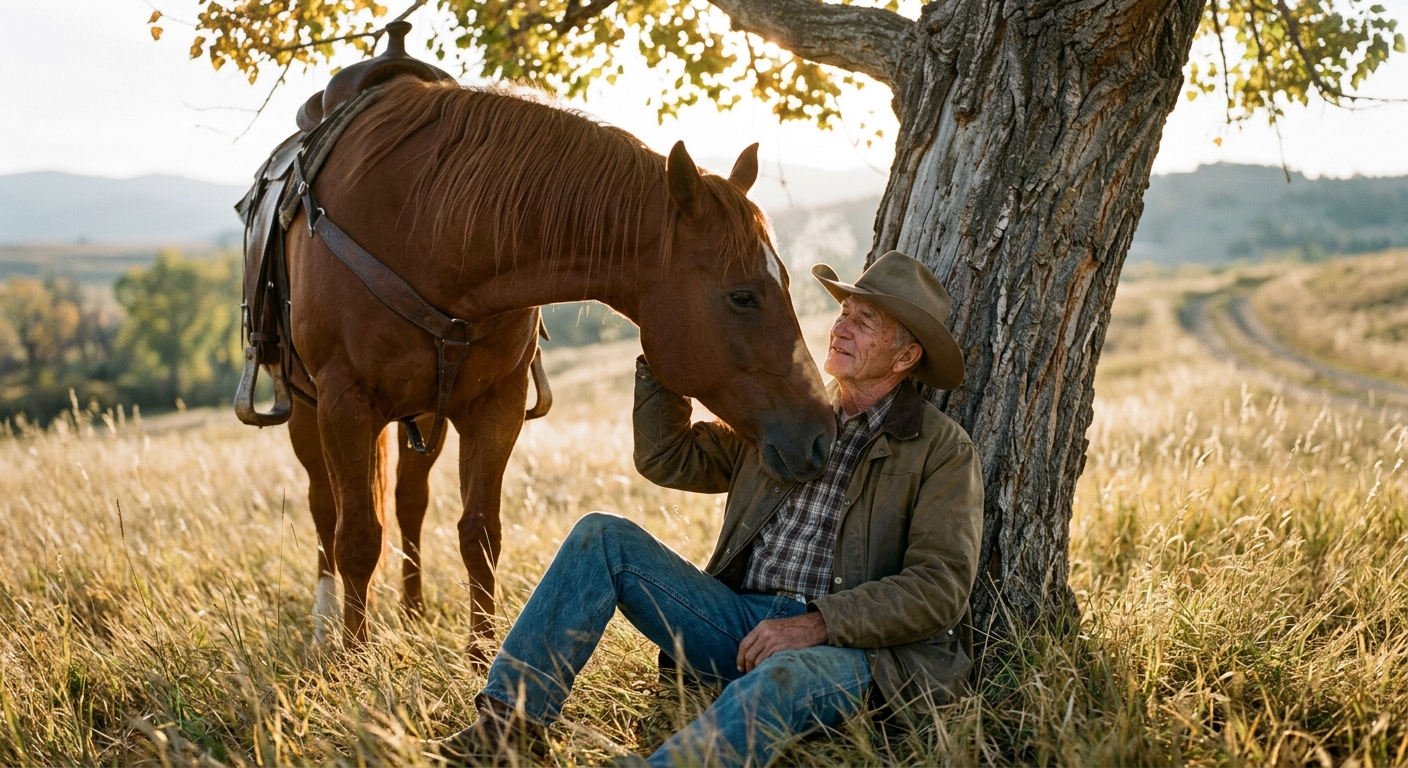
Patricia’s son, Marcus, drove the property in his truck. What he found at the far edge of the east pasture stopped him cold. Dale was on the ground, barely conscious, his face pale and his breathing shallow. And standing directly over him, motionless, was Copper.
“Copper was not grazing, not pacing, not doing anything a horse normally does when left alone in a field,” Marcus recalled. “He was just standing there, positioned over my dad almost like he was shielding him. His head was lowered, and he was making this low sound, almost like a hum. I had never seen anything like it in my life.”
Copper had been beside Dale for an estimated three to four hours. The horse had not wandered, had not spooked, and had not returned to the barn where his feed waited. He had simply stayed.
Can Animals Actually Sense a Medical Crisis?
The story of Dale and Copper is remarkable, but it is far from isolated. Across the world, horses, dogs, cats, and even birds have been documented responding to human medical emergencies in ways that defy easy explanation. Researchers and animal behaviorists have spent years trying to understand exactly what is happening in these moments.
Dr. Linda Cole, an animal cognition researcher affiliated with Colorado State University who was not involved in Dale’s case but has studied similar incidents, offered some context: “Horses are prey animals with extraordinarily sensitive sensory systems. They can detect changes in human heart rate, cortisol levels, and even subtle shifts in body chemistry that occur during a cardiac event. Whether we call it instinct, empathy, or something else entirely, the response is measurable and it is real.”
Horses have been shown in multiple studies to read human emotional and physical states with surprising accuracy. A 2018 study published in the journal Biology Letters found that horses can distinguish between positive and negative human facial expressions and adjust their own stress responses accordingly. A dying or critically ill person would present a constellation of signals, physical and chemical, that a bonded horse would register immediately.
What Copper May Have Detected
- Changes in breathing patterns: Cardiac events dramatically alter respiration, and horses are acutely sensitive to breath sounds and rhythms.
- Body temperature shifts: A person in cardiac distress experiences sudden temperature fluctuations that a nearby animal can detect.
- Chemical signals: Fear, pain, and physiological crisis all trigger hormonal releases that horses can smell at close range.
- Muscle collapse and stillness: Horses are highly attuned to the body language of those they are bonded to, and sudden stillness reads as a serious alarm signal.
The Bond That Made It Possible
Those who know Dale and Copper say the horse’s response was not random. It was the product of a relationship built over twelve years of daily contact, mutual trust, and something that horse people sometimes struggle to name but immediately recognize when they see it.
Dale had raised Copper from a foal after purchasing him from a breeder in New Mexico. The two had worked cattle together, navigated blizzards together, and spent thousands of quiet hours in each other’s company. Patricia describes Copper as “more like a member of the family than a farm animal.”
“Dale used to say that Copper always knew his mood before he did,” Patricia said, her voice steady but soft. “If Dale was having a hard day, Copper would press his head against his chest and just stand there. Dale called it his therapy. I used to tease him about it. I don’t tease him about it anymore.”
What Veteran Horse Trainers Say
Longtime horse trainer and behavioral consultant Ray Dellacroce, who has worked with horses for 35 years across Wyoming and Colorado, says stories like Copper’s are not as rare as people think. They are simply underreported.
“Horses that are deeply bonded to a person will absolutely change their behavior when that person is in danger,” Dellacroce explained. “I have seen horses refuse to leave a fallen rider, refuse to cross a trail where danger was present, and stand guard over humans and other animals in distress. People are surprised because they underestimate how emotionally complex these animals are. Copper did not just notice something was wrong. He made a choice to stay. That is the part that matters.”
The Recovery, and What Dale Says Now
Dale was airlifted to a regional hospital where he underwent emergency surgery for a blocked artery. His cardiologist told the family that another thirty to sixty minutes without intervention would likely have been fatal. The three to four hours Copper stood vigil were the hours that kept Dale alive long enough to be found.
Dale spent eleven days in the hospital and several months in cardiac rehabilitation. Today, he walks with a little more caution and carries his phone every time he goes out to the pasture. He has made one other change to his routine.
Every single morning, before he does anything else, he goes to Copper’s stall, presses his forehead against the horse’s nose, and stays there for a few minutes in silence.
“People ask me if I think Copper knew what he was doing,” Dale said during a conversation with a local Colorado agricultural publication last spring. “I don’t know how to answer that in a scientific way. What I know is that he stayed. When everything in his nature said to move, to graze, to go back to the barn, he stayed. If that isn’t love, it’s the closest thing to it I have ever seen in this world.”
What This Story Teaches Us About Connection
Beyond the medical marvel and the emotional weight of Dale and Copper’s story, there is something quieter and more universal here. It is a reminder that the bonds we build, with animals, with people, with the places we inhabit, are not decorative. They are survival-level real.
Copper did not stay because he was trained to. He was not a service animal or a rescue dog. He was a ranch horse who loved the man who fed him, rode him, and talked to him every day for twelve years. And when that man needed him most, the horse simply refused to leave.
In a world that often moves too fast to notice the quiet loyalties around us, there is something profoundly grounding about that. The people and creatures who show up when things fall apart are not always the ones we expect. Sometimes they are the ones we have been walking beside all along, without ever fully understanding how much they see.
A Note for Anyone Who Has Ever Doubted Animal Bonds
If you have ever questioned whether the relationship between a person and their animal is truly meaningful, or whether animals experience something like love, consider Copper standing in a cold Colorado field for four hours over a man who could not speak, could not move, and could not offer a single reward for the staying.
He stayed anyway. And that, in the end, is the whole story.