
🎧 Listen to this story
Narrated by Gacrux · 8,234 characters
A Quiet Secret Hidden Behind the Reference Desk
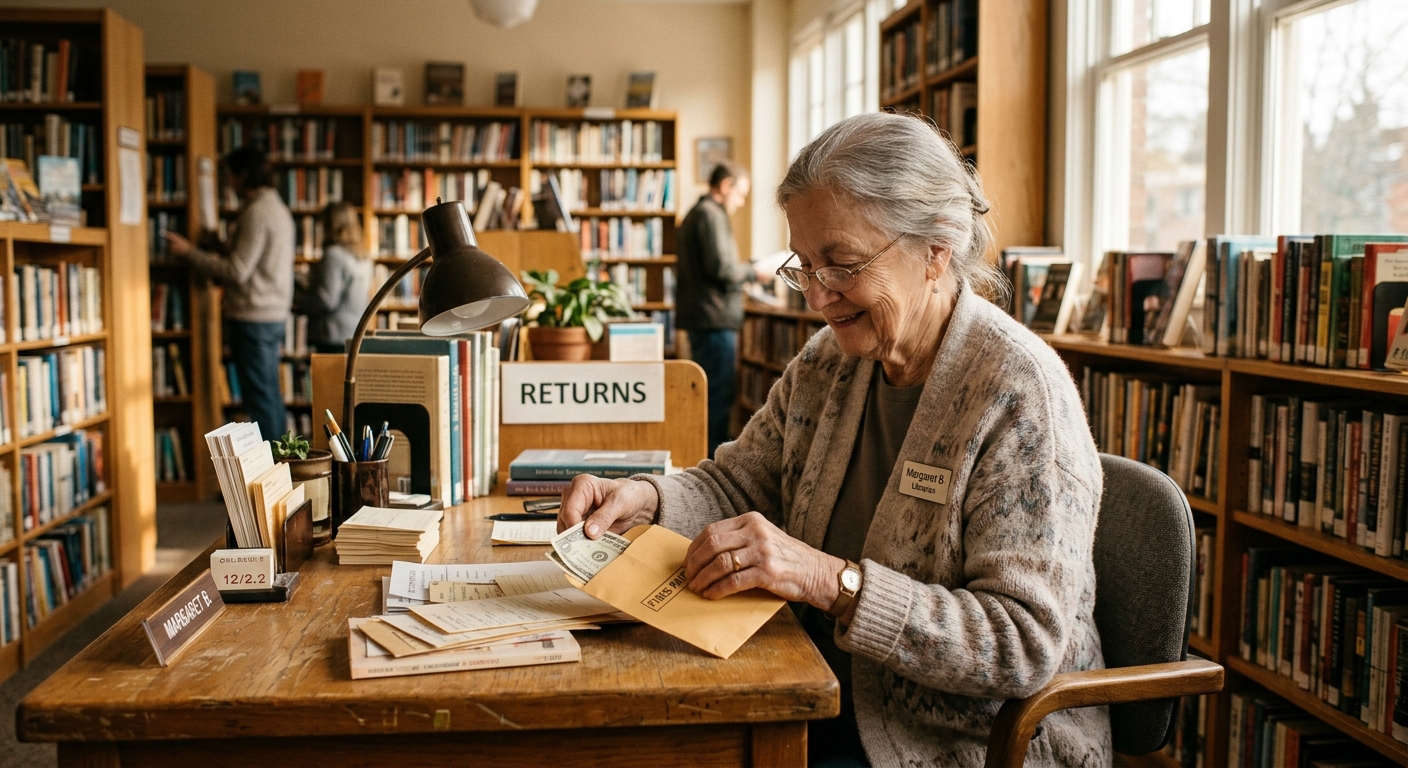
For twenty years, Margaret Elise Tanner arrived at the Crestwood Public Library before anyone else. She made the coffee, straightened the periodicals, and logged into the system with the same steady routine she had kept since 1993. But there was one thing her colleagues never noticed, one small act she performed so carefully and so consistently that it never once showed up on a performance review or a staff newsletter.
Every single overdue fine that came across her desk, she paid herself.
Not the institutional fines. Not the forgotten encyclopedias checked out by university researchers. The ones she paid were the ones that made her chest tighten: the child whose mother came in red-faced and quietly desperate, fishing through a purse that clearly did not have enough. The elderly man who had lost track of time while reading through a stack of World War II histories. The teenager who had checked out five novels over the summer and come back in September with a look that said she already knew she was going to be embarrassed.
Those were the fines Margaret paid. Quietly, at the end of her shift, she would pull up the accounts, check the balance, and make it right out of her own pocket.
How the Story Finally Came to Light
The secret lasted until the spring of 2023, when the Crestwood library system updated its software and a new IT coordinator named Dennis Ruiz began auditing the historical payment records. He noticed a pattern he could not explain: hundreds of small balances, cleared by cash payments in the evenings, linked to an employee ID he eventually traced back to Margaret.
He brought it to the library director, Patricia Solano, who had worked alongside Margaret for eleven years without any idea.
“I genuinely thought it was some kind of data error,” Patricia told a local reporter who later covered the story. “When Dennis showed me the full picture, the total, I had to sit down. I was shaken. In the best possible way, but shaken.”
The total, estimated from the records Dennis could recover, was somewhere between fourteen thousand and seventeen thousand dollars over twenty years. Margaret had never kept her own running tally. She had never wanted to know the number.
In Her Own Words: Why She Did It
When Patricia gently confronted Margaret in her office, she did not deny it. She also did not seem to think it required much explanation. She sat with her hands folded and said something that Patricia later repeated almost word for word to anyone who asked:
“A library is one of the last places left where you can walk in with nothing and leave with something. I never wanted money to be the thing that took that away from somebody.”
Margaret grew up in a household where the library was a luxury that still felt free. Her mother walked her there on Saturday mornings, and those mornings, she has said, were some of the most formative of her life. She discovered science fiction, fell in love with biography, and quietly decided she wanted to live inside that world of books for as long as she could.
She became a librarian not for the salary, which she was the first to describe as modest, but because the library had given her so much that she felt permanently in its debt.
“I figured I was just paying it forward,” she said. “I never thought of it as charity. It was more like… maintenance. Keeping the door open.”
The People Whose Fines She Paid
After the story was covered by a regional newspaper, several people came forward to share their own memories of the Crestwood library in ways that, in retrospect, pointed back to Margaret.
- A woman named Cora remembered bringing her daughter in when she was eight years old. The little girl had kept a book of fairy tales for three months, reading and rereading it. When Cora had tried to apologize for the fine, the librarian at the desk had smiled and said it was already handled. Cora had assumed it was a glitch. Twenty years later, she realized it was not.
- A high school student named Jaylen wrote on social media that he had been terrified to return a graphic novel collection because he had calculated the fine and thought his library card would be suspended. Instead, the woman behind the desk handed him a new reading list and asked if he had tried any of the newer releases. He had no idea his account had been quietly cleared.
- An elderly patron named Walter said he had always assumed the library had some kind of hardship waiver program for senior citizens. He was moved to tears when he learned there was no program. There was only Margaret.
What Her Coworkers Said
The staff reactions ranged from stunned to emotional. A colleague who had worked the adjacent desk for nine years said she felt like she had been sitting next to a quiet superhero the whole time and missed it entirely.
“She never once hinted at it. She never used it to make herself look good. She didn’t put it in a suggestion box or advocate for a policy change, although honestly she probably could have,” said the colleague. “She just fixed the problem herself, every day, and then went home.”
Others noted that Margaret had always been the person who organized the holiday book drives, who stayed late to help patrons navigate government assistance websites, who knew by memory which picture books were appropriate for which reading levels and which children in the community needed extra encouragement.
“Now we understand it better,” Patricia Solano said. “It was never just a job to her. It was a calling.”
7 Things Margaret’s Story Teaches Us About Quiet Generosity
1. Generosity does not require an audience.
Margaret never told anyone. Not a friend, not a family member, not a coworker. She did not post about it, did not hint at it, did not frame it as a sacrifice. The act was complete in itself.
2. Small, repeated actions accumulate into something extraordinary.
No single payment was dramatic. Some fines were less than a dollar. But over twenty years, that daily commitment built into something that changed real lives.
3. Proximity to a problem is a form of responsibility.
Margaret did not campaign for systemic change from a distance. She saw the problem up close, every single day, and decided that was enough reason to act.
4. People remember kindness longer than they remember transactions.
Every person who came forward had carried the memory of that library visit for years. They had not forgotten the feeling of walking out without shame. They had just not known who to thank.
5. You do not need to be wealthy to be generous.
Margaret was not rich. She was a public librarian with a modest salary, living in a mid-sized town. She made it work because she chose to.
6. The places that shaped us deserve our protection.
Her motivation was deeply personal. The library had given her a childhood worth having. She spent her career making sure it could do the same for others.
7. Secrets kept for the right reasons are a kind of grace.
She did not keep it secret out of shame. She kept it secret because she understood that the gift was only a gift if it did not come with a weight for the recipient to carry.
What Happened Next
After the story went regional and then national, a crowdfunding campaign was launched to reimburse Margaret. She asked for it to be stopped. The funds were redirected, with her blessing, to establish a permanent fine forgiveness fund at the Crestwood library, ensuring that no patron would ever lose access to their card due to an unpaid fine.
The library named a reading corner after her. She protested that too, though less convincingly.
Margaret Tanner retired in June of 2023, six months after the story broke. At her retirement party, surrounded by two decades of colleagues and dozens of patrons who had heard the news and wanted to say thank you in person, she reportedly smiled and said she just hoped the coffee would stay as good without her.
She left, as she had always worked: without fanfare, without drama, and without asking for anything in return.
Some people change the world loudly. Margaret Elise Tanner changed hers one overdue fine at a time, quietly, for twenty years, and never once thought it was anything special.
That is exactly what makes it so.