
🎧 Listen to this story
Narrated by Schedar · 7,699 characters
An Unlikely Family at a Brazilian Sanctuary
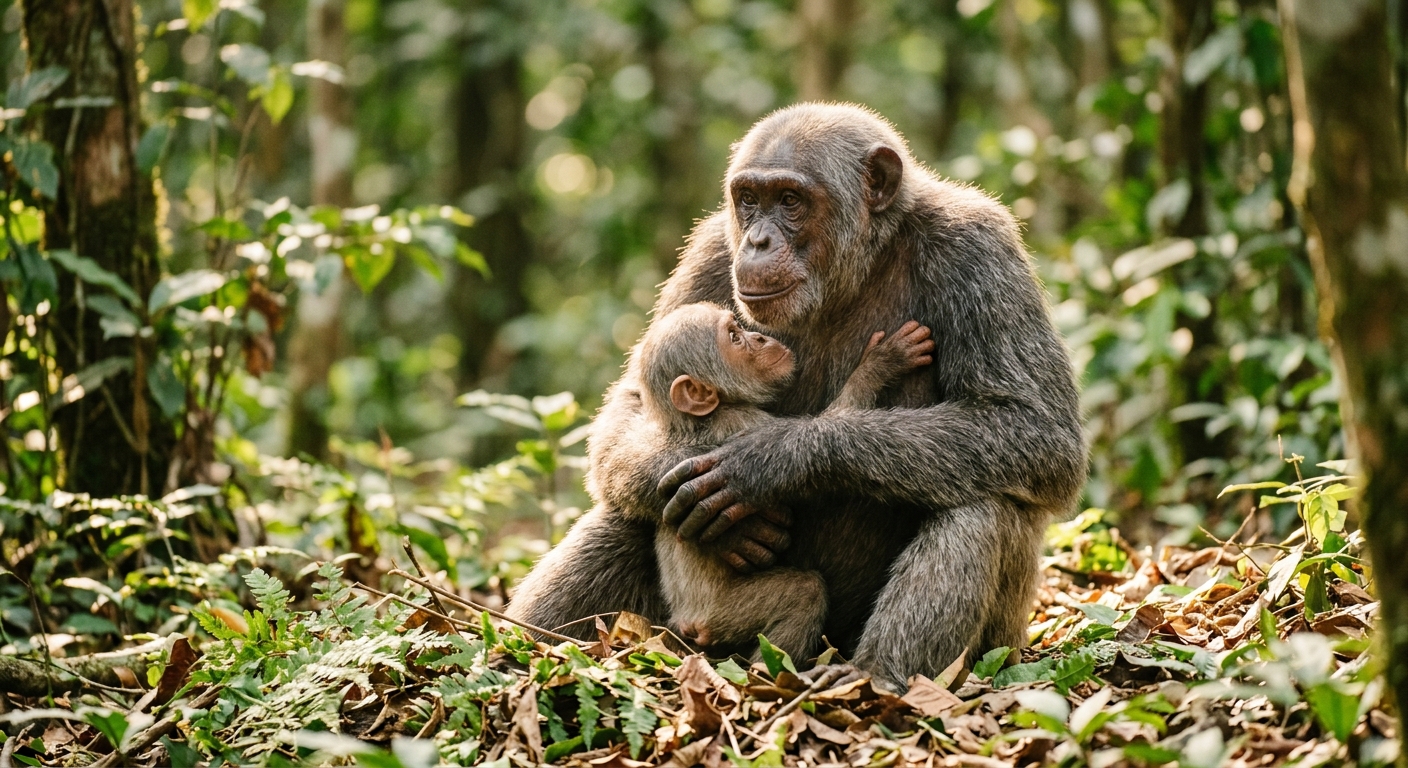
When sanctuary workers at Reserva Particular do Patrimônio Natural Mata do Paraíso in Brazil first noticed Cleo, a female chimpanzee, hovering protectively over a tiny, trembling capuchin monkey, they held their breath. The two species, though both primates, rarely form bonds this deep. Yet what unfolded over the following weeks was one of the most extraordinary acts of maternal instinct ever documented in a primate sanctuary setting.
The capuchin, barely weeks old, had been found abandoned near the edges of the forest. Malnourished, frightened, and without any mother to cling to, the infant was brought into the sanctuary’s care. But it was Cleo, not the human staff, who ultimately stepped forward to fill that role.
How It Started: A Quiet Moment That Changed Everything
Sanctuary coordinator Fernanda Lima recalled the first interaction with quiet amazement. “We placed the capuchin in a neutral space to observe how the other animals reacted,” she explained. “We expected curiosity. Maybe some aggression. What we did not expect was Cleo.”
Cleo approached the infant slowly, crouching low so as not to frighten it. She extended a single hand, palm upward, in what primatologists describe as a classic gesture of non-threatening contact. The capuchin, exhausted and overwhelmed, crawled into her arms. Within minutes, Cleo had pulled the tiny monkey to her chest and began grooming it with the same careful, deliberate motions she would have used with her own offspring.
She has not let go since.
Understanding the Science Behind Cross-Species Bonding
To understand why this happened, it helps to understand a little about chimpanzee psychology. Chimpanzees are among the most emotionally complex animals on Earth. They grieve. They form lasting friendships. They experience joy and frustration and fear. And when they lose a child, they mourn deeply and sometimes for prolonged periods.
Cleo had experienced her own loss roughly eight months before the capuchin arrived. Her infant had died shortly after birth, a tragedy that staff noted left her visibly withdrawn for weeks. When the capuchin appeared, researchers believe Cleo’s maternal hormones, her instincts, and her emotional need for connection all converged at once.
Dr. Isabel Carneiro, a primatologist who has studied inter-species relationships in captive primate populations, offered this perspective: “What we are seeing with Cleo is not unique, but it is rare enough to be remarkable. Chimpanzees have the cognitive and emotional architecture to extend nurturing behavior beyond their own species. Grief, in particular, can amplify that drive. The brain is looking for a way to redirect what was lost.”
A Day in Their Life: What the Bond Actually Looks Like
Visitors to the sanctuary who are lucky enough to observe Cleo and her capuchin companion describe the scene as both moving and almost comically tender. The size difference alone is striking. Cleo, who weighs around 50 kilograms, carries the tiny capuchin the way a person might carry a plush toy tucked under one arm. And yet her grip is precise, gentle, and responsive to every squirm and squeak.
Here is what a typical day looks like for the two of them, according to sanctuary staff:
- Morning: Cleo wakes first and immediately locates the capuchin. Grooming begins before breakfast, a clear sign of social bonding and trust-building behavior.
- Feeding time: Cleo allows the capuchin to eat from her bowl, often nudging softer food pieces toward the smaller animal. Staff have noted she eats less herself when the capuchin seems particularly hungry.
- Play sessions: The capuchin has grown bolder over time and frequently climbs Cleo’s back or tugs at her ears. Cleo tolerates all of it with what staff describe as “unmistakable patience.”
- Rest periods: The capuchin sleeps curled against Cleo’s torso. Cleo wraps one long arm around the monkey during sleep, even unconsciously adjusting her position to keep the smaller animal warm and secure.
- Social interactions: When other chimps approach too aggressively, Cleo places herself physically between them and the capuchin. This protective posturing is identical to what a mother chimp would do with her biological offspring.
What the Other Chimps Think
Not everyone in the sanctuary was immediately welcoming. Several of the younger male chimpanzees initially showed intense curiosity about the capuchin, and not all of it was benign. There were tense moments in the early weeks where staff considered separating Cleo and the capuchin during group social periods.
But Cleo’s status within the group, she is mid-ranking and well-respected, seems to have communicated something important to the others. Over time, the troop has largely accepted the capuchin as an extension of Cleo. A few of the older females have even been observed grooming the capuchin themselves on occasion, a significant sign of acceptance within chimpanzee social culture.
What This Story Teaches Us About Grief and Love
There is a human instinct to project emotions onto animals and to be skeptical of those who do. Researchers rightly caution against over-anthropomorphizing. But there is also a growing body of science that suggests the gap between human emotional experience and that of our closest primate relatives is far narrower than we once believed.
Cleo did not choose love strategically. She did not weigh her options or consult anyone. She saw a small, vulnerable creature in need of protection, and something deep in her nervous system said: this one is mine now.
That impulse, raw and instinctive and boundless in its generosity, is something most humans would recognize immediately. Because we have felt it too. In the neighbor who quietly brings groceries to the elderly widow next door. In the foster parent who stays up all night soothing a child who is not biologically theirs. In anyone who has ever looked at someone else’s pain and decided, without fanfare or reward, to do something about it.
A Lesson Without Words
Cleo cannot speak. She cannot write a book or post on social media or explain in an interview why she did what she did. She just does it, every day, without hesitation or expectation of applause.
Maybe that is precisely why her story is so powerful. The most profound acts of love rarely come with a speech. They come with a palm held open, an arm wrapped around a trembling stranger, and a quiet, unspoken message:
You are safe now. I have you.
The Bigger Picture: Why Stories Like This Matter
Beyond the heartwarming surface of Cleo’s story lies a deeper conversation about the nature of maternal instinct, the universality of grief, and the surprising ways living creatures reach across the boundaries of species and circumstance to find connection.
Conservation workers and sanctuary staff often note that these kinds of stories, while not the primary reason for their work, serve an important function. They remind the public that the animals in their care are not objects or exhibits. They are emotional beings with inner lives that are worthy of respect, protection, and wonder.
If you have never thought much about primate welfare or wildlife sanctuary funding, perhaps Cleo’s story is a good place to start. Organizations around the world rely on donations and public awareness to continue the work of rescuing, rehabilitating, and providing lifelong care for animals like her.
And if you ever find yourself doubting whether love can exist beyond the boundaries of language, biology, or even species, remember a chimpanzee named Cleo, who lost everything and then quietly, gently, chose to give everything she had left to someone who needed it more.