
🎧 Listen to this story
Narrated by Rasalgethi · 7,789 characters
Before the Rest of the Street Wakes Up, He Is Already Outside
It is 5:47 a.m. in Duluth, Minnesota. The temperature has dropped to 14 degrees Fahrenheit overnight, and a fresh eight inches of snow have blanketed Orchard Street in a thick, unbroken white. Most residents are still asleep, coffee makers not yet switched on, children bundled under covers dreading the cold walk to the school bus.
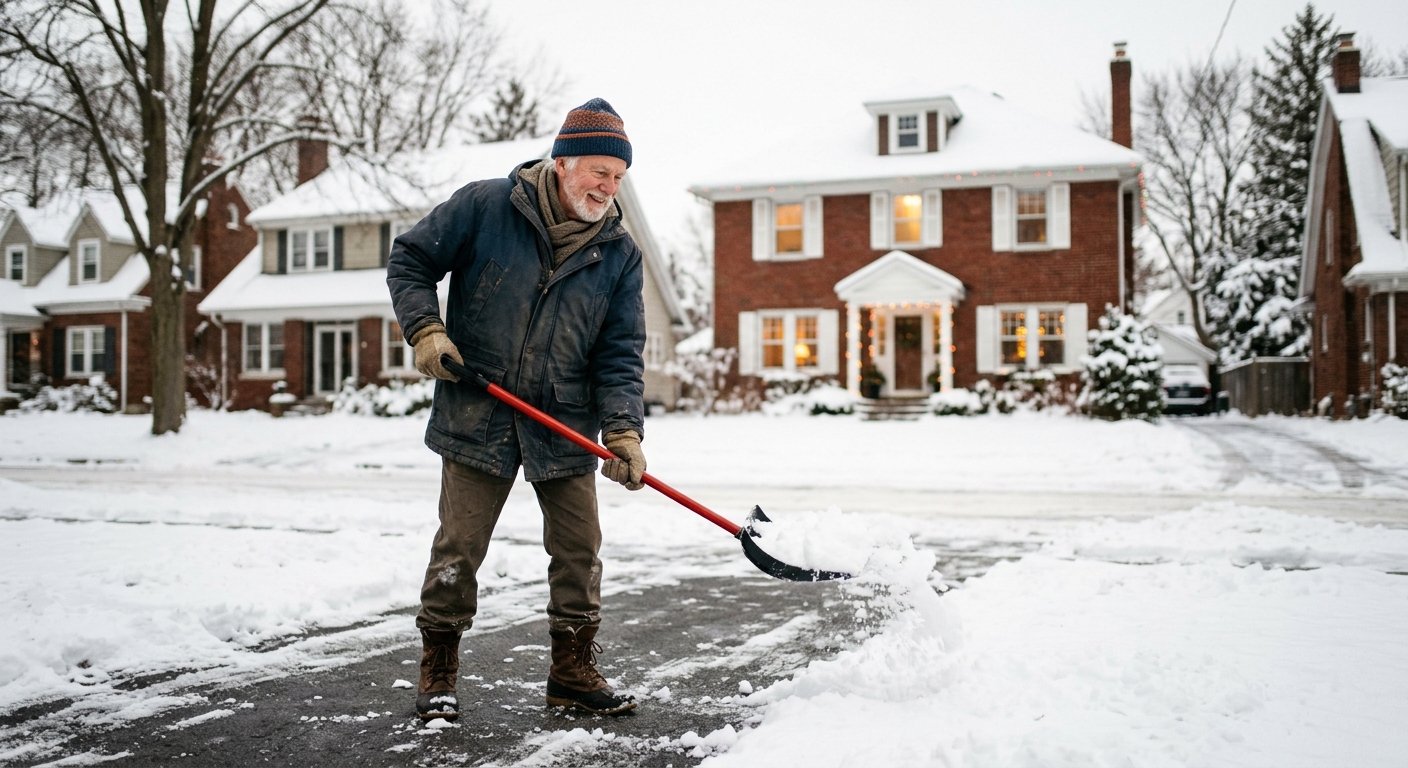
But Gerald Martz, 71, is already outside. He has been at it for nearly an hour. His breath fogs in the frozen air, and his bright orange snow shovel cuts methodically through the drifts lining his neighbor’s driveway. He is not being paid. He has not been asked. He will not knock on the door afterward to announce what he has done. He will simply move to the next house, and the one after that, until every driveway and front walkway on his block has been cleared.
Gerald has done this every single winter for 25 years. No exceptions. No winters off. No complaints.
How It All Started
Gerald was 46 years old in the winter of 1999 when the habit began. It was not born of some grand resolution or a dramatic moment of inspiration. It started, as most lasting things do, with something small.
“My neighbor Dorothy was in her late seventies at the time,” Gerald recalls, leaning against the handle of his shovel in his driveway. “Her husband had passed the previous spring. I watched her one morning struggling with her walkway, slipping a little. I just went over and did it for her. That was it.”
But that was not quite it. The next snowfall, Gerald was out there again. And the one after that. Somewhere along the way, Dorothy’s driveway became Dorothy’s driveway and the Pattersons’ driveway and the Garcias’ and the young couple at the end of the block who both worked early shifts and were always scrambling to get out the door on time.
“I never really decided to expand it,” he says. “It just happened organically. I had the time, I had the energy, and people needed it. That felt like enough of a reason.”
What 25 Years of Showing Up Actually Looks Like
Let’s put Gerald’s commitment in perspective. Duluth averages roughly 86 inches of snowfall per year, one of the highest totals of any city in the continental United States. Over 25 years, that is an estimated 2,150 inches of snow, and Gerald has moved a significant portion of it off of other people’s property, voluntarily and without ceremony.
His routine has evolved over the decades. In the early years, he used only a basic push shovel. Around 2008, a neighbor gifted him a heavy-duty ergonomic model after noticing some back soreness. In 2015, he accepted a secondhand electric snow blower from a family moving to Florida. He uses the blower for the heavy, wet snows and still prefers the shovel for lighter dustings, which he says feel more personal somehow.
“The blower is faster, sure,” he admits. “But there’s something about using the shovel that keeps me connected to the work. You feel every inch of it.”
The Neighbors Weigh In
Over the years, the residents of Orchard Street have tried many times to repay Gerald. He has refused cash on at least a dozen occasions. He accepted one plate of homemade tamales from Rosa Garcia in 2011 and still brings it up as one of the best meals of his life. He has been offered gift cards, bottles of whiskey, and a brand new shovel from the hardware store down the road.
“He took the shovel,” Rosa laughs. “That was the only thing he ever actually kept.”
For many on the block, Gerald’s presence has come to feel like something elemental, like a force of nature in its own right. Priya Nair, who moved onto Orchard Street three years ago with her husband and two young daughters, says she cried the first winter morning she stepped outside to find her driveway already cleared.
“I had no idea who had done it,” she says. “I asked around and everyone just pointed to Gerald’s house and smiled like it was the most normal thing in the world. I guess for them, it is. But for me, it was extraordinary.”
The Philosophy Behind the Shovel
Ask Gerald why he does it, and he will not give you a speech. He is not the kind of man who traffics in speeches. But press him a little, and something thoughtful emerges beneath the modesty.
“I grew up watching my dad do things for people without being asked,” he says. “He used to say that the most important acts of kindness are the ones nobody sees. I always thought that was right. If you need applause, you’re doing it for the wrong reason.”
Gerald never married. He spent 30 years working as a city water inspector before retiring in 2017. He has no children of his own, but speaks warmly of the neighborhood kids who have grown up watching him work. Several of them, now adults, have told him that he was one of the most quietly influential people in their childhoods.
“That surprised me,” he admits. “Kids notice more than we think.”
Lessons the Rest of Us Can Take From Gerald
- Consistency beats grand gestures: Gerald did not do one enormous thing. He did one small thing, over and over, for 25 years. The accumulation of small, reliable actions builds something far more meaningful than a single dramatic act.
- Community is maintained, not inherited: Tight-knit neighborhoods do not happen by accident. They require people who make small investments in one another’s daily comfort and dignity.
- Service without expectation is the purest kind: Gerald never keeps score. He never checks whether people thanked him or noticed. That indifference to recognition is what makes his generosity genuine.
- Routine can be a form of love: The steady repetition of a caring act, season after season, is its own kind of devotion. Gerald’s neighbors do not just benefit from cleared driveways. They benefit from knowing someone sees them.
- You do not need a big platform to make a big impact: Gerald has no social media. He has not been on the local news. His impact lives entirely on one modest street in one midwestern city, and it is profound.
What Happens When Gerald Can No Longer Shovel
It is a question his neighbors have started to ask quietly among themselves, not with dread but with a kind of tender concern. Gerald turned 71 last October. His knees bother him some mornings. He moves a little slower than he did in 2005.
When asked about it directly, Gerald is characteristically unfazed. “I’ll do it until I can’t,” he says simply. “And when I can’t, hopefully someone else picks it up.”
That hope may already be materializing. Priya’s teenage daughter, Leela, started helping Gerald two winters ago, appearing beside him with her own shovel on heavy snow days without being asked. The Pattersons’ son Marcus, now 22, has quietly started clearing the two driveways at the far end of the block on mornings when he gets up early for his shift at the hospital.
Nobody organized this. Nobody sent a group text or started a neighborhood committee. It seems to be spreading the same way it started, organically, one person watching another person do something good and deciding to do the same.
The Quiet Power of Being the Person Who Shows Up
In an era that celebrates the bold, the viral, and the loudly generous, Gerald Martz is a reminder that some of the most important people in any community are the ones you barely notice. They are up before you. They do their work and go home. They do not need a documentary or a fundraiser or a hashtag.
They just need a shovel and the willingness to use it for someone else.
Orchard Street will get snow again this winter. Gerald will be outside before sunrise. His neighbors will wake up to cleared driveways and a wordless assurance that someone on their block still believes, quietly and consistently, that we owe each other something.
That belief, repeated over 25 winters, has made all the difference.