🎧 Listen to this story
Narrated by Kore · 7,894 characters
The whistle at the Harlan Brothers Textile Mill blew for the last time on a Friday afternoon in the spring of 2016. By the following Monday, a town of nine thousand people had lost its largest employer, its sense of rhythm, and for a while, its nerve.
What happened next did not begin with a grant, a consultant, or a charismatic mayor. It began with eleven tired people in a church basement, a pot of burnt coffee, and a question nobody had asked out loud yet: what do we do now?
This is the story of how that question, asked again every single evening for the better part of two years, turned a grieving factory town into one of the quietest comeback stories in the region.
The Silence After the Whistle
If you have never lived in a mill town, it is hard to explain how completely the factory shapes the day. The whistle told you when to wake, when to eat, when to pick up the kids, when to go home. Churches scheduled services around the shift change. The diner opened at 5:40 a.m. because that is when the first wave of workers came through.
When the mill closed, the silence was not peaceful. It was disorienting.
Dolores Whitfield, who had worked the weaving floor for twenty-six years, described the first week this way: “I kept waking up at 5 a.m. and standing in my kitchen with nowhere to be. My husband would find me there, just standing. We never talked about it. We were both too scared to.”
Across town, the same scene repeated itself in hundreds of kitchens. Men and women who had spent decades being useful were suddenly unsure whether they still were.
Eleven People and a Basement
The first meeting was not planned as a movement. A retired maintenance foreman named Teodor Ruiz simply unlocked the basement of St. Brendan’s Church and told a few neighbors he would be there at 6:30 that evening, same time his shift used to end, if anyone wanted to talk.
Eleven people came. Nobody had an agenda. They sat on folding chairs and listened to each other describe the fear, the bills, the shame.
Near the end of that first night, a younger worker named Priya Nandakumar said something that changed the direction of the room. She had run the quality-control line for six years.
“We’re all sitting here saying what we lost,” she said. “But we’re the same people who made ten thousand units a day without a single defect. Why are we acting like we don’t know how to build things?”
Nobody answered right away. But Teodor wrote one line on the back of an old hymnal sheet: Same time tomorrow.
Why Evenings Mattered
It would have been easy to hold the meetings at noon, or on weekends. But the group kept returning to the evening hour, and over time, that choice became part of their identity.
Evening, they realized, was the hour when the old life had ended each day. It was when people clocked out, washed up, and felt the particular satisfaction of work completed. Reclaiming that hour, rather than letting it become the loneliest part of the day, gave the group something unexpected: a ritual.
“There is something about the end of the day,” Teodor said later. “The noise drops. People are tired enough to stop performing. You say the true thing at 7 p.m. that you would never say at noon.”
The meetings developed a gentle structure:
- The first fifteen minutes: No planning allowed. Just a check-in. How is everyone actually doing?
- The middle hour: One problem, one conversation. Housing, retraining, childcare, a business idea.
- The last ten minutes: Each person names one small thing they will do before tomorrow’s meeting.
That last rule mattered more than anyone expected. Small promises, kept night after night, rebuilt something that mass layoffs had stripped away: trust in their own follow-through.
The Inventory Nobody Thought to Take
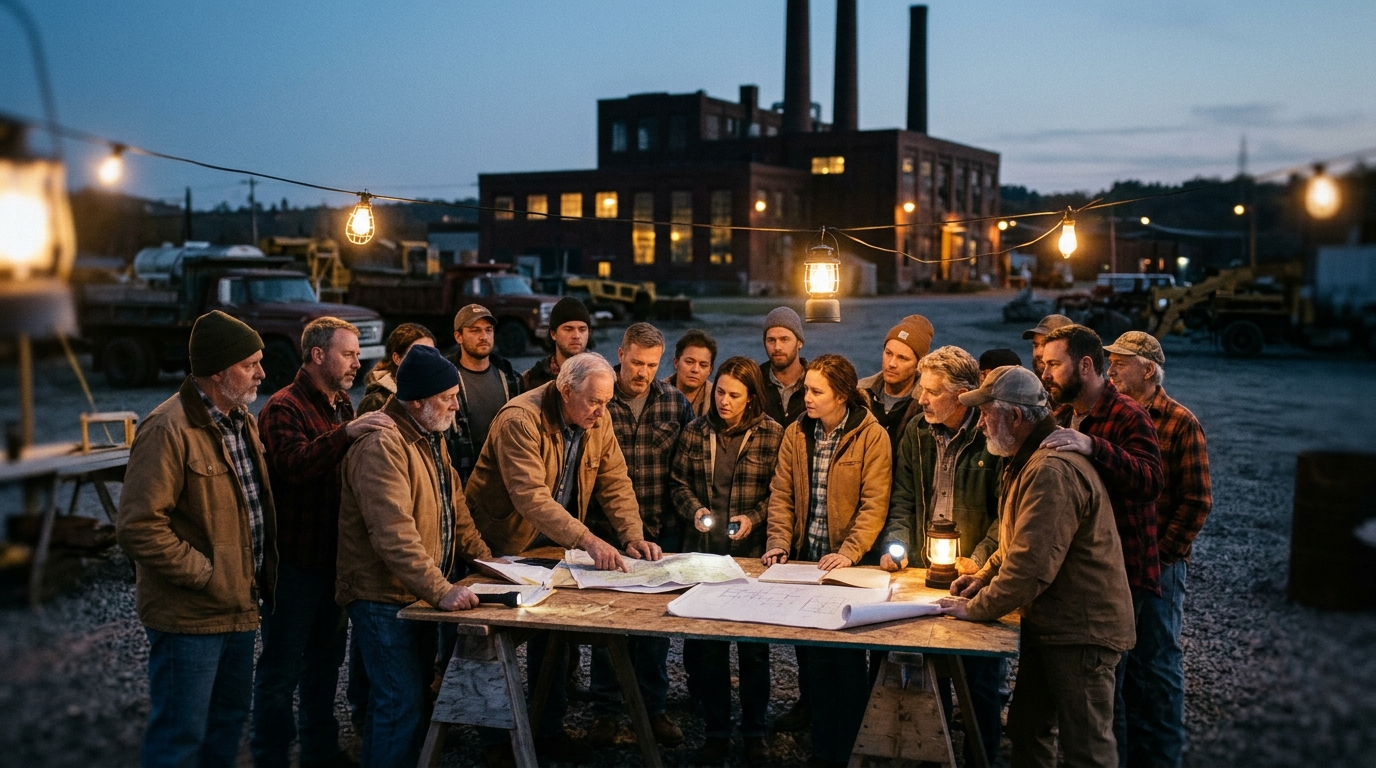
By the third week, the basement held forty people. By the second month, it was over a hundred, and the group moved to the old union hall.
It was there that Priya proposed an exercise she called “the inventory.” Instead of asking what jobs were available elsewhere, the group would catalog what the town itself already possessed.
The list, written on butcher paper and taped across the wall, was startling:
- Sixty-two certified machinists and equipment repair specialists
- A fully intact industrial laundry facility that the mill had never used to capacity
- Thirty-one people with commercial sewing and pattern expertise
- A rail spur still connected to the main line
- Four hundred thousand square feet of vacant, structurally sound floor space
- Three accountants, two lawyers, and one retired bank officer, all willing to volunteer
“We weren’t a town with nothing,” Dolores said. “We were a town with everything except a plan.”
Building the Plan, One Evening at a Time
What followed was slow, unglamorous, and deeply human. The group formed a worker-owned cooperative, and through the long winter of 2017 they hammered out the details in evening sessions that sometimes ran past ten o’clock.
The cooperative’s early projects were modest. They took contract work repairing industrial equipment for regional businesses. They launched a small line of work aprons and durable bags, stitched by former mill seamstresses, sold first at a church bazaar and then through a handful of local shops.
Money was tight. There were arguments. One evening in February, two founding members nearly walked out over how profits should be divided. The group did not vote that night. They simply sat in silence, drank the terrible coffee, and agreed to return the next day.
“That is the thing about meeting every evening,” Teodor said. “You cannot storm off forever. You have to come back tomorrow, and the person across from you will be there too.”
A Few Lessons the Group Wrote Down
At the one-year mark, the members compiled a short list of principles. It still hangs in the cooperative’s front office:
- Show up tomorrow, even if today went badly.
- Start with how people are, not what needs doing.
- Make promises small enough to keep.
- Count what you have before you mourn what you lost.
- Nobody rebuilds alone, and nobody is too old or too new to help.
What the Town Looks Like Now
Today, the cooperative employs just over two hundred people, many of them former mill workers, along with a growing number of younger residents who returned after leaving for city jobs. The old rail spur carries finished goods out instead of raw material in. The diner still opens at 5:40, though now the early crowd includes bakers, drivers, and apprentices.
The mill building itself has been partially converted. One wing houses the cooperative’s workshops. Another holds a community kitchen and a small training center where retired machinists teach teenagers to read blueprints.
And at 6:30 each evening, the lights still come on in the union hall. The meetings are shorter now, and fewer people attend, but the ritual has never stopped. Newcomers are welcomed with a folding chair and a cup of coffee, still burnt, by tradition.
The Quiet Lesson at the End of the Day
When asked what she would tell other struggling communities, Dolores did not mention funding, strategy, or leadership. She talked about the hour.
“Find your people at the end of the day,” she said. “That is when you are most honest and most tired and most willing to listen. Do not wait until you feel ready. Nobody ever feels ready. Just unlock a door, put out some chairs, and say you will be there tomorrow.”
It is a small instruction, almost too simple to believe. But on a Friday in 2016, a town lost its whistle, and on a Saturday evening eleven people decided that the end of the day did not have to mean the end of everything.
Tonight, as the light fades and your own day winds down, you might ask yourself who your people are, and what small thing you could promise to do before tomorrow. Sometimes a whole future begins with a folding chair, a bad cup of coffee, and the courage to say: same time tomorrow.