🎧 Listen to this story
Narrated by Schedar · 9,472 characters
When a Rescue Cat Becomes the One Doing the Rescuing
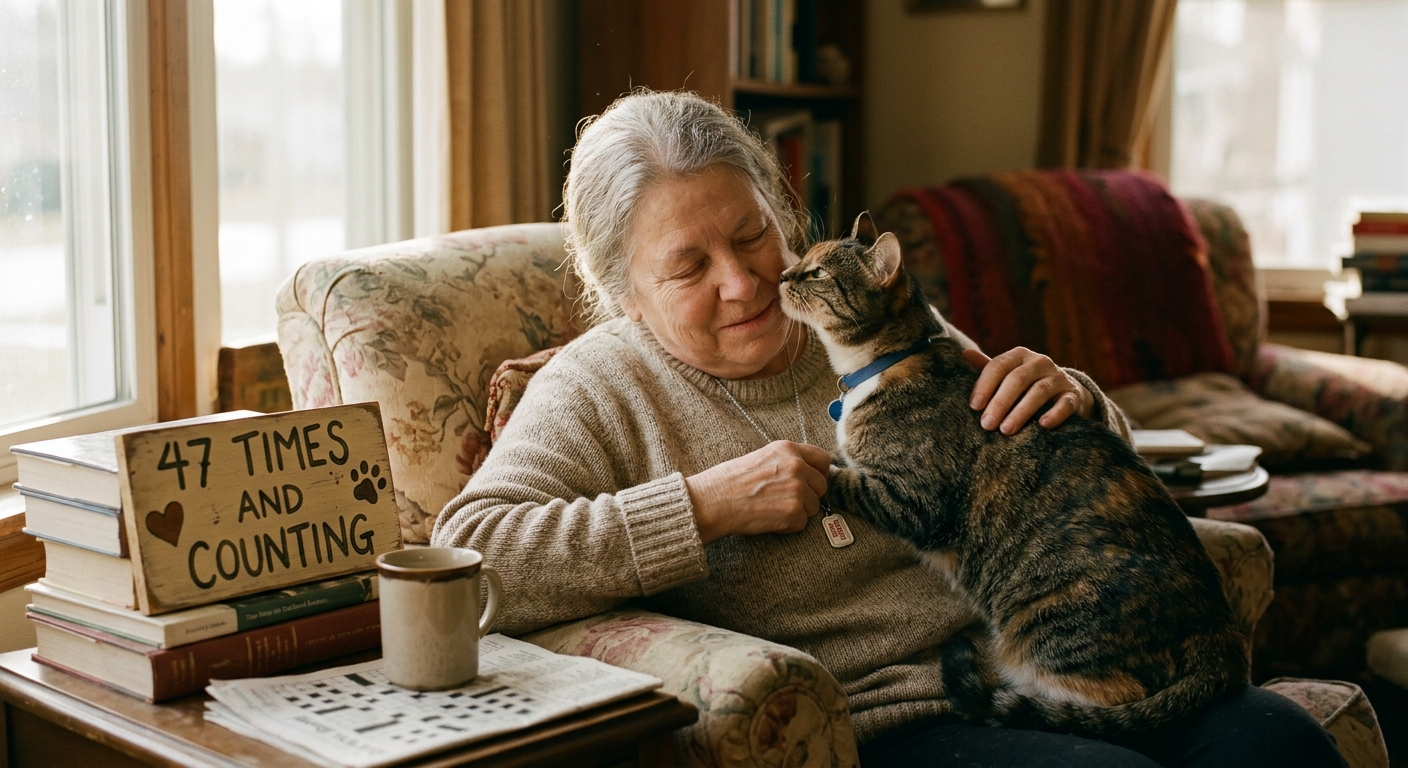
Nobody told Mochi he was supposed to be an ordinary cat. He wasn’t trained by any organization, didn’t graduate from a service animal program, and certainly didn’t arrive with a certificate declaring him medically useful. He was a scrawny, one-year-old tabby pulled from a shelter in Portland, Oregon, by a woman named Diane Calloway who simply wanted some company after her divorce. What happened next confounded her doctors, amazed her neurologist, and changed everything she thought she knew about the animals we call pets.
Diane was diagnosed with epilepsy at age 34, following a frightening grand mal seizure she had while cooking dinner alone in her apartment. The neurological condition, which affects nearly 3.4 million Americans, meant she lived under a constant cloud of uncertainty. Any moment, without warning, her brain could short-circuit. She could fall. She could hit her head. She could lie unconscious for minutes with no one knowing.
“The scariest part wasn’t the seizures themselves,” Diane explained in a community health newsletter interview. “It was the not knowing. Going to sleep at night wondering if I’d wake up on the floor. Taking a bath and being terrified. You lose your independence in ways most people can’t imagine.”
Then came Mochi, and everything changed.
The First Time It Happened
About three weeks after adopting Mochi, Diane noticed something odd. The cat, who was generally mellow and independent, suddenly became intensely focused on her. He jumped onto her lap, butted his head against her chin repeatedly, and refused to move. He let out a low, insistent vocalization she hadn’t heard from him before. Diane, confused and a little annoyed, tried to move him aside.
Eleven minutes later, she had a seizure.
She didn’t connect the two events that first time. It seemed like coincidence. But when it happened again two weeks later, with Mochi performing the exact same ritual of head-butting, pawing, and persistent vocalization before she lost consciousness, Diane started paying attention. She began keeping a journal. She logged every unusual behavior from Mochi, and every seizure she experienced. The correlation was impossible to ignore.
Over the next four years, Mochi preceded 47 of Diane’s seizures with his alert behavior, giving her an average of eight to fifteen minutes of warning time. That window allowed her to get to a safe location, lie down on soft surfaces, alert a neighbor or family member, and avoid the kind of traumatic fall injuries that hospitalize thousands of epilepsy patients each year.
What the Science Actually Says
Skeptics might roll their eyes, but researchers have been quietly building a case for seizure-sensing animals for decades. Here is what the current science suggests about how animals like Mochi might be doing what they do:
- Scent detection: Some researchers believe animals may detect subtle biochemical changes that occur in the human body before a seizure, including shifts in adrenaline, body odor compounds, or electrical activity that produces detectable physical cues.
- Behavioral micro-cues: Animals are extraordinarily tuned to human behavior. Even tiny changes in posture, movement, or facial expression that a person is unaware of may signal to a perceptive cat or dog that something is wrong.
- Electrical field sensitivity: A more speculative but increasingly discussed theory suggests that some animals may detect changes in the body’s electrical fields prior to a neurological event.
- Learned association: Over time, animals may learn to associate pre-seizure behaviors or scents with what follows, essentially training themselves through repeated experience.
Dr. Lorna Henderson, a neurologist at Oregon Health and Science University who reviewed Diane’s case with permission, noted that while no peer-reviewed study has confirmed cats as reliable seizure predictors, anecdotal reports are consistent and numerous enough to warrant serious research. “We can’t dismiss 47 documented instances as random,” she said. “That’s not noise. That’s signal.”
A Day in the Life: How Diane and Mochi Navigate Together
Diane’s routine now revolves around watching Mochi as much as he watches her. She has learned his vocabulary. A slow blink means he is relaxed and everything is fine. A sudden stillness and fixed gaze in her direction is the first sign. The head-butting is the urgent alarm. She describes it as having a small, furry, perpetually vigilant roommate who has made it his personal mission to keep her alive.
Her neurologist helped her create a response protocol based on Mochi’s alerts. When the cat begins his warning behavior, Diane:
- Moves away from the kitchen, bathroom, or any stairs immediately
- Sends a quick pre-written text to her sister and neighbor
- Lies down on her bed or couch with a cushion under her head
- Waits, breathing through the anxiety, knowing that what comes next will be survivable
“He has probably saved me from a broken skull at least a dozen times,” she said. “Once I was standing at the top of my staircase when he started. I sat down right there on the landing. I had my seizure on the carpet instead of falling down fifteen steps.”
What Mochi Gets Out of It
This is the question that makes the story feel less like a medical case study and more like something warmer and harder to categorize. What motivates a cat, an animal famously associated with self-interest and independence, to behave this way?
Animal behaviorists suggest a few possibilities. Cats form deep emotional bonds with their primary caregivers, far more complex than popular culture acknowledges. Mochi may have learned early on that Diane’s pre-seizure state was distressing and responded instinctively to comfort her. Over time, that instinct calcified into habit, and then into something that functions, remarkably, like purpose.
Diane has her own answer, and it is simpler. “He loves me,” she said. “I know that sounds like something people say about their pets. But I have seen this cat ignore everything else in the world, his food, a bird outside the window, a nap in the sun, to come find me when something is wrong. That’s love. I don’t need a study to tell me that.”
The Broader Conversation This Story Opens Up
Mochi’s story is not unique, and that is precisely the point. Across the country and around the world, people with epilepsy, diabetes, PTSD, and other conditions report animals, both trained and untrained, alerting them to medical events. A woman in the UK wrote about her golden retriever predicting her diabetic crashes. A veteran in Texas credited his rescue mutt with interrupting multiple PTSD episodes before they escalated into crisis.
What these stories collectively suggest is something researchers, veterinarians, and medical professionals are only beginning to take seriously: the human-animal bond may carry biological and neurological dimensions we have barely begun to map. Our pets are not passive. They are watching us, reading us, and in some cases, responding to us in ways that defy easy explanation but carry life-or-death consequences.
Organizations like the Epilepsy Foundation have begun exploring how to better support people who, like Diane, rely on untrained animal companions as part of their safety plan. Conversations are happening about whether cats, not just dogs, could be formally assessed for seizure alert potential.
What We Can Take From This Story
You do not have to have epilepsy to be moved by what Mochi and Diane represent. Their story holds lessons that reach far beyond the medical:
- Pay attention to what the quiet ones are telling you. Mochi had no words. He had only behavior. The people and animals around us communicate constantly in ways we often miss when we are too distracted to notice.
- Rescue goes both ways. Diane saved Mochi from a shelter. Mochi saved Diane from 47 potential tragedies. The ledger between humans and the animals they adopt is rarely as one-sided as we assume.
- Help does not always look the way you expect. The support that changed Diane’s life did not come from a medical device, a specialist, or an expensive treatment. It came from a seven-pound tabby who simply refused to stop caring.
- Connection is its own form of medicine. The research on pet ownership and health outcomes is substantial: lower blood pressure, reduced anxiety, improved survival rates after cardiac events. Mochi is perhaps the most dramatic proof point of what companionship, at its most devoted, can do.
Forty-Seven Times, and the Story Is Not Over
Mochi is five years old now. He still sleeps at the foot of Diane’s bed. He still watches her with those amber eyes when she moves around the kitchen. He still has opinions about her bathing schedule and her tendency to stay up too late reading.
And when the signals come, whatever biochemical or behavioral whisper tells him that his person is about to need the floor beneath her and a cushion for her head, he still comes. He still butts his small, insistent head against her chin. He still refuses to be ignored.
Forty-seven times, Mochi said: not today, not alone, not without warning.
Some stories do not need a tidy explanation. Some forms of love simply work, regardless of whether we can put them under a microscope and explain the mechanism. Diane Calloway is alive and well and grateful every single morning for a scraggly shelter cat who decided, entirely on his own, to become her guardian.