🎧 Listen to this story
Narrated by Kore · 7,598 characters
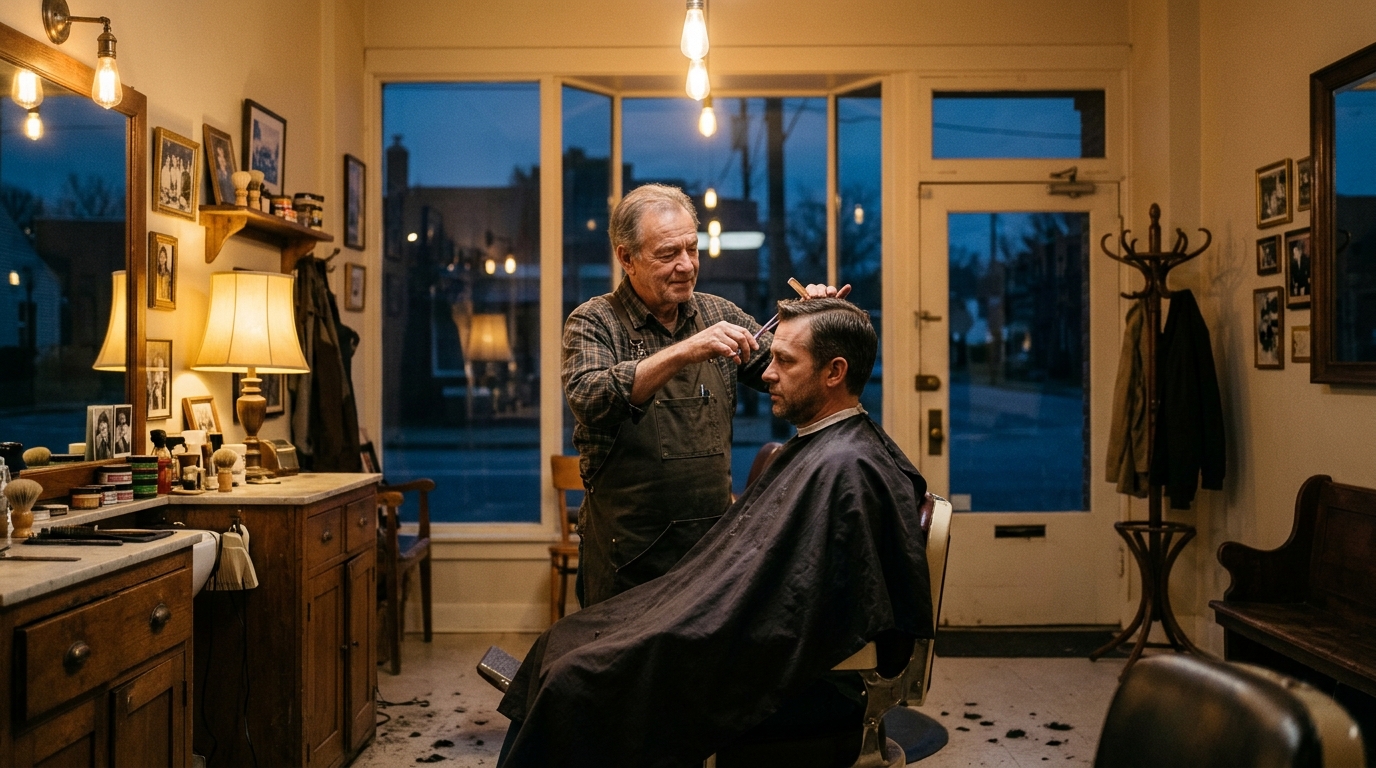
Most shops on Alder Street are dark by six on a Friday. The bakery has pulled its shutters down, the shoe repair has flipped its sign, and the sidewalks have gone quiet in that soft, blue way they do when the day is finished with everyone. But halfway down the block, one window keeps glowing. Inside, a red leather chair swivels slowly, a radio hums low, and a man in a gray apron sweeps the floor, not because the day is over, but because it is just beginning for the people he is waiting for.
His name is Marcus Delgado, and he has been cutting hair for twenty-six years. For the last nine of them, he has done something that has no line item on any invoice. Every Friday, when his paying customers have gone home, he stays open late for men who cannot afford a haircut. No charge. No questions. No paperwork.
How It Started: A Man at the Door
Marcus remembers the first night clearly, because he almost missed it. It was a cold evening in late October, and he was counting the register, ready to lock up. A tap came at the glass. Outside stood a man in a thin jacket, holding a folded piece of paper.
“He told me he had a job interview Monday morning,” Marcus recalls. “Warehouse work. He said he hadn’t had a haircut in almost a year, and he didn’t want to walk in looking like he’d given up. He asked me how much, and I could see him already doing the math in his head.”
Marcus did not say a price. He pulled the chair out, draped the cape, and got to work. By the time he brushed the loose hair from the man’s collar, the stranger was looking at himself in the mirror with an expression Marcus has never forgotten. It was not vanity. It was recognition. He looked like himself again.
The man got the job. A few weeks later, he came back and left a paper bag on the counter with two oranges and a thank-you note written in careful block letters. Marcus kept the note. It is still taped beside the register.
The Quiet Mathematics of a Haircut
To someone with a steady paycheck, a haircut is a small, forgettable expense. To a man stretching every dollar between rent, bus fare, and food, it is a luxury that quietly slips off the list. And the consequences are larger than they appear.
“People think it’s about hair,” Marcus says. “It’s not. It’s about whether you feel like you belong in a room. When a man walks into an interview or a clinic or a courtroom, and he looks worn down, people treat him differently. They decide things about him in the first three seconds. A clean cut changes those three seconds.”
Over nine years, Marcus estimates he has given away more than eleven hundred haircuts. He keeps no ledger of names, only a mental map of faces. Some come once and are never seen again, which he takes as a good sign. Some come every few weeks. A few have become friends.
What Friday Night Looks Like
There is no sign in the window announcing the offer, and that is deliberate. Marcus did not want anyone to feel they had to stand in a visible line or explain themselves to passersby. Word travels the way it always has: through shelters, church basements, the bus stop, and one man telling another.
Here is how a typical Friday unfolds:
- 6:30 p.m.: The last paying customer leaves. Marcus sweeps, wipes down the chair, and sharpens his shears.
- 7:00 p.m.: The first knock comes. Often it is someone who has been waiting down the block, unsure whether to come in.
- 7:00 to 10:00 p.m.: One by one, men sit in the chair. Marcus talks if they want to talk and stays quiet if they do not.
- After the cut: Every man gets a hot towel on the back of the neck and a mirror held up to see the back of his head, just like any paying customer.
That last detail matters to him. “I never want anyone to feel like they got the lesser version,” he says. “Same towel. Same care. Same mirror.”
The Hour When Things Get Quiet
There is a particular stillness that settles over the shop around nine o’clock, once the street outside has emptied and the radio has drifted into slower songs. The overhead lights seem warmer then. The scissors make a soft, rhythmic sound, and the men in the chair tend to loosen, the way people do when the day has stopped asking things of them.
Marcus has noticed that the hardest conversations happen in this window of the evening. A man who has said nothing for ten minutes will suddenly mention a daughter he has not seen in two years, or a job he lost, or the last time someone touched his shoulder kindly. “The dark outside makes it easier,” Marcus says. “There’s no audience. It’s just two men and a pair of clippers. People say true things in that kind of quiet.”
He does not try to fix anything. He listens, and he keeps cutting. Sometimes, he says, listening is the only thing the man in the chair came for, and the haircut is simply the reason that made it feel acceptable to ask.
What One Man Told Him
A few winters ago, a regular named Elias, who had been sleeping in his car, sat down and said nothing for the first five minutes. Then, as Marcus tapered the sides, he spoke softly. “I forgot that people could be gentle,” Elias said. “Nobody’s touched my head in years, and you’re doing it like it matters.”
Marcus said he had to step away for a moment to compose himself. “I pretended I needed a different comb,” he laughs. “I just stood in the back for a minute.”
Elias eventually found steady work and a small apartment. He still stops by on Fridays, not for a cut anymore, but to sweep the floor and keep Marcus company while the evening unfolds.
Why Small Kindness Carries Weight
It would be easy to dismiss one barber’s Friday habit as a modest gesture in a world of enormous problems. But those who have sat in that red chair would disagree. Kindness at this scale is not about solving poverty. It is about restoring a small, specific piece of dignity, and doing it without strings attached.
A few lessons stand out from Marcus’s quiet routine:
- You do not need a grand plan. Marcus simply used the skill he already had and the hours he already kept.
- Dignity is in the details. The hot towel and the mirror cost almost nothing, yet they communicate everything.
- Consistency beats intensity. Nine years of Fridays has helped more people than any single dramatic gesture could.
- Listening is a gift. Often what people need most is someone who is unhurried and unafraid of their story.
Locking Up at Night
When the last man leaves, usually around ten, Marcus does what he has done thousands of times. He sweeps the pile of hair into the dustpan, switches off the radio, and stands for a moment in the quiet shop. The chair is still turned slightly from the last cut. The mirror holds the faint outline of the evening.
“I’m tired by then,” he admits. “My feet hurt, and my back is not twenty-five anymore. But I drive home lighter than I came. It’s strange. I give something away every Friday, and I always end up feeling like I received more than I gave.”
Then he flips off the last light, turns the key, and the glow on Alder Street finally goes dark. But somewhere across the city, a man is waking up Saturday morning, running a hand over a fresh cut, and remembering that someone was kind enough to stay late.
A Small Question to Carry Into the Night
Tonight, as the day winds down and the noise fades, you might ask yourself a gentle question: what ordinary skill or hour do you have that could quietly become a doorway for someone else? It does not need to be a barber’s chair. It might be a meal, a ride, a phone call, or simply a few minutes of patient attention. The people who need it will find the lit window, if you are willing to leave the light on.