🎧 Listen to this story
Narrated by Kore · 7,441 characters
There is a particular hour in every hospital when the building seems to exhhale. Visitors have gone home, the cafeteria shutters have rolled down, and the corridors settle into a hush broken only by the soft rhythm of monitors. It is the hour when daytime noise falls away and whatever people have been holding back finally rises to the surface. Fear. Loneliness. The question nobody wanted to ask out loud while the family was still in the room.
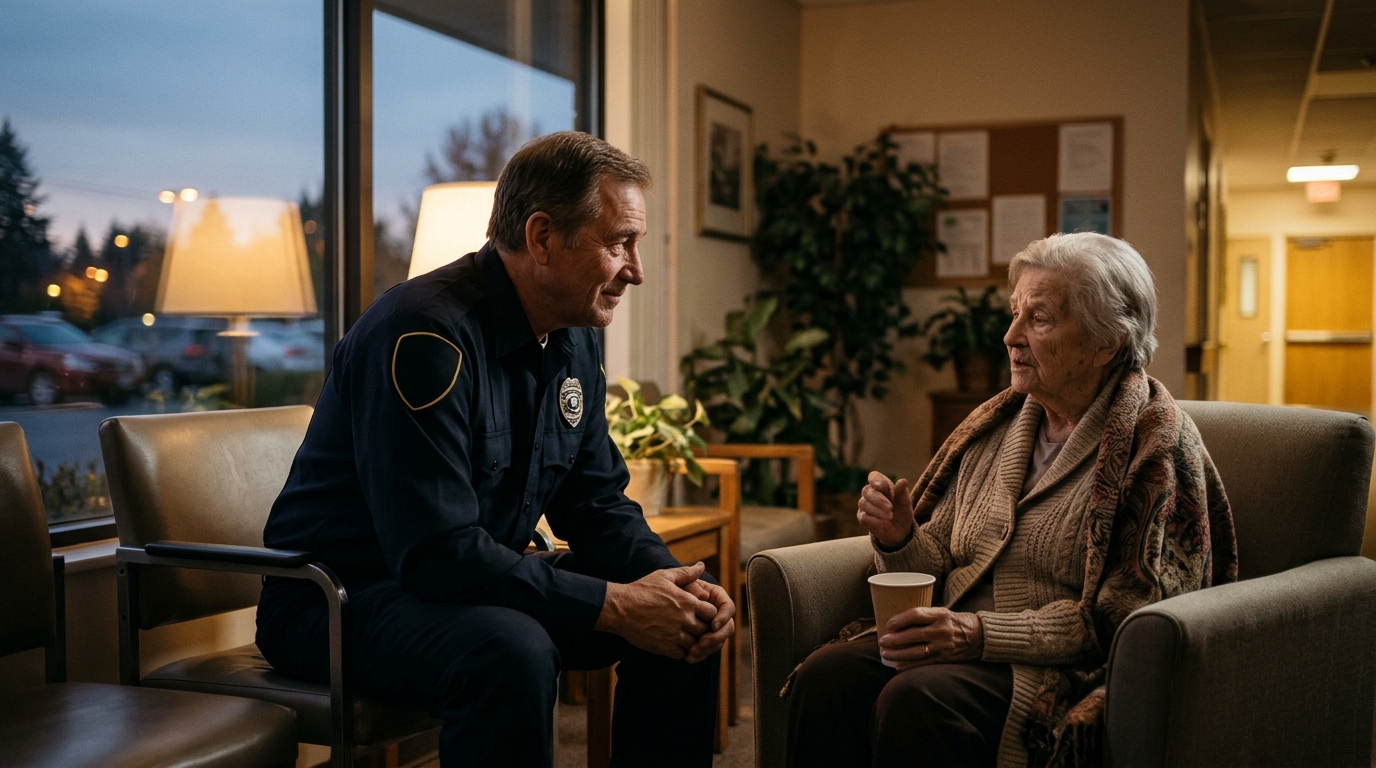
This is the story of a man who works inside that hour. For the purposes of this piece, we will call him Marcus, because he asked us not to use his real name. He would tell you he is just a security guard. The patients on the fourth floor would tell you something different.
The Job Description Doesn’t Mention This
On paper, Marcus’s role is straightforward. He checks badges, walks the perimeter, responds to alarms, and keeps the building safe after dark. He has done it for eleven years. The written duties run to a single page.
What the page leaves out is the thing that happens somewhere around nine or ten each evening, when the last family members drift toward the elevators with their coats half on and their eyes red. Marcus sees them go. And then he sees who is left behind.
“Some of them don’t have anybody,” he says. “Not a visitor all week. You can tell by the way the room looks. No cards, no flowers, no phone buzzing on the tray table. Just a person and a window.”
He started small. A nod and a hello during his rounds. Then a few minutes of conversation in a doorway. Then, one night, a longer stay, because an elderly man named Walter asked him a question about the old shipyard where Marcus’s father once worked, and the answer turned into an hour.
How One Chair Changed the Floor
There is a plastic chair near the end of the fourth floor hallway. It was originally placed there for tired relatives. Marcus now treats it as part of his route.
Nurses on the overnight shift noticed the pattern before anyone else did. Patients who usually pressed the call button every twenty minutes, not because anything hurt but because the silence was unbearable, began pressing it less. Patients who refused to sleep began to rest. A woman recovering from surgery, who had barely spoken to anyone in three days, started telling stories about her garden.
“We can’t be everywhere,” one nurse explained. “We have medications, charts, emergencies. Marcus has something we don’t always have at night: time to just be there.”
What he actually does
Marcus is careful to say he is not a counselor, a chaplain, or a medical professional. He stays within the lines of his role and calls a nurse whenever a patient needs real care. But within those lines, there is a lot of room for plain human decency. His nightly habits include:
- Greeting every patient by name during his first round, so no one feels like a number.
- Pausing at doorways where the lights are still on, since a lit room at midnight often means a worried mind.
- Asking one real question, then actually listening to the answer.
- Sitting down, rather than standing over a bed, so the conversation feels like company instead of an inspection.
- Telling the nurse on duty when someone seems especially low, so the care team can follow up in the morning.
The Evening Reflection
When the shift winds toward its final hours, Marcus does something he has never mentioned to his supervisors. He sits in his car in the parking structure for a few quiet minutes before driving home. The engine is off. The concrete is cool. The sky above the open top level has gone from navy to the first thin gray of morning.
He thinks about the faces. Not in a heavy way, he says, but in a settling way, like sediment drifting to the bottom of a glass of water until everything clears.
“The day is loud,” he told us. “You carry it around. And then at night it all goes still, and you realize the loudest thing in the building is a person who feels forgotten. So you just try to make it a little less loud.”
There is something worth noticing in that. We tend to measure kindness by its size: the donation, the rescue, the dramatic gesture that makes a headline. But the evening teaches a different arithmetic. A quiet presence at the exact hour when loneliness peaks can be worth more than a grand gift handed over at noon.
Why the Night Hours Matter So Much
Anyone who has spent a night in a hospital, as a patient or beside one, knows how the hours stretch. Daytime offers distractions: rounds, meals, visitors, the rattle of carts. Nighttime strips all that away and leaves people alone with their thoughts.
Studies of hospital stays have long suggested that loneliness and anxiety can affect how patients feel and how well they rest. A calm, familiar voice at the right moment will not replace medicine, but it can take the edge off a long and frightening night. Marcus has never read the research. He simply noticed that people seemed to breathe easier after a few minutes of conversation.
Small stories from the fourth floor
He remembers a retired schoolteacher who, after a long talk about her favorite books, asked him to write down the titles so he would have something to read on his breaks. He still has the folded paper in his wallet.
He remembers a young man, newly diagnosed and terrified, who just wanted someone to sit nearby while he tried to fall asleep. Marcus stayed until the man’s breathing slowed, then slipped quietly out.
He remembers Walter, the one who started it all, who was discharged on a bright Tuesday morning and shook Marcus’s hand with both of his own. “You were the only one who asked me about my life,” Walter said. Marcus did not know what to say. He still does not.
What We Can Learn From a Plastic Chair
It would be easy to treat this as a feel-good curiosity and move on. But there is a genuine lesson folded inside it, one that applies far beyond hospital walls.
- Presence is a skill, and anyone can practice it. Marcus has no special training. He pays attention and he stays.
- Kindness does not require permission or a title. Nobody assigned him this duty. He saw a need and quietly met it.
- The overlooked hours are often the most important ones. The world rewards the loud and the visible. Some of the deepest good happens after everyone else has gone home.
- Respecting limits is part of caring well. Marcus knows when to call a nurse. Compassion works best when it knows its place in a larger team.
A Question to Carry Into Your Own Evening
As you read this, the day is probably winding down where you are. Maybe the house is quiet. Maybe the dishes are done and the lamp beside you is the only light on.
Consider who in your own life might be sitting in a quiet room right now, waiting for the world to ask how they are. A neighbor who lives alone. A friend whose phone has gone silent. A relative who always says they are fine. You do not need a uniform or a hospital corridor. You need a few minutes and a willingness to sit down.
Marcus will be back on the fourth floor tonight, pulling the plastic chair a little closer to someone’s bed, asking one real question and waiting for the real answer. When the building exhales and the hallway lights dim, he will be there. And somewhere in that stillness, a person who felt forgotten will remember that they were not.
That is the quiet kind of heroism. It does not make noise. It just makes the night a little shorter, and a little less lonely, for someone who needed it.