🎧 Listen to this story
Narrated by Kore · 7,764 characters
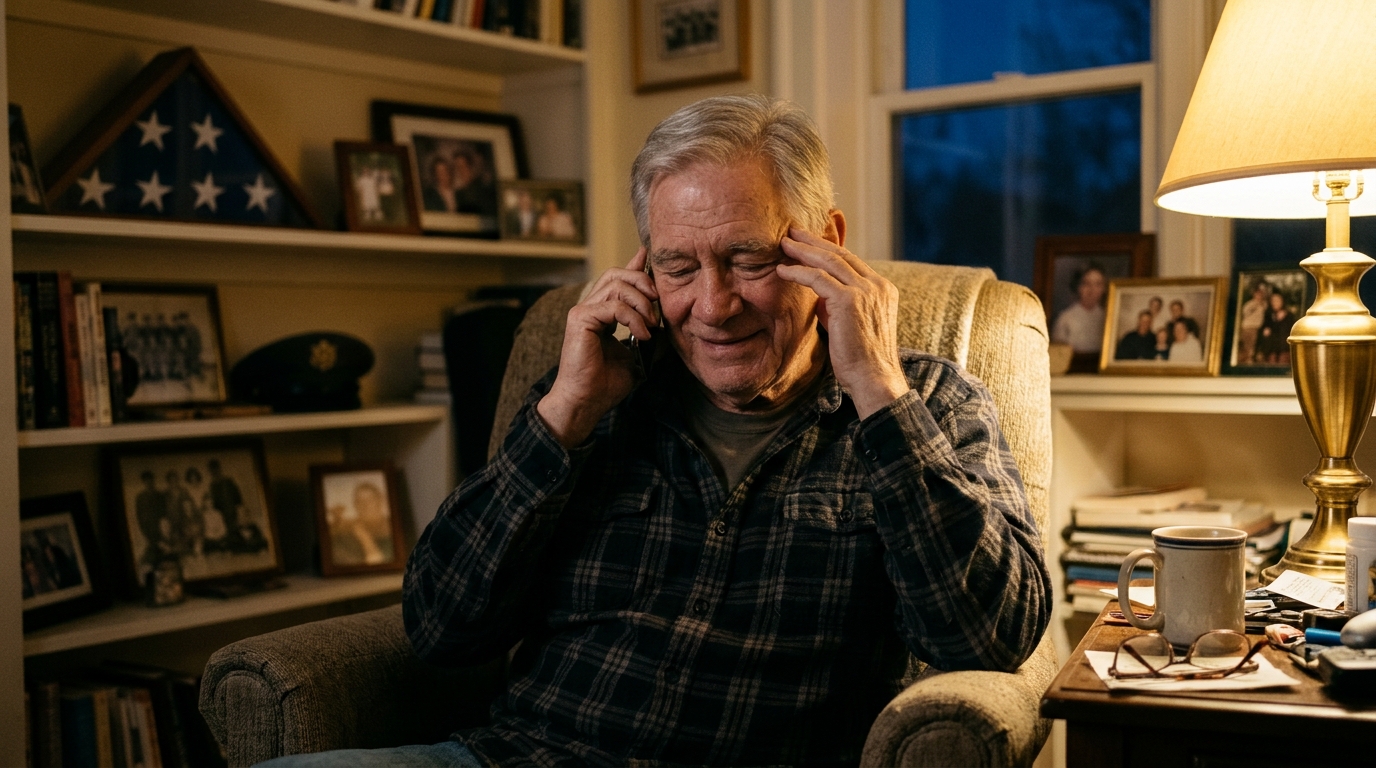
At 8:58 every evening, Margaret Ellison turns off the overhead light in her small kitchen, switches on the lamp by her armchair, and sets a worn paperback on her knee. A cup of chamomile cools on the side table. Her phone sits face up, waiting.
At exactly nine o’clock, it rings.
“Evening, Margaret,” says a gravelly voice on the other end. “Where did we leave off?”
For the past three years, this has been the closing ritual of two lives that, on paper, have very little in common. She is a retired public librarian in her late sixties. He is a Vietnam veteran named Walter Dunmore, seventy-four, who lost his sight to a degenerative eye condition and has not slept a full night since he came home from the war.
This is the story of how a library card, a lonely phone number, and a quiet promise turned the hardest hour of the day into the best one.
How It Started: A Question at the Reference Desk
Margaret spent thirty-four years behind the desk of a small-town branch library. She retired with a pension, a garden, and an unexpected restlessness. “I had spent my whole life helping people find the next thing to read,” she says. “Then suddenly nobody needed me to.”
She began volunteering with a local program that matched library patrons who could no longer visit in person with someone who could help them. That is how she was handed Walter’s name. The note beside it was brief: Veteran. Recently lost most of his vision. Used to be a voracious reader. Hasn’t touched a book in over a year.
Their first phone call lasted four minutes. Walter was polite but guarded. He told her he had audiobooks, but the narrators “all sounded like they were selling me something.” He said he did not really need anything.
Margaret did not argue. She asked him a single question instead: “What was the last book you loved?”
The line went quiet for so long she thought the call had dropped. Then Walter said, “A Farewell to Arms. I read it on a transport ship in 1969. I didn’t finish it.”
“Would you like me to start it for you?” she asked.
The Hour When Everything Gets Loud
What Margaret did not yet understand was why evening mattered so much.
Walter explained it slowly, over the following weeks. During the day, he could manage. There were sounds to hold onto: the radio, the neighbor’s lawn mower, the mail carrier’s footsteps on his porch. But as the light faded, something in him unraveled. The silence of a house at night was not truly silent. It was full of memory.
“People think blindness is darkness,” he told her once. “For me it’s more like being left alone in a room with the lights off and everyone I used to know.”
He would lie awake until two or three in the morning, his mind replaying the past. Sleep, when it came, was shallow and broken. For decades he had managed it with sheer stubbornness. After losing his sight, stubbornness stopped being enough.
So Margaret made a suggestion. What if she read to him, not during the day, but at the very moment the loneliness started to creep in? Not as a cure, just as company. A voice in the dark that wanted nothing from him.
He said he would try it for a week.
The Ritual They Built Together
Over time, the two of them shaped a routine so gentle it began to feel like a small, private tradition. Here is how a typical evening unfolds:
- 8:45 p.m.: Margaret brews her tea and settles into her chair, marking her place in the book with a faded bookmark Walter once told her he could “almost picture.”
- 9:00 p.m.: The phone rings. They trade a few minutes of ordinary talk: the weather, a bird at his feeder, whether his knee is acting up.
- 9:10 p.m.: Margaret begins to read. She keeps her voice low and even, never dramatic, never rushed.
- 9:50 p.m.: She closes with the same words each night: “That’s a good stopping place. Sleep well, Walter.”
- 9:52 p.m.: Often, by then, the other end of the line has gone quiet, and she can hear the soft rhythm of his breathing.
They have worked through Hemingway, Steinbeck, a long stretch of Willa Cather, and a surprising run of cozy British mysteries that Walter pretends to find silly but never lets her skip. Last winter, they read all of Lonesome Dove together, which took nearly four months.
“I get quiet near the end of a chapter,” Margaret admits. “I’ve learned to read a little slower when I think he’s drifting. If I hear him breathing evenly, I’ll finish the page and then just stay on the line for a moment. I don’t hang up until I’m sure.”
What Changes When Someone Waits for You
The first thing Walter noticed was not that he slept better. It was that he began to look forward to something.
“Nine o’clock used to be the start of the worst part of my day,” he says. “Now it’s the best part. I eat my supper a little early. I get myself settled. I’m like a kid waiting for a bedtime story.” He laughs, a dry, warm sound. “A seventy-four-year-old kid.”
The sleep followed, slowly. First an hour more than before. Then two. Within a few months he was sleeping through most nights, waking rested in a way he had almost forgotten was possible.
But the deeper change was harder to measure. Walter started talking more. He began calling an old Army friend he had lost touch with. He asked his niece to take him to a veterans’ breakfast on Saturday mornings. One evening he told Margaret, almost offhand, that he had remembered something good from the war: a quiet night on that transport ship, a young man reading by a dim light, and how peaceful it had felt.
“That was the first good memory he ever shared with me,” Margaret says. “I didn’t say anything. I just kept reading.”
Why Simple Kindness Works So Well at Night
There is a reason this arrangement works, and it has less to do with books than with presence.
Evening is when we are most exposed to ourselves. The distractions of the day fall away, and whatever we have been outrunning catches up. For people who live alone, who are grieving, who carry old wounds, that stretch before sleep can feel endless. It is the hour when a small human gesture carries the most weight.
Margaret did not set out to heal anyone. She simply offered something steady: the same time, the same voice, the same promise to show up. There was no pressure to talk, no expectation that he feel better. Just company, delivered reliably, at the moment it was needed most.
Small Ways to Offer Evening Kindness
You do not need a library degree to do something similar. A few ideas to carry with you:
- Call someone at the hour they feel loneliest. Ask a widowed neighbor or an aging relative when their evenings feel longest, then show up for that window.
- Offer a voice, not a solution. Reading aloud, humming, or simply describing your day can be enough.
- Keep the schedule. Consistency is its own kind of comfort. A promise kept nightly says, you matter, and I will be there.
- Check local volunteer programs. Many libraries, senior centers, and veteran organizations run phone-reading or friendly-call programs.
The Last Page of the Day
Not long ago, Walter asked Margaret something he had been working up to for weeks. He wanted to know why she kept doing it, night after night, year after year, with no reward.
Margaret thought about it. Then she said, “Because you pick up on the first ring.”
That is the part that stays with her when she turns off the lamp at the end of the night. Somewhere across town, a man who once believed his best days were behind him is lying in the dark, no longer alone with it, drifting toward sleep to the sound of a story told gently in a familiar voice.
Tonight, as the sky goes dim and the house grows quiet, consider who in your life might be waiting for a call. It does not have to be grand. It only has to be on time.
At nine o’clock, a phone will ring. And a voice will say, “Where did we leave off?”