🎧 Listen to this story
Narrated by Kore · 7,029 characters
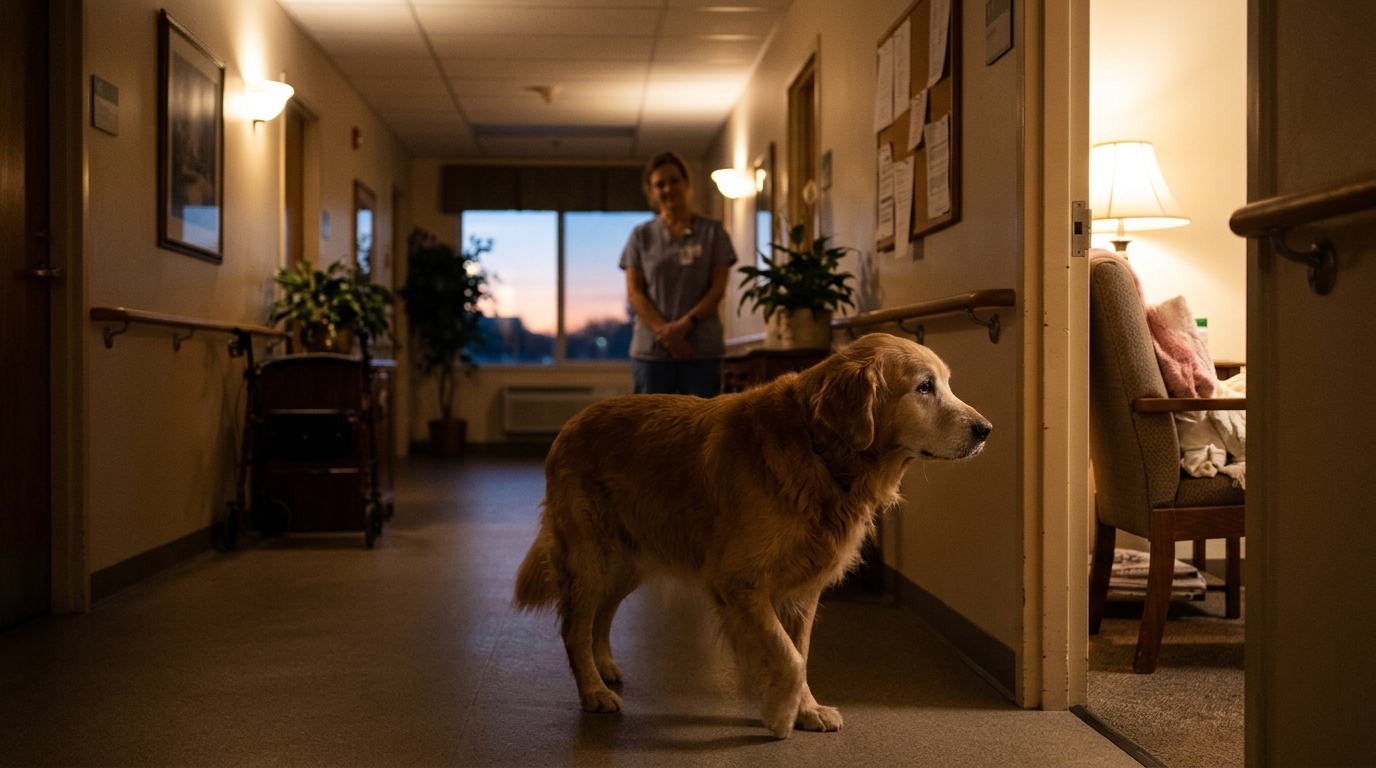
At 5:45 every evening, when the cafeteria trays have been cleared and the hallway lights soften to amber, a nine-year-old golden retriever named Willa stands up from her bed in the volunteer office and shakes out her coat. She does not need to be called. She has a shift to work, and it is the only shift she has ever loved.
This is a reported look at one evening on the hospice floor of a small community care center, and at the quiet question the staff have stopped trying to answer: how does she always know?
The Hour When the Building Exhales
Anyone who works in end-of-life care will tell you that evening is different. During the day, the hospice hums with visitors, medication rounds, chaplains, social workers, and phone calls. But as the light fades, the noise drains out of the building like water from a tub. Families go home to sleep. Patients are left with their thoughts, and thoughts, at that hour, can grow heavy.
“Evening is when people get honest,” said Marguerite, a night-shift nurse with twenty-two years in palliative care. “The fear that they were able to keep busy all day long just finds them. That is exactly when Willa starts her rounds.”
Willa came to the center six years ago as a retired therapy dog, donated by a family whose elderly father had died there. Her handler, a soft-spoken volunteer named Desmond, expected her to simply be a pleasant presence. What he got was something he still struggles to describe.
The Walk Down the Hall
Here is how a typical evening goes. Desmond clips on her leash, though he admits it is mostly for show. Willa walks past the first room, then the second. She does not glance in. She does not slow down. Then, at some door that looks no different from the others, she stops, sits, and looks up at him.
Nobody tells her where to go. The nurses do not hand her a list. Often the patient behind that door has said nothing to anyone about struggling. And yet, again and again, the staff have found the same pattern.
- The man in Room 6 who had insisted for days that he was “fine, just tired,” and who wept openly for the first time when Willa rested her chin on his blanket.
- The retired schoolteacher who had not spoken in two days but began stroking Willa’s ears and quietly reciting a poem from memory.
- The young mother in her thirties who had refused every counselor, then let the dog climb carefully onto the end of the bed and fell asleep with a hand buried in golden fur.
“I used to think it was coincidence,” Desmond said. “Then it was a hundred coincidences. Then I just stopped counting.”
What Willa Actually Does
Willa does not perform tricks. She does not wag wildly or demand attention. The staff describe her entire approach as a kind of patient stillness. She enters slowly, waits to be welcomed, and settles near the person, close enough to touch but never crowding. If there is a hand available, she places her head under it. If there is not, she simply lies on the floor and breathes, a warm and steady sound in a quiet room.
Her visits rarely last more than twenty minutes. In that time, the staff have observed measurable changes: slower breathing, relaxed shoulders, softened faces. Some patients talk. Many do not. Several have told their families afterward that for the first time in weeks, they did not feel alone with what was happening to them.
Why Dogs May Notice What We Miss
Researchers who study canine behavior point out that dogs are extraordinarily sensitive to subtle cues: shifts in scent, tiny changes in posture, the rhythm of a person’s breathing, the tension held in a face. A person quietly overwhelmed by grief or fear may give off a dozen small signals that humans walk right past. A dog, whose whole world is built on reading the people around her, does not walk past them.
That is a plausible explanation, and the staff are happy to accept it. But they also admit that it does not fully account for the nights Willa chooses a patient who has been calm, smiling, and apparently at peace, only to have that patient quietly confess, minutes later, that they were terrified.
A Night Marguerite Still Thinks About
Marguerite remembers one evening in late autumn. A retired fisherman named Alder had been admitted just days earlier. He was gruff, private, and polite to the point of distance. He told everyone he wanted no fuss. He declined the chaplain, the music therapist, and the volunteer who offered to read to him.
Willa walked straight to his door and sat.
“I almost turned her around,” Desmond said. “He had made it so clear he wanted to be left alone. But she would not budge.”
So they went in. Alder looked at the dog for a long moment. Then he said, very quietly, “I had a dog like her. Her name was Biscuit. I never got to say goodbye when she went.” Willa laid her head on his knee. He talked for nearly an hour, about the boat, about the dog, about the daughter he had not spoken to in years. The next morning, he asked a nurse to help him write a letter.
He died ten days later. His daughter was at his side.
The Quiet Lesson at the End of the Day
When the evening shift winds down and the building settles, Desmond walks Willa back to the volunteer office. She curls up on her bed with a long, contented sigh, the kind of sigh that sounds like a day well spent. And Desmond, more often than not, sits beside her for a few minutes before he drives home.
“People think she is the one giving comfort,” he said. “But I think she is teaching all of us something. She does not try to fix anything. She does not say the right thing. She just shows up, close and calm, and lets the person know they are not alone. Isn’t that really what everybody wants at the end of the day?”
It is a lesson that reaches far beyond the hospice walls. We spend so much of our lives believing that comfort requires the perfect words, the grand gesture, the right solution. But Willa suggests something simpler and harder: that sometimes the kindest thing we can do is notice who is quietly struggling, move toward them without fuss, and stay.
Small Ways to Carry Willa’s Example Into Your Own Evening
- Notice the quiet ones. The people who say they are fine are often the ones who most need someone to sit nearby.
- Offer presence, not advice. You do not have to say anything wise. Being there is enough.
- Slow down at dusk. Evening is when honesty surfaces. Make room for it in yourself and in the people you love.
- Let silence be okay. Not every moment of comfort needs words.
When the Lights Go Low
Tonight, somewhere down that amber-lit hallway, a door will open and a golden shape will pad quietly across the floor. Someone who has spent the whole day being brave will feel the weight of a warm head against their hand, and something in their chest will loosen.
No one will have told Willa where to go. She will simply have known.
And when the day finally ends and the building falls silent, she will lie down in her bed, tired and content, having done the one thing she was always meant to do: show up, gently, for whoever needed her most.