🎧 Listen to this story
Narrated by Kore · 6,903 characters
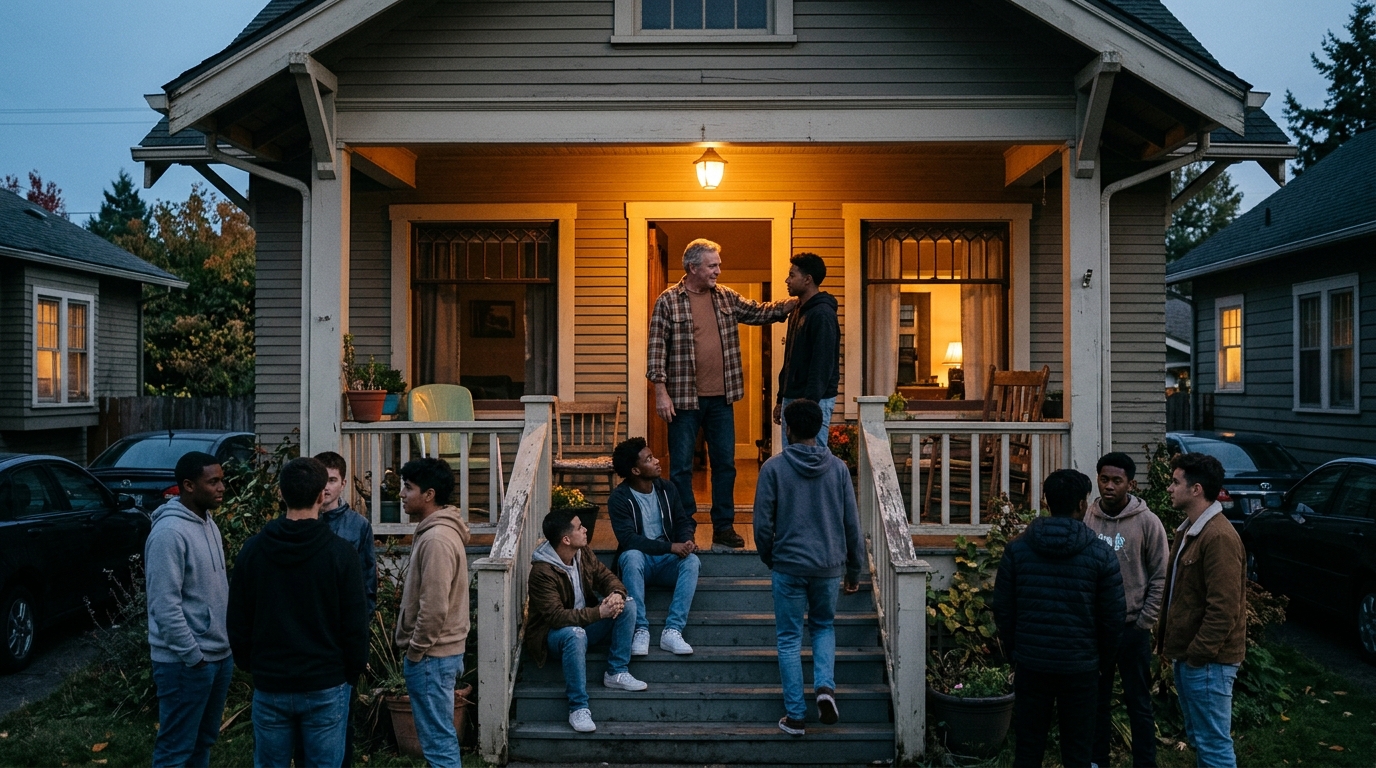
The light on Raymond Okafor’s front porch has not been switched off in six years. It burns through winter storms and summer heat, a plain yellow bulb in a plain glass fixture, and it is the first thing most of the boys notice when they come up the walk. It is also the last thing Raymond sees at night before he finally lets himself sleep.
This is the story of why that light stays on, and of the hundred young men who have walked toward it.
The Night the Phone Rang
Raymond’s son, Daniel, was nineteen. He was funny in a quiet way, the kind of kid who would fix a neighbor’s bike chain without being asked and then leave before anyone could thank him. In his second year of community college, something shifted. He grew withdrawn. He stopped answering texts. His father, a long-haul mechanic who worked days and slept lightly, noticed the change but told himself it was a phase.
On a cold evening in October, just as the streetlights were flickering on, Raymond received the call no parent can prepare for. Daniel was gone. He had taken his own life in the quiet hours when the world goes still and a person feels most alone with the loudest thoughts.
In the weeks that followed, Raymond did what grieving people do. He replayed everything. He counted the evenings he had been too tired to sit and talk. He remembered the times Daniel lingered in the kitchen doorway, hovering, as though waiting to be asked a question that never came.
“I kept thinking about the hour after dinner,” Raymond says. “That gap between the day ending and sleep coming. That’s when it gets heavy for a lot of people. And nobody is awake to catch them.”
A Kitchen Table and a Kettle
The idea did not arrive as a grand plan. It started with a single sleepless night, about four months after the funeral. Raymond sat at the kitchen table, unable to rest, and realized that the hardest hours of his own grief were the same ones that had been hardest for his son: the quiet evening stretch when the house settles and the mind refuses to.
He wondered who else was sitting alone at that very moment, and whether anyone was keeping the door open for them.
So he started small. He put a notice on a community board at the local barbershop and the rec center: If you are a young man and the evenings are hard, there is a seat and a hot drink at 7 PM, any night, no questions asked. He added his address and a phone number. Then he turned on the porch light and waited.
The first night, no one came. The second night, no one came. On the ninth night, a sixteen-year-old named Marcus stood at the edge of the yard for twenty minutes before he knocked.
What Happens at Seven O’Clock
Today, the program has a name the boys gave it themselves: The Porch Light. It runs every evening, seven days a week, from seven until the last person leaves. There are no applications, no forms, and no requirement to talk about anything at all.
A typical evening looks something like this:
- Arrival: Boys and young men drift in between seven and eight, often straight from work, school, or a long walk they did not want to end.
- The kettle: Raymond keeps a kettle going, along with tea, cocoa, and whatever food someone has brought. Hands with something to hold tend to loosen tongues.
- The unspoken rule: Nobody is made to share. Some nights are board games. Some nights are silence. Some nights are a hard conversation that runs until midnight.
- The closing ritual: Before anyone leaves, Raymond asks one question: “Will you be okay getting through tonight?” If the answer is no, someone stays.
Over time, trained volunteers joined him, including a retired school counselor, two nurses, and a pair of young men who had once been guests themselves. They learned to listen for the particular quiet that signals a person is in real danger, and they built relationships with local crisis services so that no one slips through when the conversation turns serious.
A Hundred Sons
Raymond is careful about the number. He does not like to say the program has “saved” anyone, because he believes the boys saved themselves by choosing to walk up that path. But he keeps a small notebook where he writes down first names, and when he counts, it comes to more than a hundred.
Some of those names belong to young men who came for a single evening and never returned, which Raymond has learned to read as a good sign. Others have come hundreds of times. A few have gone on to become volunteers. One, Marcus, the boy who stood at the edge of the yard on night nine, is now twenty-two and studying to become a social worker.
“People think I started this to honor Daniel,” Raymond says. “That’s true. But it’s also because I couldn’t bear the thought of another father getting that phone call if I could do something about it.”
The Lesson That Settles In at Dusk
There is a reason this program lives in the evening, and it is not an accident. Anyone who has lain awake knows that darkness changes the size of our troubles. A worry that feels manageable at noon can feel unbearable at ten at night, when the distractions fall away and the house goes quiet.
Raymond understood something that no textbook had taught him: loneliness has a schedule. It tends to arrive as the light fades. The most protective thing you can do for someone is not to give advice at noon but to be present at dusk, to sit beside them while the day winds down and the mind starts to spin.
He says the work has taught him three simple things:
- Presence matters more than answers. Most boys do not need to be fixed. They need to be witnessed.
- Ask directly. The word “okay” is a door. Asking someone plainly how they are, and meaning it, gives them permission to be honest.
- Keep the light on. Consistency is its own kind of comfort. Knowing a place is always open can be what carries a person through the worst hour.
If This Story Finds You Tonight
If you are reading this in the quiet of your own evening and the weight feels heavy, please know you are not a burden and you are not alone. In the United States, you can call or text 988 at any hour to reach the Suicide and Crisis Lifeline. If you are elsewhere, a local crisis line or a trusted friend can be a first step. Reaching out is not weakness. It is one of the bravest things a person can do.
And if you are someone who loves a person who has gone quiet, consider this your gentle nudge. Sit with them. Ask the question. Leave a light on.
The Last Look Before Bed
Each night, once the final guest has gone and the cups are rinsed, Raymond walks to the front window and looks out at the porch. The bulb glows steady against the dark. He does not switch it off.
He lets it burn for Daniel, and for every boy who might still be walking toward it through the dusk. Then he turns away from the window, the house settles around him, and for the first time in years, he sleeps a little easier knowing someone, somewhere, found a door that was open.