🎧 Listen to this story
Narrated by Kore · 7,687 characters
It started on a Tuesday in January, on one of those evenings when the day had been so ordinary and so tiring that I could not have told you a single thing that happened in it. I was sitting on the edge of my bed with my shoes still on, staring at a cheap spiral notebook I had bought months earlier for a project I never started. I decided, almost out of spite for my own tiredness, to write down one good thing from the day. Just one. Just a line.
That night I wrote: The bus driver waited while I ran for it.
That was it. Seven words. I turned off the lamp and went to sleep. I had no idea I had just begun a year-long habit that would change the way I moved through the world.
Why Evening Became the Right Time
I had tried gratitude practices before. Morning journals, phone reminders, an app with a cartoon sun that sent me cheerful notifications. They all fizzled out within a couple of weeks. Mornings, for me, are a sprint. My mind is already running ahead to the schedule, the inbox, the errands.
Evening is different. By the time the dishes are done and the house goes quiet, something softens. The day has stopped asking things of you. The noise settles like silt in a glass of water, and what remains is clearer. That is when I found I could actually look back at the day and see it for what it was, instead of just what it demanded.
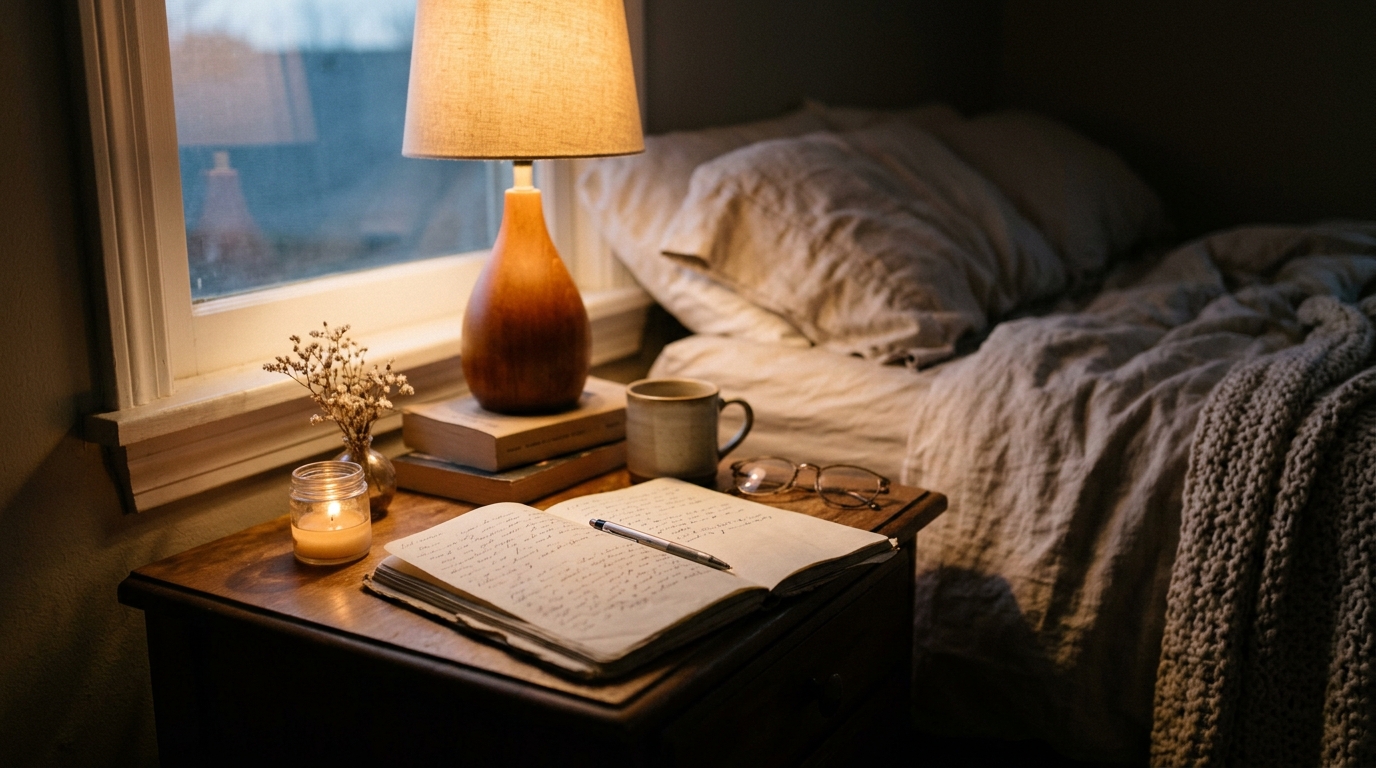
I kept the notebook on my nightstand, under the lamp, with a pen clipped to the cover. The rule was simple, and I think the simplicity is why it lasted:
- One good thing, no more required.
- Written before I turned off the light.
- It did not have to be profound, only true.
- No skipping because the day was bad. Especially not then.
The First Month: Hunting for Material
In the early weeks, I treated it like a chore with a quota. I would sit there at night straining to remember anything worth recording. Some entries were embarrassingly thin. Good coffee. Sun came out at lunch. Found my keys.
But something curious began to happen around the third week. I noticed I was noticing during the day. Walking to the train, a small part of my brain would quietly tag a moment: that could go in the notebook. A neighbor’s laugh drifting over a fence. The way the light hit the kitchen counter at four in the afternoon. A coworker who remembered how I take my tea.
I was not living more. I was paying attention to the life I was already living, and that turned out to be a very different thing.
The Months That Got Hard
I want to be honest here, because this is not a story where a notebook fixes everything. In April, my father went into the hospital. There were weeks when the good thing felt like an insult, like asking me to smile at a funeral.
There is an entry from that month I still cannot read without my throat tightening. It says: The nurse brought Dad an extra blanket without being asked.
That was the good thing. On the worst week of my year, the good thing was a stranger in scrubs who noticed my father was cold. I almost did not write it down. I sat there thinking nothing good had happened. And then I remembered the blanket, and the small, unprompted tenderness of it, and I wrote it, and I cried a little, and then I slept better than I had in days.
That was the night I understood what the practice was really for. It was never about pretending the hard things were not hard. It was about refusing to let the hard things be the only things. Even the heaviest days had a thread of something kind running through them, and the notebook trained my eyes to find it.
What Actually Changed
When December came and I flipped back through all twelve months, I expected to feel a vague sense of positivity. What I felt was more specific, and more surprising. Here is what I noticed had genuinely shifted:
1. I Became a Better Noticer
The biggest change was not in my evenings but in my afternoons. I began catching small kindnesses in real time: the stranger holding a door, the barista’s genuine hello, a text from an old friend that arrived at exactly the right moment. Gratitude stopped being a thing I did at night and became a lens I carried all day.
2. My Bad Days Got Shorter
I still had rough days. But they stopped bleeding into each other. Because I knew I would have to find one good thing by bedtime, I would unconsciously start looking for it earlier, and often the looking itself lifted the mood. A hard day became a day with a hard stretch in it, rather than a hard day, full stop.
3. I Slept Differently
I will not make medical claims, but I can tell you what I felt. Ending the day by writing something warm gave my mind a place to land. Instead of lying awake rehearsing tomorrow’s worries, I drifted off with a small, kind image sitting at the front of my thoughts. The last thing I thought about each night was something good, and that mattered more than I would have guessed.
4. I Started Telling People
Somewhere around month seven, I began telling the people in my entries. A quick text: Thank you for waiting for me yesterday, it made my whole afternoon. I realized I had been collecting good things for months while quietly hoarding the gratitude that belonged to other people. Giving it away felt even better than writing it down.
The Pattern I Did Not Expect
Reading the whole year back, I saw something I never would have spotted day to day. The good things were almost never big. I had no promotions or windfalls or grand victories in the notebook. They were nearly all tiny, human, and free:
- A kid on the street waving at my dog.
- The smell of rain on warm pavement.
- A long phone call that ran past midnight.
- A stranger who returned the glove I dropped.
- Soup, made from scratch, on a cold Sunday.
If you had asked me in January what makes a good life, I might have said something about goals and milestones. If you ask me now, I will point at that notebook. A good life, it turns out, is mostly made of small good things that we are usually too busy to count.
How to Start Your Own
If this stirs something in you, here is the gentlest possible way to begin. You do not need a special journal or a ritual or an hour of quiet.
- Pick any notebook. The cheaper and less precious, the better. Nothing kills a habit like a notebook too beautiful to write badly in.
- Keep it where you will see it at night. Your nightstand, your pillow, next to your toothbrush. Make forgetting difficult.
- Write one line. Not a page. One line, one good thing. You can write more if you want, but one is enough.
- Be specific. Not my family but my sister laughing so hard she snorted at dinner. Specific things are the ones that bring the moment back.
- Do not skip the bad days. Those are the entries that will matter most when you read them later.
The Last Page
On the final night of the year, I sat on the edge of the bed, shoes off this time, and wrote the three hundred and sixty-fifth entry. I will not tell you what it says. Some things are better kept in the quiet of the notebook where they were born.
But I will tell you this. The woman who bought that spiral notebook in January could not have named a single good thing from her own Tuesday. The woman closing it in December could have filled a page with them in a minute flat. Nothing about my life had been rearranged. The same bus, the same job, the same small apartment. All that had changed was where I was looking, and what I let myself see.
Tonight, when the dishes are done and the house goes quiet, I hope you will give yourself a minute. Not to fix anything, not to plan anything. Just to look back over your day and find the one small, good thing that was hiding in it. It is almost certainly there. It was for me, every single night, even on the nights I swore it was not.