🎧 Listen to this story
Narrated by Kore · 6,934 characters
There is a particular hour in an emergency department, somewhere past ten o’clock, when the noise changes. The ambulance bays quiet down. The waiting room lights seem to dim on their own. The frantic energy of the day gives way to something slower and heavier, and it is in that hour that Dr. Marguerite Ashby does the part of her job she says matters most.
She sits down.
This story is told in the way hospital staff tell it to one another: in fragments, over bad coffee, in the break room at the end of a shift. It is a story about a doctor, but really it is about what happens in the waiting room after the doors close behind the person everyone is afraid for.
The Rule She Made for Herself
Dr. Ashby has worked nights and evenings in a mid-sized city emergency department for nineteen years. Early in her career, she says, a senior physician told her something she has never forgotten: “You will save some and lose some. But every single family walks out of here remembering how you made them feel in the worst hour of their life.”
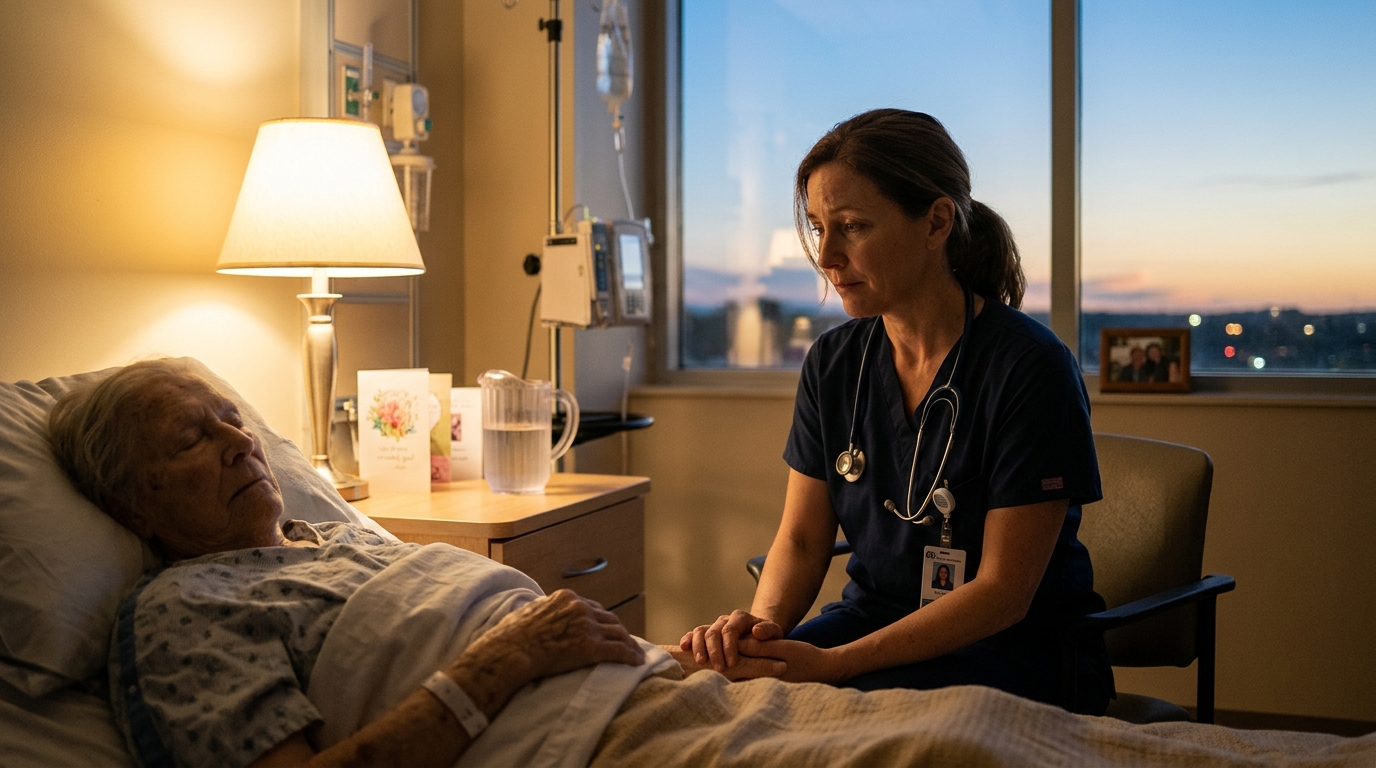
So she made a rule. Before she leaves for the night, she checks the waiting area. If there is a family still there, still waiting, still holding their coats in their laps with nowhere to put their fear, she does not walk past. She pulls up a chair and sits at their level.
Not standing over them with a clipboard. Not delivering news from the doorway. Sitting, knees almost touching theirs, in the pale light of a room that has seen too many long nights.
What Evening Does to a Waiting Room
Anyone who has spent a night in a hospital waiting room knows that the hours after sunset feel different. During the day, there is distraction: phones ringing, traffic outside the window, the sense that the world is still moving. At night, the world seems to hold its breath. Fear gets louder when everything else gets quiet.
Families tend to go still in the evening. They stop pacing. They stop making phone calls. They sit and stare at the double doors, willing them to open, and the silence fills with every question they are afraid to ask.
“That is when people need a human being the most,” Dr. Ashby says. “In the daytime you can hide in busyness. At night, there is nowhere to hide. So I try to be the person who doesn’t make them sit in it alone.”
The Night a Man Waited in the Dark
One of the nurses who has worked beside her for a decade recalls an evening she says she will carry for the rest of her life.
An older man had been in the waiting room since the afternoon. His wife of fifty-one years had been brought in after a sudden collapse, and the team had worked on her for hours. By the time the sun had set and the windows had gone dark, the outcome was clear to the staff, though not yet to him.
Dr. Ashby had been on her feet for eleven hours. Her shift had technically ended. Her coat was on. Her keys were in her hand.
She took off the coat.
She walked into the waiting room, pulled a plastic chair across from him, and sat. She did not start with medical terms. She started by asking him his wife’s name, and then she asked him how they had met. For several minutes, in the gentle half-light of an evening that had run out of urgency, she let him talk about the woman he loved. Only then, when he was ready, did she tell him the truth.
He cried, and she stayed. She stayed another forty minutes, until his daughter arrived, and then she stayed a few minutes longer.
“People think the difficult part of being a doctor is the medicine,” the nurse says. “Marguerite will tell you the medicine is the easy part. The hard part is the chair.”
The Small Things She Does at the End of the Night
Colleagues say her bedside manner is not complicated, but it is consistent. Over the years, she has built a quiet routine for those final hours of a shift:
- She sits, always. Eye level, never standing, never rushed, even when the department is stretched thin.
- She uses names. Not “the patient” but the person’s actual name, said gently and often.
- She tells the truth plainly. No jargon, no hiding behind vague phrases, and no false hope. Families, she says, can handle honesty far better than uncertainty.
- She offers the small comforts. A blanket from the warming cabinet. A cup of water. A quiet room away from the fluorescent glare.
- She asks if they are okay to drive. Because grief makes people reckless, and she does not want the worst night of someone’s life to get any worse.
- She never says “I know how you feel.” Instead she says, “I’m so sorry,” and lets the silence do the rest.
Why It Costs Her Something
It would be easy to tell this story as one of effortless compassion, but Dr. Ashby is quick to correct that picture. Sitting with grief, she says, is not free. She carries each of those evenings home with her.
She has a small ritual for that, too. When she finally leaves the hospital, she sits in her car for five minutes before turning the key. She does not check her phone. She watches the parking lot lights flicker against the dark and lets herself feel whatever the night has handed her.
“If I don’t let myself feel it, I’ll stop being able to do this,” she says. “And the families deserve a doctor who can still feel it.”
What Stays With the Families
Ask anyone who has been on the other side of one of those late evening conversations, and the details they remember are rarely clinical. They remember the chair. They remember that she did not look at her watch. They remember being asked about the person they loved as a person, not a case number.
One woman, whose father died in the department on a winter night, later wrote a letter to the hospital. She never mentioned the treatment he received. She wrote only this: “A doctor pulled up a chair and sat with us in the dark. I did not know that was something a person could do. I have thought about it every day since.”
An Evening Lesson Worth Keeping
There is something we can all take from the way Dr. Ashby ends her days, whether or not we ever set foot in an emergency room.
So much of kindness is about presence, not solutions. We cannot always fix what is broken. We cannot always change the outcome. But we can almost always choose to stay a little longer, to pull up a chair, to sit across from someone in the quiet and let them know they are not alone with it.
The evening has a way of stripping everything down to what matters. The noise fades. The tasks pile up less loudly. And in that stillness, the smallest gestures become the largest: a hand on a shoulder, a blanket, a seat beside someone who is waiting for news they dread.
Tonight, as the light goes soft outside your window, you might ask yourself who in your life is sitting in a waiting room of their own, and whether you could be the one to pull up a chair.
Dr. Ashby would tell you it costs almost nothing. And she would tell you, having done it for nineteen years of evenings, that it is the thing people remember long after everything else has faded.