🎧 Listen to this story
Narrated by Kore · 6,637 characters
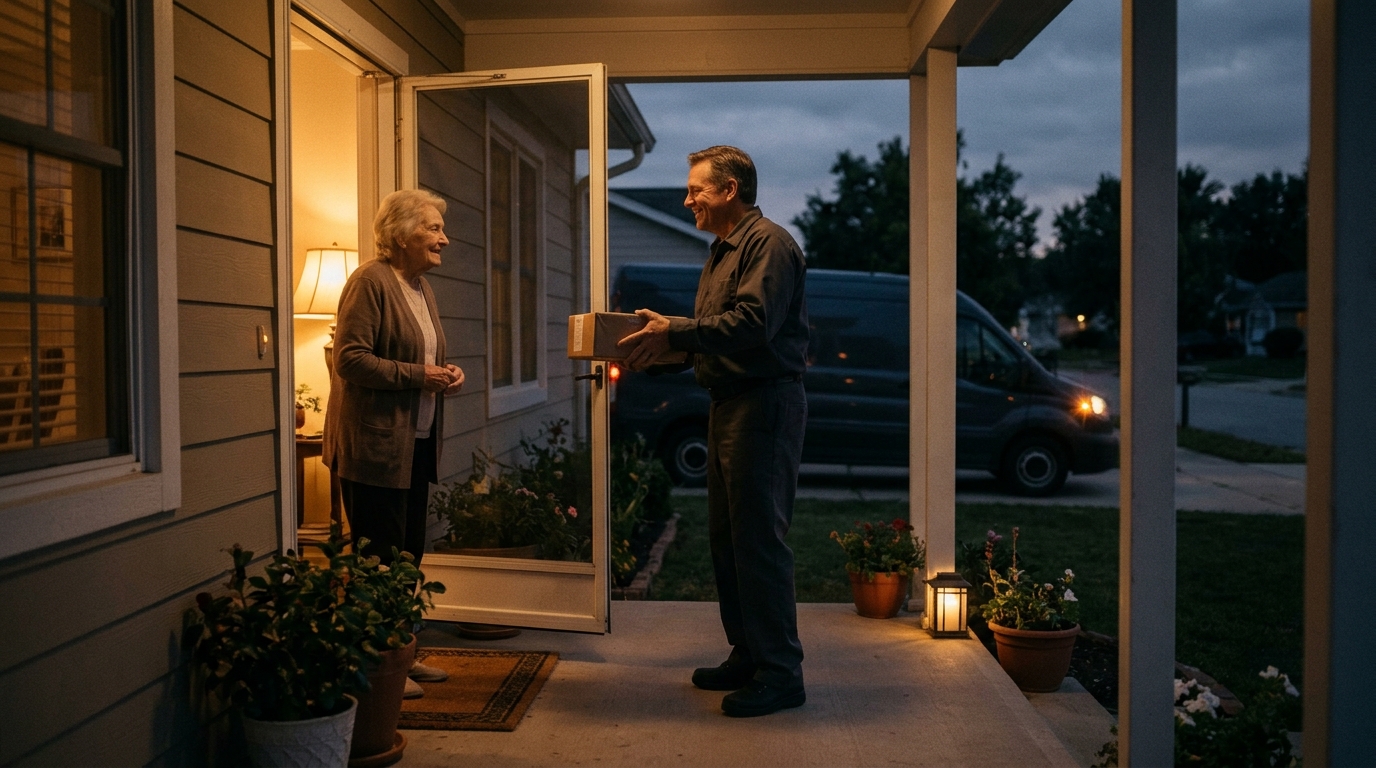
There is a particular kind of quiet that settles over a small town around six in the evening. The porch lights flicker on. Sprinklers click off. Somewhere a screen door creaks and a dog barks once, then thinks better of it. For most people, this is the hour when the day finally loosens its grip. For a delivery driver named Marcus Dellaverne, it is the hour when his real work begins.
Marcus has driven the same rural and suburban route for eleven years. He knows which driveways flood in March, which dogs are friendly, and which mailboxes have been leaning since the ice storm. But what he knows best, and what no routing software has ever tracked, is which of his customers might not have spoken to another human being all day.
How a Package Became a Pulse Check
It started with a woman named Eleanor. She was in her late seventies and lived at the end of a gravel road, in a house with a wraparound porch that had once hosted what she called ‘a hundred summers of lemonade.’ She ordered things constantly: reading glasses, birdseed, jigsaw puzzles, tea she could have bought at the corner store. Marcus noticed, the way people who show up every day tend to notice, that the orders came whether or not she needed anything.
One autumn afternoon, he rang the bell and she opened the door before the second chime. She had been waiting by it. She talked for twenty minutes about her late husband’s tomato plants, and Marcus stood on the porch with his handheld scanner buzzing in his pocket, already running behind schedule, and listened to every word.
‘I realized the package was the excuse,’ he told me when we spoke. ‘It was never really about the package. She just wanted somebody to come to the door.’
The Quiet Rules He Lives By
Marcus never set out to build a program. There is no clipboard, no official title, no company initiative behind it. Over the years, he developed a handful of small habits that he follows without fanfare:
- Knock twice, then wait. A doorbell is fast. A knock followed by patience says you are not in a hurry, even when you are.
- Notice the small changes. Newspapers piling up, curtains that stay closed, a porch light left burning through the afternoon. These are the quiet signals he watches for.
- Ask one real question. Not ‘how are you,’ which invites a reflexive ‘fine,’ but something specific: ‘Did the tomatoes come in this year?’
- Remember the answer. The next visit, he asks about it again. Being remembered is its own kind of gift.
- Keep a phone number. For a few customers, with permission, he holds an emergency contact, just in case a door stays shut one day.
The Day the Door Stayed Closed
That last habit mattered more than Marcus ever expected. One winter morning, a man named Walter, a retired machinist who lived alone and ordered replacement parts for the radios he repaired as a hobby, did not answer. Marcus knocked twice. Waited. Knocked again.
The newspaper on the mat was two days old.
He called the emergency contact Walter’s niece had given him years earlier, and within the hour, paramedics found Walter on his kitchen floor. He had fallen and could not get up. The doctors said another night in that cold house might have been the end of him.
Walter recovered. These days, he leaves a thermos of coffee on the porch rail on delivery mornings. Marcus drinks it standing up, boots on the frosted boards, and the two of them talk about vacuum tubes and weather and nothing much at all.
What the Evening Teaches
I asked Marcus when he thinks about all of this, and he laughed. ‘Honestly? Night. After the route, after dinner, once the house is quiet. That’s when the faces come back to me.’
He described sitting on his back steps as the light drains out of the sky, running through the day like a rosary: Eleanor and her tomatoes, Walter’s thermos, the young mother who accepted a package and then lingered in the doorway because the baby had been crying since dawn and she just needed someone to say it would be okay.
‘The day is loud,’ he said. ‘You’re moving, you’re scanning, you’re beating the clock. But in the evening it gets still, and you remember that every one of those boxes landed in a life. Somebody was on the other side of that door.’
There is something worth sitting with in that. We tend to measure our days by what we completed, the stops made and the tasks checked off. But the evening has a way of re-weighing everything. The twenty minutes that put you behind schedule turn out to be the only part you remember. The thing you almost skipped becomes the thing that mattered.
The Ripple Nobody Scheduled
Word of Marcus’s habit has spread quietly through the neighborhoods he serves. A few customers now leave small notes on their doors: ‘Home today, come say hi.’ One family started baking extra bread on Fridays so he always has a loaf in the cab. Eleanor, who is now well into her eighties, keeps a chair on the porch just for him, though he rarely has time to sit.
Some of his customers have started checking on each other, too. Eleanor now calls the woman two houses down. Walter drives, carefully, to a neighbor’s place every Sunday. Kindness, it turns out, is contagious in the gentlest possible way. It does not announce itself. It just passes from one porch to the next.
A Small Thing You Can Do Tonight
You may not drive a truck or carry a scanner, but every one of us has a route. A street, a floor of an apartment building, a handful of coworkers, a line of neighbors we wave to without ever really talking. The people on our route may be waiting by their own doors.
As the day winds down tonight, consider these small, unhurried gestures:
- Think of one person you have not heard from in a while, and send a short message. No agenda required.
- Notice one neighbor you have never really spoken to, and plan to say hello tomorrow.
- Remember that being unhurried is a form of respect. Ten minutes of real attention can outweigh a year of passing nods.
The Light in the Window
As our conversation was ending, the sun had slipped low and the whole street glowed amber. Marcus glanced at his watch, a habit more than a need, and said something I have been turning over ever since.
‘People think heroes are loud. Mine just drive a truck and knock twice.’
Somewhere tonight, a porch light is on for someone who is waiting to hear a familiar engine on the gravel. And somewhere, a driver is parking his truck, slipping off his gloves, and thinking about the faces behind every door. That is the quiet kind of goodness this world runs on. Not grand. Not noisy. Just a knock, a pause, and the simple, stubborn belief that no one should have to spend a whole day unseen.